Showing posts with label corallinaceae. Show all posts

Sunday, 10 April 2016

Rockpooling Destination: Revisit West Penwith, December, 2015

The rocky shore is comprised of boulders and bedrock with rockpools, crevices and gullies. Habitat classification: LR.HLR (High energy littoral rock) EUNIS: A1.1 , LR.FLR.Rkp (Rockpools) EUNIS:A1.41 and LR.FLR.Lic.(Lichens on supralittoral and littoral fringe rock) EUNIS: B3.11


The rocky shore is a high energy environment comprised of boulders and bedrock with rock pools, crevices and gullies.


The high energy environment of the shore leads to an extended lichen zone, that descends over much of the boulder field, which apart from Littorinids is relatively barren. Patches of lichens extend further down into the barnacle communities, which dominate from the upper to lower shore, interdispersed by shallow coralline rockpools in the mid shore, and deeper cobble filled rockpools on the lower shore. As the low tide mark is reached wave tolerant seaweeds lace the gullies.


Habitat classification:


Substrate
LR (Littoral rock)
Habitat
LR.HLR (High energy littoral rock)
LR.FLR (Features of littoral rock)
Biotope complex
LR.HLR. MusB (Mussel and/or barnacle communities)
LR.HLR.FR (Robust fucoid and/or red seaweed communities)
    LR.FLR.Lic.(Lichens on supralittoral and littoral fringe rock).
LR.FLR.Rkp (Rockpools)
Biotope
LR.HLR.MusB.Cht (Chthamalus sp on exposed upper eulittoral rock)
LR.HLR.MusB.Sem (Semibalanus balanoides on exposed to moderately exposed or vertical sheltered eulittoral rock)

LR.FLR.Lic.Ver (Verrucaria Maura on  littoral fringe rock)
LR.FLR.Lic.YG (Yellow and grey lichens on supralittoral rock)
LR.FLR.Rkp.Cor (Coralline crust dominated shallow eulittoral rockpools)
Below are images of the organisms you may encounter in these habitats:


A 'By the wind sailor' (Velella velella)  washed up high onto the shore. This is a pelagic hydrozoa that is often washed up onto shores during the winter months.

Lichens have a patchy distribution, covering the larger and more stable boulders and bedrock of the supralittoral and littoral fringe rock. Habitat classification: LR.FLR.Lic.(Lichens on supralittoral and littoral fringe rock) EUNIS: B3.11.
Many boulders are too mobile to facilitate lichen growth, in such circumstances lichen growth is restricted to areas surrounding 'protected' crevices.
The boulders of the littoral fringe support a community of  rough and small periwinkles with seasonal growths of green ephemeral seaweeds. Towards the lower extend of the littoral fringe rock, sparse barnacles are found. On the boulders where the V. maura is absent the littoral fringe is identified by the presence of other organisms, including rough (Littorina saxatilis) and small periwinkles (Melarhaphe neritoidesand sparse barnacles. The ineffective application of the JNCC and EUNIS habitat classification to the littoral fringe boulder habitat is rectified by the much broader 1993 phase 1 habitat classification which seems to capture these environments under the boulder habitat classification which is in turn is listed under the EUNIS website as comparable to the habitat classification supralittoral rock (lichen or splash zone).
On stable bedrock and larger boulders  V. maura is evident. Common limpets (Patella vulgata), sparse barnacles and an increased diversity of periwinkles (Littorina sp)are also present. The mobile organisms congregate within crevices, nooks and crannies or the leeward sides of rock in a bid to avoid wave exposure.

Littorinid identifications helped by Ian Smith..... 

Rough periwinkles (Littorina saxatilis agg)

Rough periwinkles (Littorina saxatilis agg)

Rough periwinkles (Littorina compressa)

Rough periwinkles (Littorina compressa)

Rough periwinkles (Littorina sp)

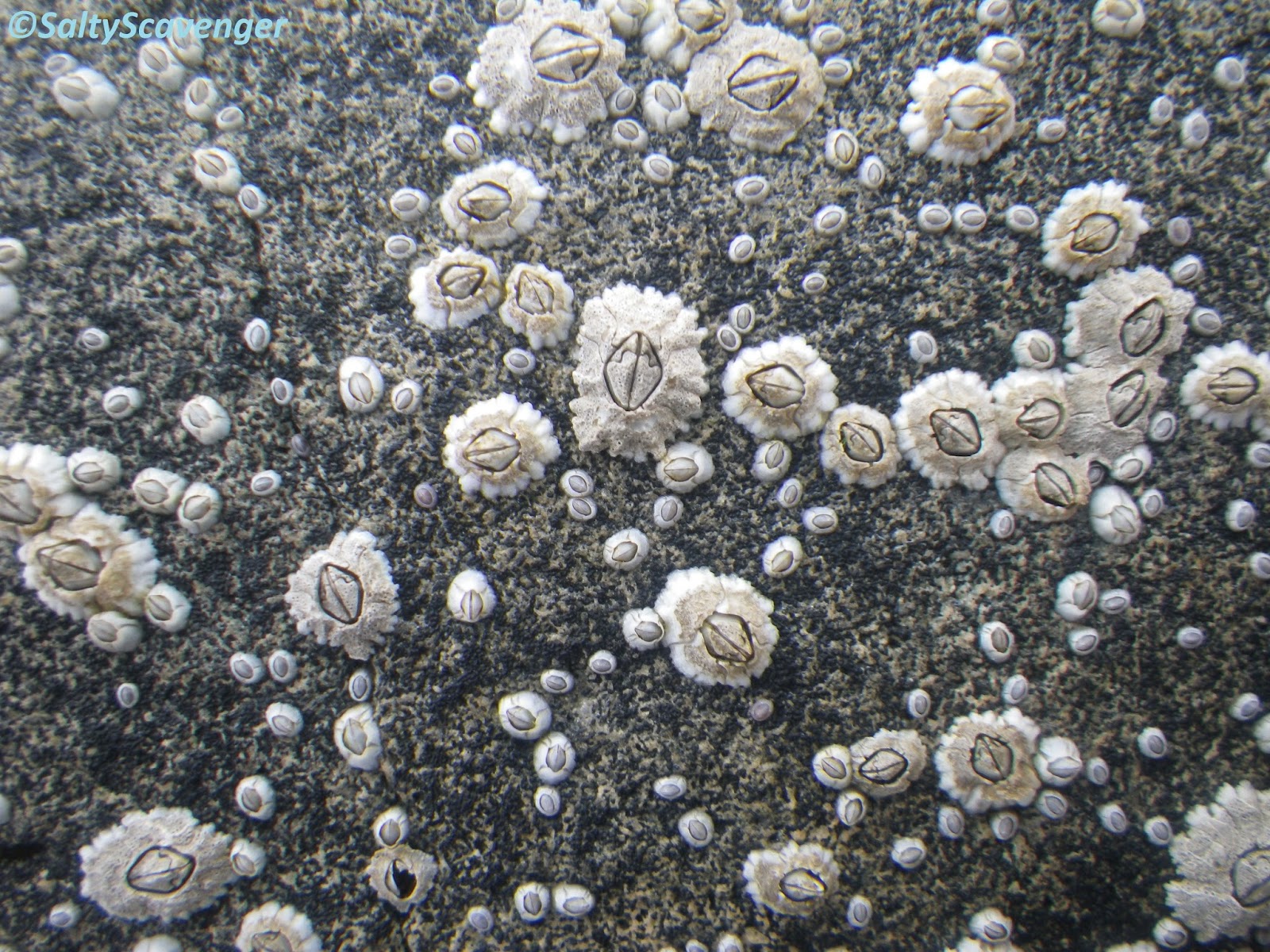
The bedrock of the upper eulittoral supports barnacle communities and shallow coralline rockpools. Patches of the lichen, Lichina pygmaea occur on certain rock faces, as does Verrucaria mucosa, whilst the crevices support mussels (Mytilus edulis), periwinkles and  beadlet anemones (Actina equina). Habitat classification: LR.HLR.MusB.Cht (Chthamalus sp on exposed upper eulittoral rock) EUNIS: A1.112 and LR.HLR.MusB.Sem (Semibalanus balanoides on exposed to moderately exposed or vertical sheltered eulittoral rock) EUNIS: A1.113.

Patches of Lichina pygmaea show seasonal die back.

Barnacles

Coralline rockpools occur throughout the bedrock of the eulittoral. During the winter months the ephemeral seaweeds of the pools have died back, as too has those corallinaceae crusts that were exposed to the sun. China limpets (Patella ulyssiponensis),  M. edulis and the seaweeds Corallinaceae crusts, Corallina officinalis, Chondrus crispus and ephemeral greens can be found within these pools. Habitat classification: LR.FLR.Rkp.Cor (Coralline crust dominated shallow eulittoral rockpools) EUNIS: A1.411.

Mid eulittoral bedrock and less stable boulders, support a more patchy distribution of barnacles, and appear 'pinker' as the granite colour can be seen. Robust fucoids cling on in this environment and between the boulders are filter feeders and robust red seaweeds and beadlet anemones (Actina equina) and among boulders in sheltered gullies are dog whelks (Nucella lapillus) and topshells. Habitat classification: LR.HLR.MusB.Sem (Semibalanus balanoides on exposed to moderately exposed or vertical sheltered eulittoral rock) EUNIS: A1.113.
A flat topshell (Littorina sp) found among the robust fucoids.
Where wave exposure and scour from pebbles and cobbles is high, faunal cover is low.
Bedrock of the lower eulittoral supports an ever increasing diversity of filter feeders, that form 'turfs' with the robust red seaweeds.Habitat classification: LR.HLR.FR (Robust fucoid and/or red seaweed communities) EUNIS: A1.12

Sponges occur beneath shaded over hangs.
Red seaweeds including, Palmaria palmata, Corallinaceae crusts and foliose reds, lace a gully of the lower eulittoral. 
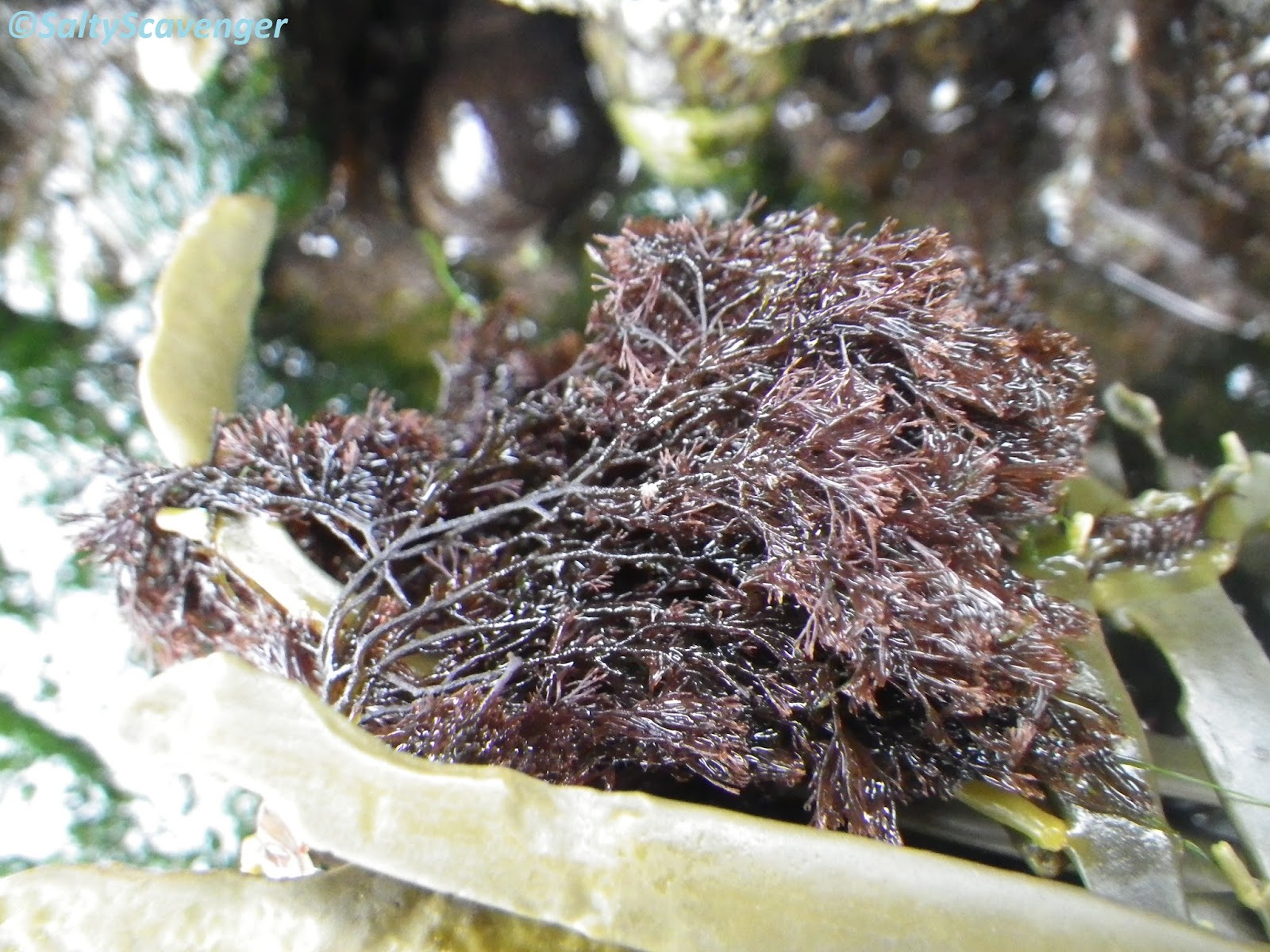
Red seaweed diversity is highest on the lower eulittoral, comprising Calliblepharis sp, Fucus serratus,  Chondrus crispus, Mastrocarous stellatus, Corallinaceae crusts, Corallina officinalis,  Geldium sp and others.

The coralline rockpools of the lower eulittoral support higher densities and diversity of red seaweeds and anemones. Habitat classification: LR.FLR.Rkp.Cor (Coralline crust dominated shallow eulittoral rockpools) EUNIS: A1.411.

In those rockpools filled with coarser sediment the diversity is less.


Sunday, 16 August 2015

Rockpooling Destination: Ardnamurchan, near Light House, Scotland, May 2015


The rocky shore is comprised of  extensive shallow shelving bedrock with gullies, crevices and rockpools.


The uneven topography of the shore leads to a patchy distribution of habitats, experiencing a range of exposures.

Lichen communities characterise the supralittoral and littoral fringe rock, below which barnacle communities and rockpools occur and finally a mosaic habitat of fucoids and barnacles. The rockpools vary from hostile Ulva spp dominated pools of the littoral fringe, to coralline rockpools of the mid shore and deep fucoid filled rockpools of the lower shore.

Below are images of some of the organisms you may encounter whilst rockpooling within these habitats:


The rocky shore comprises shelving bedrock with gullies, crevices and rock pools. Habitat classification: LR.FLR.Lic.YG (Yellow and grey lichens on supralittoral rock) EUNIS: B3.111, LR.FLR.Lic.Ver  (Verrucaria maura on littoral fringe rock) EUNIS: B3.113,  and LR.HLR.MusB (Mussel and/or barnacle communities) EUNIS: A1.11.

The variable topography of the bedrock has resulted in a patchy distribution of yellow and grey lichens on higher elevation rock and the black tar lichen (Verrucaria maura) below. Habitat classification:  LR.FLR.Lic.YG (Yellow and grey lichens on supralittoral rock) EUNIS: B3.111 and LR.FLR.Lic.Ver (Verrucaria maura on littoral fringe rock) EUNIS: B3.113.
At this altitude on the shore  fluctuating temperatures and salinity lead to prolific growth of Ulva spp (formally Entomorpha spp) in some of the rockpools. Habitat classification: LR.FLR.Rkp.G (Green seaweeds (Entomorpha spp. and Cladophora spp.) in shallow upper shore rock pools) EUNIS: A1.421. 
Pelvetia canaliculata forms patches on the sheltered littoral fringe rock growing on top of  Verrucaria spp. Habitat classification: LR.LLR.F.Pel (Pelvetia canaliculata on sheltered littoral fringe rock) EUNIS: A1.311.
Rough periwinkles (Littorina spp) and young growth of Pelvetia canaliculata.
A Rough periwinkle (Littorina spp)
Occasional limpets (Patella vulgata) and lichens (Verrucaria spp) mark the transition between the littoral fringe and upper shore habitats.
The large but relatively shallow coralline rockpools of the shore support a variety of seaweeds and fauna that differs from the surrounding rock communities. Habitat classification: LR.FLR.Rkp.Cor (Coralline crust dominated shallow eulittoral rockpools) EUNIS: A1.411.
Ulva spp within a coralline rockpool.
Cladophora spp within a coralline rockpool.
Edible periwinkles (Littorina littoriawithin a coralline rockpool.
Edible periwinkles (Littorina littoria), China limpet (Patella ulyssiponensis), corallinaceae crusts and Cladophora spp within a coralline rockpool.
Prolific growth of ephemeral greens in summer has swamped this coralline rockpool.
Barnacles communities characterise large stretches of the upper and mid shore, with tufts of Lichina pygmaea on rock pinnacles and Fuus spiralis and limpets in the crevices below. Habitat classification: LR.HLR.MusB (Mussel and/or barnacle communities) EUNIS: A1.11.
Barnacles (Chthamalas montagui)


Barnacles (Semibalanus balanoides)


Glistening beadlet anemones (Actina equina) and small mussels (Mytilus edulis) can be found deep within the rock crevices. Surrounded by barnacles and limpets (Patella spp).
Osmundea spp and Corallina spp occur in damp patches.
A limpet (Patella depressa), Gibulla umbilicus, Osmundea spp and sparse barnacles.
Flat periwinkle (Littorina obtusata)
Flat periwinkle (Littorina obtusata)
Fucus spiralis
Beneath the Fucus spiralis is an under story comprised of red seaweeds and Cladophora rupestris.
An epiphytic seaweeds grows on Fucus spiralis.
Red seaweed abundance increases on the damp rock faces of the lower shore, these exposed specimens appear 'bleached' by the sun. 
Bleached Osmundea spp and Lomentaria articulata.
Cladophora spp
Egg wrack (Ascophyllum nodosum) and epiphytic Polysiphona lanosa.
Polysiphona lanosa growing on Ascophyllum nodosum.
Coralline rockpools lower on the shore support an increased diversity of seaweeds:

A china limpet (Patella ulyssiponensis) covered by Corallinaceae crust, young Fucus spp and filamentous algae.
Filamentous Rhodophyta and spirorbidae polychaete worm tubes.
Filamentous Rhodophyta
Filamentous Chlorophyta
Filamentous Rhodophyta and Gibbula umbilicus.
Deeper rockpools of the lower shore support an increased quantity of brown seaweeds, including Fucoids, Sargassum muticum and Sea oak (Halidrys siliquosa). Habitat classification: LR.FLR.Rkp.FK  (Fucoids and kelp in deep eulittoral rockpools) EUNIS: A1.412.
Fucus serratus
Sargassum muticum
Sea oak (Halidrys siliquosa)
The understory red seaweeds of the lower shore, retain their pigmentation.
Gelidium spp
Coralline algae and bread crumb sponge (Halichondria panicea) occur within a crevices surrounded by barnacles and limpets.
Barnacles and small periwinkles (Melarhaphe neritoides).
Barnacles and rough periwinkle (Littorina spp).
Barnacles and rough periwinkle (Littorina spp).
On the lower shore fucoids form a mosaic with barnacles and dog whelks: Habitat classification: LR.MLR.BF (Barnacles and fucoids on moderately exposed shores) EUNIS: A1.21.
A ringed plover feeds on the shore..