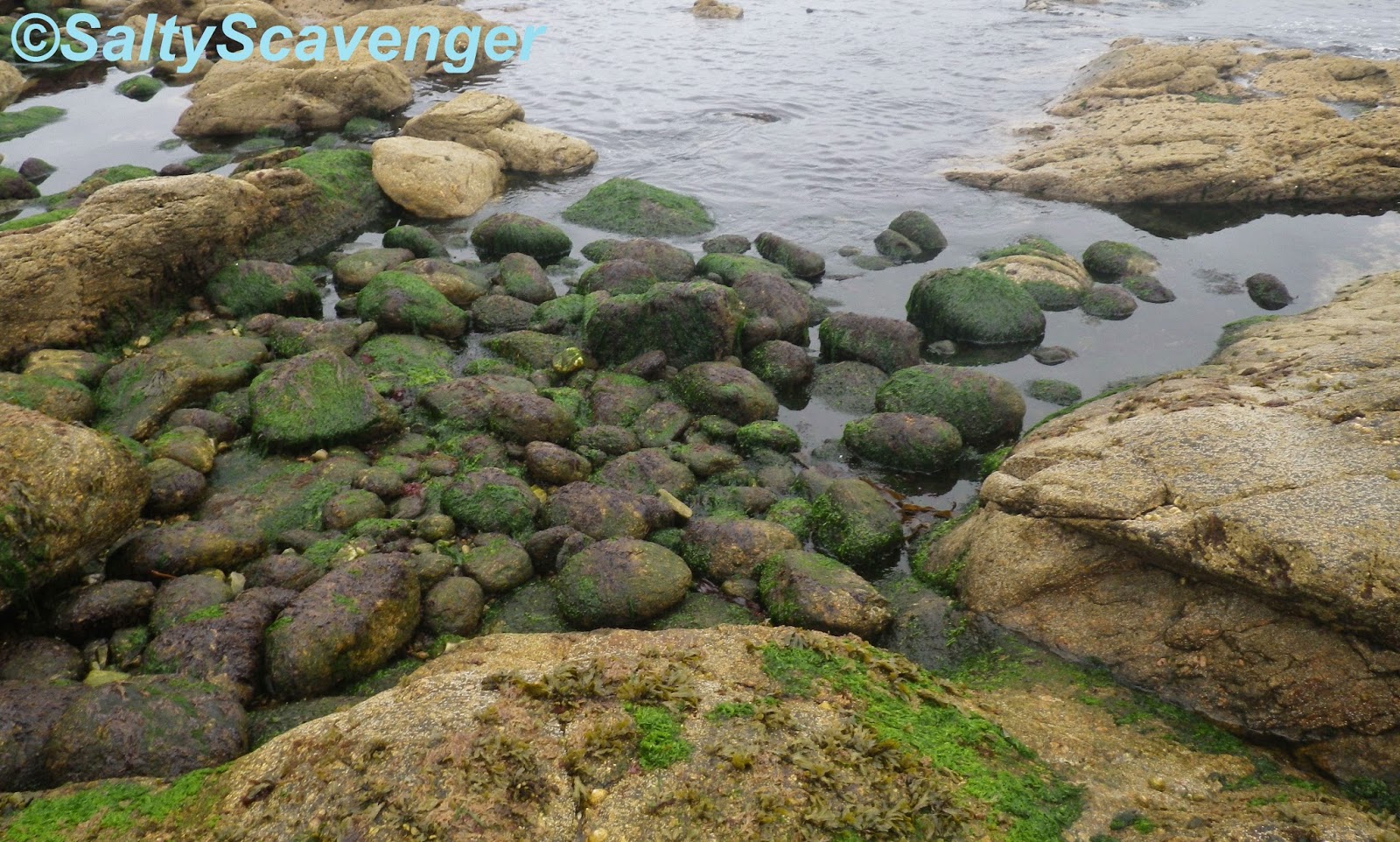
Below are images of such examples:
Sunday, 16 November 2014
Terrestrial predators in the intertidal zone
Below are images of such examples:
Friday, 7 November 2014
Rockpooling destination: Unst, Shetland, September 2014
The rocky shore comprises
shelving bedrock with crevices and small rock pools.
Tar lichen occurs in the littoral fringe and
extends as patches into the upper shore (supralittoral) with periwinkles. The upper
and mid shore are charecterised by barnacles and limpets with the addition of
mussels in the mid shore; whilst spiral wrack occurs on the sheltered aspects
of the rock and red seaweeds occur across the lower shore.
Habitat classification:
Substrate
|
LR (Littoral rock)
|
|||
Habitat
|
LR.HLR (High energy littoral rock)
|
FLR (Features of littoral rock)
|
||
Biotope complex
|
LR.HLR. MusB (Mussel and/or barnacle
communities)
|
LR.FLR.Lic (Lichens on supralittoral
rock)
|
LR.FLR.Rkp (Rockpools)
|
Eph.FLR.Eph (Ephemeral green or red
seaweed communities
|
Biotope
|
LR.FLR.Lic.Ver (Verrucaria maura
on littoral fringe rock)
|
LR.FLR.Rkp.Cor (Coralline crust
dominated shallow eulittoral rockpools)
|
LR.FLR.Eph.EntPor (Porphyra purpurea
and Entomorpha spp. on sand scoured lower eulittoral rock)
|
|
Below are images of
organisms you may encounter whilst rockpooling in these habitats:
![]() |
A small coralline rockpool of the mid shore
with a small encrustation of corallinacea crusts, Limpets (Patella sp) and Beadlet anemones (Actinia equina).
|
![]() |
| Coral weed (Corallina officinalis), Corallinaceae crust, barnacles and epiphytic seaweed within a coralline rockpool |
Limpets (Patella
vulgata) and sparse barnacles.
|
Limpets (Patella
vulgata), barnacles and a red seaweed.
|
Common blue mussels (Mytilus edulis) occur within crevices amongst barnacles and limpets
(Patella sp) of the mid shore.
Habitat classification: LR.HLR. MusB (Mussel and/or barnacle
communities.
|
M.
edulis occur within crevices amongst barnacles, limpets (Patella sp) and the red seaweed, Porphya sp.
|
Barnacles, M. edulis and periwinkles.
|
M.
edulis, barnacles and limpets (Patella sp).
|
1 Further down the shore Barnacles, M. edulis forms clumps overgrown with
red seaweed and dog whelks (Nucella
lapillus) and periwinkles.
|
Dulse on the lower shore
|
| Dulse on the lower shore |
| Dulse on the lower shore |
A red seaweed and springtails on the mid
shore
|
Mastocarpus
stellatus, Porphyra sp and Ulva
sp on the lower shore
|
Fucus
spiralis and Ulva sp
(previously Entomorpha sp) in a
sheltered area of the shore
|
F.
spiralis in a more sheltered area of the shore
|
Cladophora
rupestris and F. spiralis
|
Ephemeral greens cover the lower shore
boulders. Habitat classification: LR.FLR.Eph.EntPor (Porphyra purpurea and
Entomorpha spp. on sand scoured lower eulittoral rock).
|
Sunday, 2 November 2014
Rockpooling destination: North Shetland, September 2014
The
shore comprised of pebbles, cobbles and boulders slopes gently to the low water
mark and is positioned within a sheltered inlet on the Northern extend of
Shetland main land.
The
upper most shore shore is characterised by lichens and succulent plants with a
strandline of washed up seaweed and debris. Channel wrack forms a band in the
upper shore before a blanket of fucoids come to cover the mid and lower shore.
Habitat
classification:
Substrate
|
LR (Littoral rock)
|
||||
Habitat
|
LLR (Low energy littoral rock)
|
FLR (Features of littoral rock)
|
|||
Biotope complex
|
LR.LLR.F (Fucoids on sheltered marine
shores)
|
LR.FLR.Lic (Lichens on supralittoral
rock)
|
|||
Biotope
|
LR.LLR.F.Asc (Ascophyllum nodosum
on sheltered mid eulittoral rock).
|
LR.LLR.F.Pel (Pelvetia
canaliculata on sheletered littoral fringe rock)
|
(Fucus spiralis on moderately exposed
to very sheltered upper eulittoral rock)
|
LR.FLR.Lic.YG (Yellow and grey lichens on supralittoral rock)
|
LR.FLR.Lic.Ver (Verrucaria maura on littoral fringe rock)
|
Below
are images of organisms you may encounter whilst rock pooling in these
habitats:
![]() |
The shore comprises relatively stable
pebbles, cobbles and boulders within a sheltered inlet .Habitat classification:
LR.LLR (Low energy littoral rock).
|
Channel wrack (Pelvetia canaliculata) occurs as a band amongst Verrucaria maura in the upper shore.
Habitat classification: LR.LLR.F.Pel (Pelvetia
canaliculata on sheltered littoral fringe rock)
|
New growth of P. canaliculata.
|
| A barnacle |
New growth of F. spiralis
|
| F. spiralis, Bladder wrack (Fucus vesiculosus) and Egg wrack (Ascophyllum nodosum). |
Egg wrack (A. nodosum) dominates the mid shore. Habitat classification:
LR.LLR.F.Asc (Ascophyllum nodosum on
sheltered mid eulittoral rock).
|
Beneath the A. nodosum are limpets (Patella
vulgata) and barnacles.
|
Limpets, dog whelks (Nucella lapillus), edible periwinkles (Littorina littorea) and spirorbid
polychaetes occur on boulders beneath the fucoid under storey.
|
A limpet covered in spirorbid
polychaetes.
|
Edible periwinkles (Littorina littorea)
|
A flat periwinkle (Littorina sp.)
|
| Ulva sp grows on the less stable mixed substrata. |
The surrounding edges of the inlet are
comprised of a higher component of cobbles and boulders. Habitat
classification: LR.LLR (Low energy littoral rock).
|
Wednesday, 29 October 2014
Rockpooling destination: South-west Shetland, September 2014
The
large South-Westerly facing sandy bay is flanked by rocky headlands and is
relatively barren of life. That which does occur is concentrated around the
strandline.
Habitat
classification:
Substrate
|
LS (Littoral substrate)
|
|
Habitat
|
LS.LSa (Littoral sand)
|
|
Biotope complex
|
LS.LSa.Mo.Sa(Barren and amphipod dominated mobile
sand shores)
|
LS.LSa.St (Strandline)
|
Biotope:
|
LS.Lsa.St.Tal (Talitrids on the upper shore and
strand-line)
|
|
Below
are images of some of the organisms you may encounter in this habitat:
Clean mobile sand with amphipod
burrows extend over vast expanses of the shore. Habitat classification: LS.LSa.Mo.Sa(Barren
and amphipod dominated mobile sand shores).
|
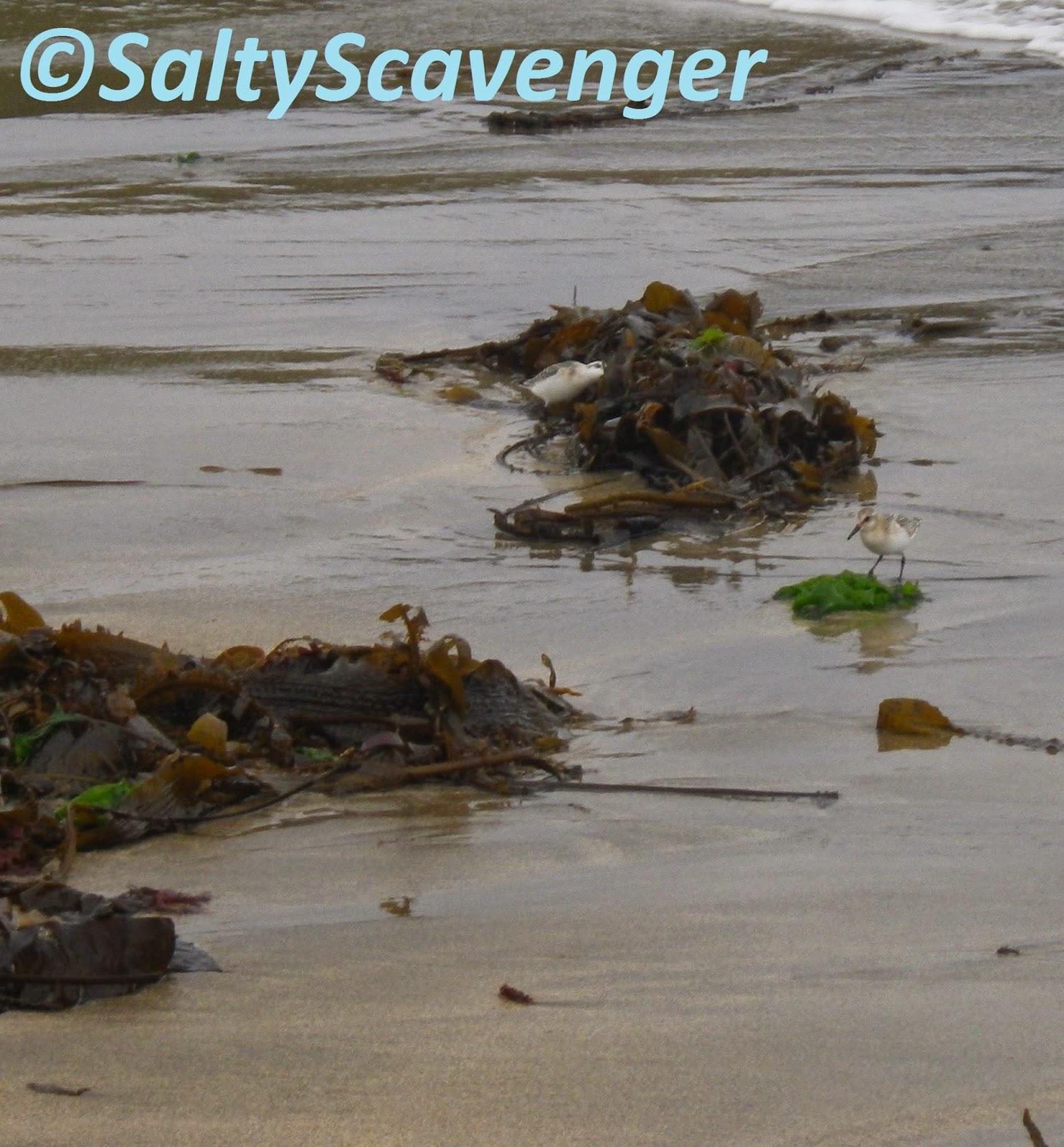
During the autumn migration many wades
come to feed on sandy shores and amongst strandlines. Here the evidence of such
feeding can be seen.
|
| Fresh seaweed and jelly fish are washed up to form the strandline, among which the burrows of talitrids occur. Habitat classification: LS.Lsa.St.Tal (Talitrids on the upper shore and strand-line). |
| Jelly fish are washed up in the strandline during the summer months. |
| Strong waves wash up kelp (Laminaria sp) from the subtidal; on the kelps stipe and holdfast is a community of epiphytic organisms, including bivalves, red seaweeds, bryozoans and polychaetes. |
Laminaria sp with a stipe covered by a variety
of red seaweeds.
|
Laminaria sp with a stipe covered by a variety
of red seaweeds and bryozoans.
|
| Furbellows (Saccorhiza polyschides) |
| Sugar kelp (Saccharina latissima) |
| Thong weed (Himanthalia elongata) |
| Egg wrack (Ascophyllum nodosum) covered in bryozoa, blue common mussels (Mytilus edulis). |
| Egg wrack (Ascophyllum nodosum) covered in bryozoa, blue common mussels (Mytilus edulis). |
| Egg wrack (Ascophyllum nodosum) covered in bryozoa, blue common mussels (Mytilus edulis). |
| Egg wrack (Ascophyllum nodosum) covered in bryozoa. |
| Egg wrack (Ascophyllum nodosum) covered in bryozoan with a goose barnacle. |
Subscribe to:
Posts (Atom)