Showing posts with label Saccorhiza polyschides. Show all posts

Wednesday, 29 October 2014

Rockpooling destination: South-west Shetland, September 2014

The large South-Westerly facing sandy bay is flanked by rocky headlands and is relatively barren of life. That which does occur is concentrated around the strandline.

Habitat classification:

Substrate
LS (Littoral substrate)
Habitat
LS.LSa (Littoral sand)
Biotope complex
LS.LSa.Mo.Sa(Barren and amphipod dominated mobile sand shores)
LS.LSa.St (Strandline)
Biotope:

LS.Lsa.St.Tal (Talitrids on the upper shore and strand-line)


Below are images of some of the organisms you may encounter in this habitat:

   The shore is comprised of mobile barren sand with strandlines at the successive tide marks. Habitat classification: LS.LSa.Mo.Sa(Barren and amphipod dominated mobile sand shores) and LS.LSa.St (Strandline).

    Clean mobile sand with amphipod burrows extend over vast expanses of the shore. Habitat classification: LS.LSa.Mo.Sa(Barren and amphipod dominated mobile sand shores).

    During the autumn migration many wades come to feed on sandy shores and amongst strandlines. Here the evidence of such feeding can be seen.

Fresh seaweed and jelly fish are washed up to form the strandline, among which the burrows of talitrids occur. Habitat classification: LS.Lsa.St.Tal (Talitrids on the upper shore and strand-line).

Jelly fish are washed up in the strandline during the summer months.

Strong waves wash up kelp (Laminaria sp) from the subtidal; on the kelps stipe and holdfast is a community of epiphytic organisms, including bivalves, red seaweeds, bryozoans and polychaetes.

Laminaria sp with a stipe covered by a variety of red seaweeds.

Laminaria sp with a stipe covered by a variety of red seaweeds and bryozoans.

Furbellows (Saccorhiza polyschides)

Sugar kelp (Saccharina latissima)
Thong weed (Himanthalia elongata)

Egg wrack (Ascophyllum nodosum) covered in bryozoa, blue common mussels (Mytilus edulis).

Egg wrack (Ascophyllum nodosum) covered in bryozoa, blue common mussels (Mytilus edulis).

Egg wrack (Ascophyllum nodosum) covered in bryozoa, blue common mussels (Mytilus edulis).

Egg wrack (Ascophyllum nodosum) covered in bryozoa.

Egg wrack (Ascophyllum nodosum) covered in bryozoan with a goose barnacle.

Saturday, 22 June 2013

Rock pooling destination: White Island, Isles of Scilly

Rock pooling destination: White Island, Isles of Scilly, May 2013.


The high energy rocky shore of White Island is comprised of bedrock and boulders with gullies and rock pools. 
Yellow and green lichens occur in the uppermost 'splash zone' of the shore. The black tar lichen forms a band below in the uppershore, with periwinkles, limpets, mussels, beadlet anemones, barnacles and channeled wrack. The mid to low shore contains robust fucoids and rock pools rich in red seaweeds which as you descend to the lower shore form an understory below the thong weed. 

The shore comes under the broad biotope description: LR.HLR (High energy littoral rock).


Rocky Shore comprising bedrock and boulders.
Sea ivory (Ramalina siliquosa) and an orange lichen on the upper most part of the shore. Biotope classification: LR.FLR.Lic.(Lichens on supralittoral and littoral fringe rock).
Tar lichen (Verrucaria maura) forms a distinctive band across the littoral fringe rock. Biotope classification: LR.FLR.Lic.(Lichens on supralittoral and littoral fringe rock).
Small periwinkles(Melarhaphe neritoides) occur within cracks and divots on the upper shore rocks.
Channel wrack (Pelvetia canaliculata) within a crevice of the upper shore.
Common limpets (Patella vulgata) and Rough periwinkles (Littorina saxatilis) seek refuge form the high energy waves beneath an overhang and within crevices of the upper shore. 
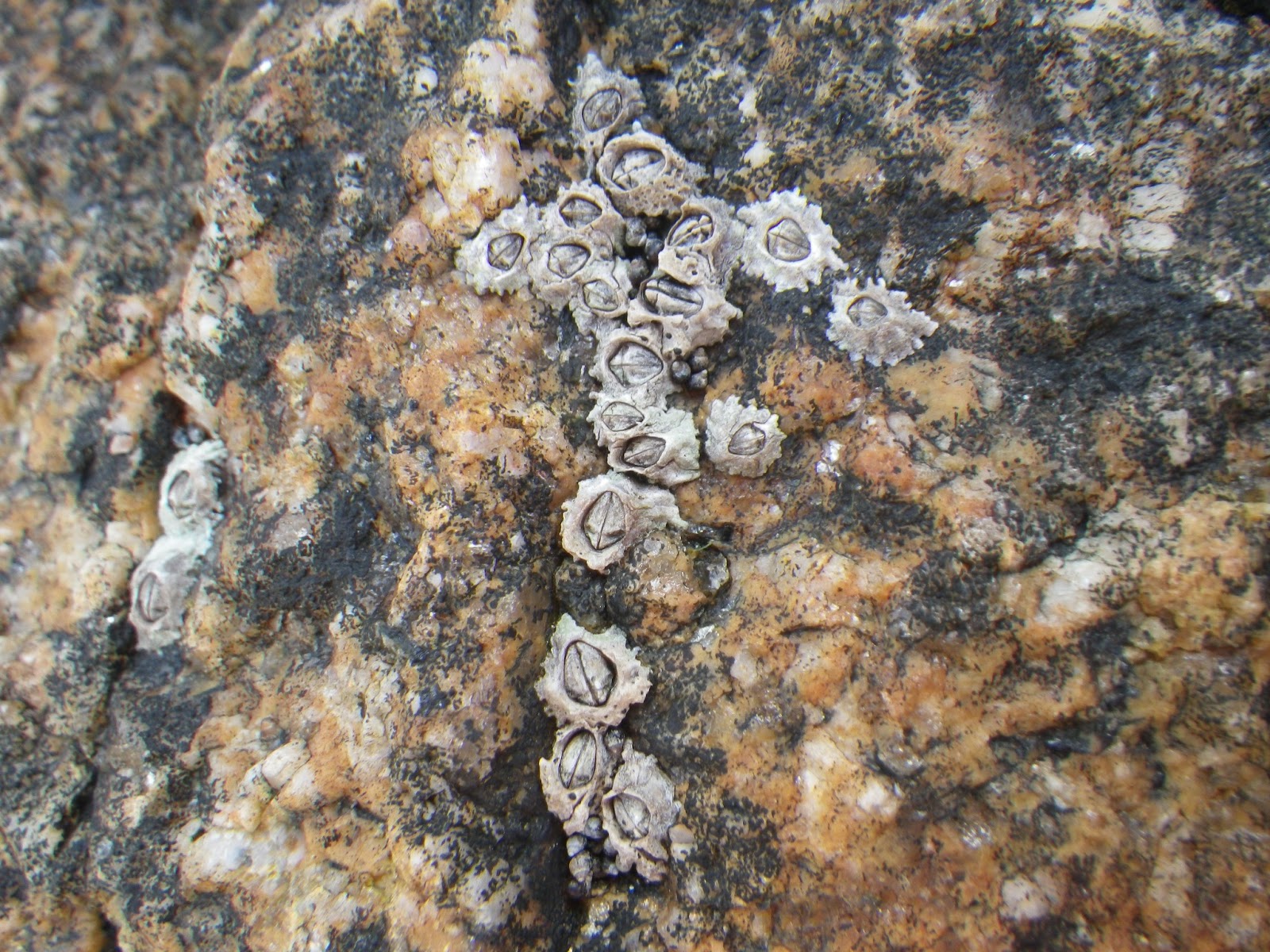
Barnacle distribution is patchy; possibly the result of heavy molluscan grazing?
The rocky shore is hit by strong winter storms. Life 'on the edge' can be stressful and many fauna including this mussel (Mytilus edulis) seek refuge  and 'cling on' within rock crevices and ledges.
Beadlet anemone (Actinia equina) and barnacles.
Mussels (Mytilus edulis), Limpets (Patella vulgata) and Beadlet anemones (Actinia equina) cluster together within a crevice of a ledge corner. Aggregation can help to reduce desiccation by forming a micro climate around the group. 
The rocky shore is exposed to high energy storms that roll the boulders forming smooth bedrock gullies and boulders.
In areas of the shore green seaweed grows over the boulders.
A blenny in a mid shore pool.
Spiral wrack (Fucus spp) on the mid shore. Biotope classification: LR.HLR.FR  (Robust fucoids and/or red seaweed communities)
Spiral wrack (Fucus spp) and Limpets (Patella vulgata) on the mid shore.  
Limpets (Patella vulgata)
 (Osmundea spp). 
Serrated wrack (Fucus serratus) edges a pool of coral weed (Coralina officinalis) and the green seaweed Cladophora rupestris on the lower shore. 
Grape pip weed (Mastrocarpus stellatus) on the lower shore.  
Cladophora rupestris and grape pip weed (Mastrocarpus stellatus) on the lower shore.
A snakelocks anemone (Anemonia viridis) in a corallinacea pool of the lower shore.
A corallinacea crust. 
Chondrus crispus.  
 Biotope classification: LR.HLR.FR  (Robust fucoids and/or red seaweed communities)
Beadlet anemones (Actinia equina) and red seaweed turfs of the lower shore.
An overhang community of the lower shore comprised of beadlet anemone (Actinaia equina), sea squirts, hydrozoa, purse sponge (Grantia compressa), red seaweeds and painted topshell (Calliostoma zizyphinum).
Grey topshells (Gibbula cineraria) occur beneath boulders of the lower shore.
Isopods and amphipods forage amongst seaweed washed up in the gullies of the lower shore.
Thong weed (Himanthelia elongata) and Chondrus crispus on the extreme low shore.
Thong weed (Himanthelia elongata) and red seaweeds on the extreme low shore.
The early stages of Thong weed (Himanthalia elongata)  resemble buttons.
Furbellows (Saccorhiza polyschides)
Thong weed (Himanthalia elongata).


Saturday, 2 February 2013

Common Seaweeds of the Shore- Kelps


Kelps include some the largest seaweed species.  Predominantly subtidal they can form underwater forests and are recognized by their long flexible stipe, flat frond and large holdfast. 

Below are images of kelps you may encounter at the low water mark and whilst snorkeling in the shallow subtidal around the UK:

Laminaria including Laminaria digitata , Laminaria hyperborea and Laminaria ochroleuca are the typical 'kelps'. They have a holdfast, stipe and a large flat frond that is divided into strips. Laminaria occur from the low water mark into the subtidal.

Laminaria in the subtidal.
Many species can be found within the hold fast of Lamiaria species, including the blue rayed limpet Patella pellucida.
The blue rayed limpet Patella pellucida within the holdfast.
Patella pellucida graze on the fronds.


Many species can be found within the hold fast of Lamiaria species, including Oysters (Anomiidae) and Starfish (Henricia oculata).
Saccorhiza polyschides is recognizable by the folds on the stipe close to the holdfast and occurs subtidally.


Dabberlocks (Alaria esculenta) Awaiting image

Bootlace weed (Chorda filum) Awaiting image


Sugar kelp (Saccharina latissima) Awaiting image