Showing posts with label Fucus serratus. Show all posts

Wednesday, 10 May 2017

Rockpooling destination: Dorset April 2017

The rocky shore comprises shelving bedrock that forms a series of ridges that extend into the sea. Fucoids and ephemeral greens lace the ridges, whilst in between, seaweed covered gravel and shingle dominate the channels. 


The rocky shore is comprised of shelving bed rock

Washed up fucoids form a strand line
Seaweeds exhibit zonation across the shore


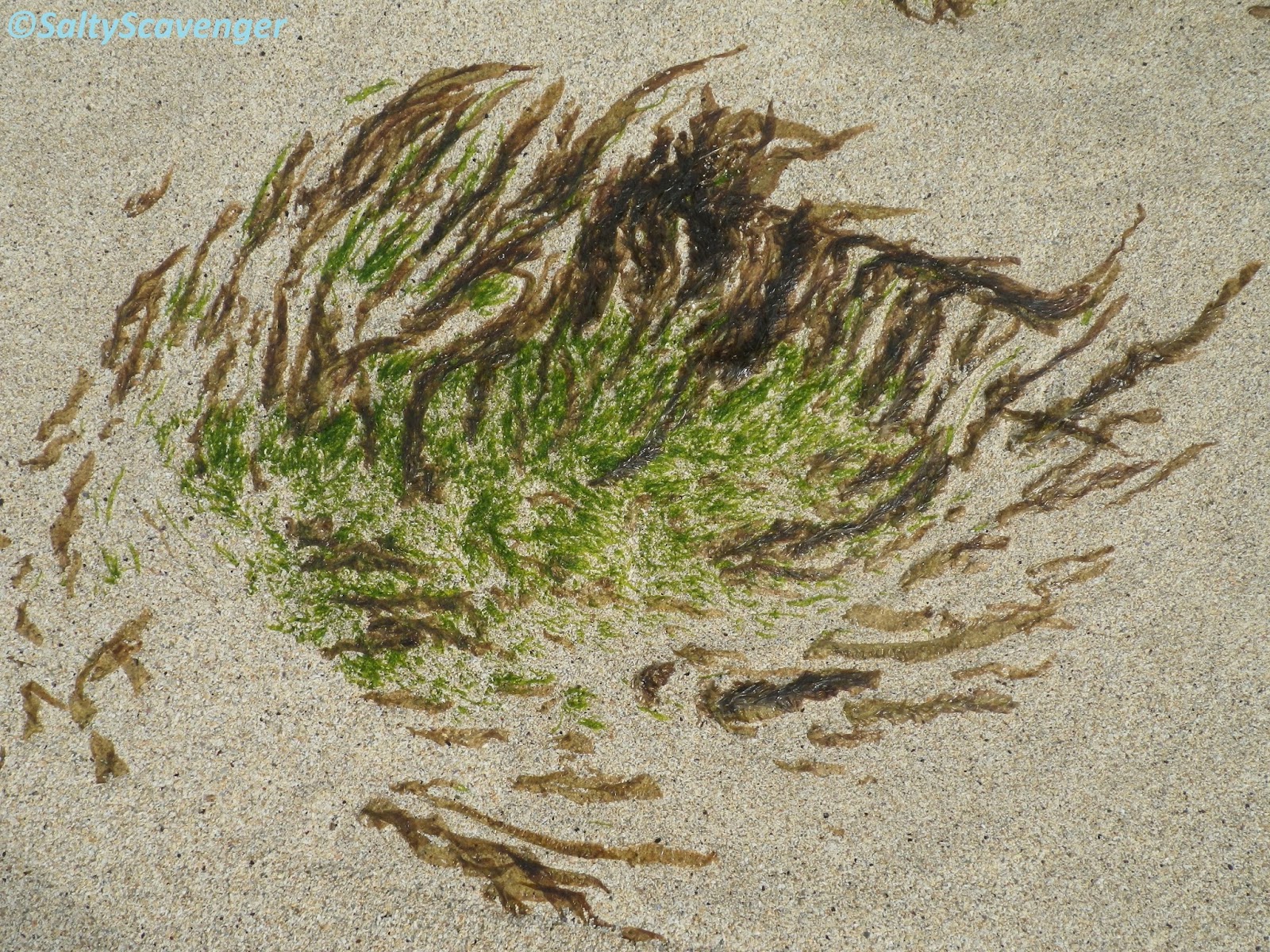
Ephemeral green seaweeds form patches on the shore 

Barnacles and ephemeral green seaweed 


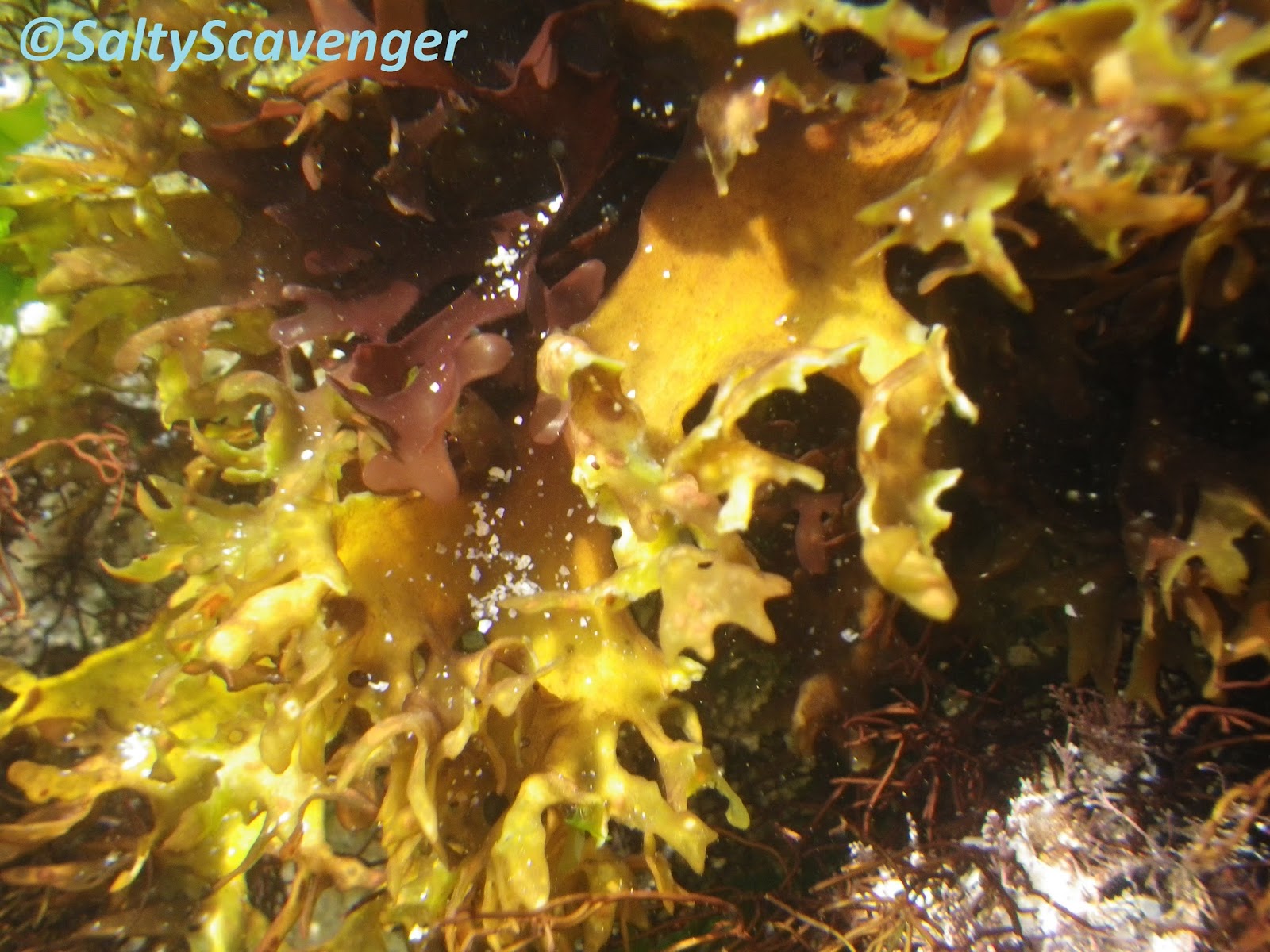
Fucus serratus and Fucus vesiculosus co-occur on sections of the shore


Beneath which are found understorey seaweeds such as the green seaweed, Cladophora sp, Corallinacea crusts and turf forming red seaweeds.

Fauna and seaweeds beneath the fucoid canopy


Coralline algae are found beneath the fucoid canopy within rockpools.


Wednesday, 20 July 2016

Rockpooling Destination: Revisit Lands End Peninsula, June 2016

Steep cliffs surround the bay, the lower craggy edges covered in lichens. The cliff bases and steeper bedrock transition between the lichen and barnacle communities with limpets, periwinkles and whelks. Boulders and bedrock on the shore host a similar barnacle community plus a variety of seaweeds, including where sand scour is event, ephemeral seaweeds. Rockpools occur sporadically throughout the shore, and a river flows downs from the cliffs.

The bay experiences a dynamic regime, alternating between periods of erosion (stony) and deposition (sandy).The underlying substrate is boulders and bedrock, however, variable amounts of sand may be deposited on top, sourced from the sand bar situated offshore. The communities encountered reflect the alternation between these regimes.


Please see previous blog posts:
http://thesaltyscavenger.blogspot.co.uk/2016/06/rockpooling-destination-lands-end.html
http://thesaltyscavenger.blogspot.co.uk/2015/10/rockpooling-destination-revisit-to.html
http://thesaltyscavenger.blogspot.nl/2015/07/rockpooling-destination-revisit-lands.html
http://thesaltyscavenger.blogspot.nl/2014/05/revisit-lands-end-peninsular-april-2014.html
http://thesaltyscavenger.blogspot.nl/2014/02/rockpooling-destination-lands-end.html


For the past 21 months the shore has been stony and a series of rockpooling visits has documented the slow colonisation and succession of the sea shore communities of the newly available substrate. Now the shore is experiencing increased sand deposition which is influencing the communities previously documented. Notably, increased sand deposition and reduced seaweed cover and the infill of many of the sediment filled rockpools.


Below are images showing the change in sediments and habitats observed since April 2015/ March 2016.


 The shore in June 2016, shows an increased fucoid and ephemeral seaweed cover since March, 2015.

The rocky shore in March 2016 exhibits increased sand deposition, reduced seaweed cover and rockpool occurrence since June 2015.
The shore in June 2015 is predominantly comprised of bedrock and boulders and has an increased seaweed cover and rockpool occurrence. 

This photograph taken in September 2015 shows the typical Fucoid and ephemeral seaweed communities that covered the bedrock and boulders of the shore which has now  been mostly covered by sand.
Rather than fucoid seaweeds ephemeral seaweeds are now the dominant seaweed on this section of the shore.

This photograph taken in June, 2015 shows an area of the shore before the sand was deposited. 
Now sand has covered much of this habitat.

Sand continues to be deposited on the shore, covering the fucoid habitat.


Ephemeral seaweeds such as Porphyra sp cover rocks of the lower shore.


Saturday, 31 October 2015

Rockpooling Destination: Revisit to Lands End Peninsula Sept 2015

Below are images of some of the organisms seen whilst rockpooling around the Land's End peninsula in September 2015:


Small and rough periwinkles together with sparse barnacles on the larger boulders of the upper shore.

Springtails investigate a crack in the shell of a rough periwinkle. 

Thick topshells (Osilinus lineatus) among the boulders  and cobbles.

Osilinus lineatus

Osilinus lineatus
The habitats of the shore are influenced by wave exposure, sand scour, fresh water run off and desiccation. The result is a patchwork of biotopes that are not distributed evenly down the shore. In general boulder tops are covered  by fucoids and/or barnacles, whilst ephemeral green seaweed lace the diluted sandy rockpools and lastly sand scour tolerant seaweeds occur in scoured rockpools and boulders of the lower shore. Habitat classification: LR.MLR.BF (Barnacles and fucoids on moderately exposed shores) EUNIS: A1.21, LR.FLR.Eph (Ephemeral green or, red seaweeds (Fresh water or sand influenced) EUNIS: A1.45 and LR.FLR.Rkp (Rockpools) EUNIS: A1.41.

Porphyra spp

Ulva spp

 LR.MLR.BF (Barnacles and fucoids on moderately exposed shores) EUNIS: A1.21.

Some areas of the shore are showing seasonal die back of fucoids.

Fucus spp (Fucus vesiculosus var. nana?)

Fucus spp (Fucus vesiculosus var. nana?)

Understory reds.


A dog whelk (Nucella lapillus) 

Verrucaria mucosa

Limpets (Patella sp) and beadlet anemones (Actinia equina)

The seaweed communities on the lower shore  are comprised of fucoids, robust reds and sand tolerant seaweeds. Habitat classification: LR.MLR.BF.Fser.R (Fucus serratus and red seaweeds on moderately exposed lower eulittoral rock) EUNIS: A1.2141.

Fucus serratus, Mastrocarpus stellatus and ephemeral greens.

Fucus serratus, Mastrocarpus stellatus, Rhodothaminiella floridula and ephemeral greens.

Mastrocarpus stellatus

Gigartinales

Cladophora rupestris

Ulva spp in a sediment filled rockpool. Habitat classification: LR.FLR.RKP.SwSed (Seaweeds in sediment floored eullitoral rockpools) EUNIS: A1.413.
Sand tolerant seaweeds in a sediment filled rockpool.

Phyllophoracea

Hypoglossum hypoglossoides

Rhodothaminiella floridula
Porphyra spp

Black scour weed (Ahnfeltia plicata)

Gigartinales

Gigartinales

Gigartinales


Gigartinales

Gigartinales

Cystoclonium purpureum

Ceramium spp


Asparagopsis armata

Corallina sp form turf in the lower shore rockpools.

Corallina officinalis

Corallina spp
There were no signs of the tube dwelling amphipods among the seaweeds of the sediment filled pools, only the cases of thier tubes remained.


In June, 2015 there were a number of amphipods encased within tubes that were in turn enveloped among the green seaweed.

Asteria rubens


'
Barnacle communities cover more exposed rocks of the lower shore. Habitat classification: LR.HLR.MusB (Mussel and/or barnacle communities).

Barnacles