Showing posts with label rockpooling. Show all posts

Sunday, 19 April 2020

Wednesday, 10 May 2017

Rockpooling destination: Dorset April 2017

The rocky shore comprises shelving bedrock that forms a series of ridges that extend into the sea. Fucoids and ephemeral greens lace the ridges, whilst in between, seaweed covered gravel and shingle dominate the channels. 


The rocky shore is comprised of shelving bed rock

Washed up fucoids form a strand line
Seaweeds exhibit zonation across the shore


Ephemeral green seaweeds form patches on the shore 

Barnacles and ephemeral green seaweed 


Fucus serratus and Fucus vesiculosus co-occur on sections of the shore


Beneath which are found understorey seaweeds such as the green seaweed, Cladophora sp, Corallinacea crusts and turf forming red seaweeds.

Fauna and seaweeds beneath the fucoid canopy


Coralline algae are found beneath the fucoid canopy within rockpools.


Thursday, 16 June 2016

Rockpooling destination: Revisit Land's End peninsula, March 2016

Steep cliffs surround the bay, the lower craggy edges covered in lichens. The cliff bases and steeper bedrock transition between the lichen and barnacle communities with limpets, periwinkles and whelks. Boulders and bedrock on the shore host a similar barnacle community plus a variety of seaweeds, including where sand scour is event, ephemeral seaweeds. Rockpools occur sporadically throughout the shore, and a river flows downs from the cliffs.

The bay experiences a dynamic regime, alternating between periods of erosion (stony) and deposition (sandy).The underlying substrate is boulders and bedrock, however, variable amounts of sand may be deposited on top, sourced from the sand bar situated offshore. The communities encountered reflect the alternation between these regimes.


Please see previous blog posts:
http://thesaltyscavenger.blogspot.co.uk/2015/10/rockpooling-destination-revisit-to.html
http://thesaltyscavenger.blogspot.nl/2015/07/rockpooling-destination-revisit-lands.html
http://thesaltyscavenger.blogspot.nl/2014/05/revisit-lands-end-peninsular-april-2014.html

http://thesaltyscavenger.blogspot.nl/2014/02/rockpooling-destination-lands-end.html


For the past 18 months the shore has been stony and a series of rockpooling visits has documented the slow colonisation and succession of the sea shore communities of the newly available substrate. Now the shore is experiencing increased sand deposition which is influencing the communities previously documented. Notably, increased sand deposition and reduced seaweed cover, particularly of ephemeral green seaweeds, and the infill of many of the sediment filled rockpools.


Below are images showing the change in sediments and habitats observed since April 2015.


The rocky shore in March 2016 exhibits increased sand deposition, reduced seaweed cover and rockpool occurrence.
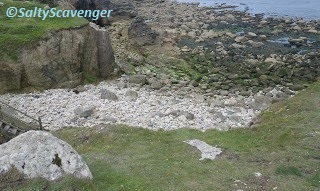
The shore in June 2015 is predominantly comprised of bedrock and boulders and has an increased seaweed cover and rockpool occurrence. 

Since April, 2015  the amount of sand deposited on the shore has increased covering the underlying boulders that previously supported a 'newly' colonising fauna of ephemeral green and red seaweeds, limpets, periwinkles and sparse barnacles. Now this area of the shore represent a barren mobile sand habitat.


This photograph taken in April 2015, shows the previous distribution of sediments in this area of the upper shore. 

This photograph taken in September 2015, shows the previous distribution of sediments in this area of the upper shore. 

Sand now covers much of the 'central' bay area which was previously boulders and bedrock.


This photograph taken in September 2015 shows the typical Fucoid and ephemeral seaweed communities that covered the bedrock and boulders of the shore which has now mostly covered by sand.

 Increased sand deposition is also evident on the lower shore where it has filled in rockpools and covered bedrock.

The lower shore in 2015

Sand has covered the lower shore bedrock and infilled most of the sediment filled rockpools.
This photograph taken in June, 2015 shows the same area of the shore before the sand was deposited. There distribution of the red seaweed and fucoid and rockpools habitats is now far more limited than at the time of this photograph as such rockpooling at either of this times would provide different data sets for the shore and demonstrates the necessity for long term monitoring to ensure accurate characterisation of rocky shores.


How will the shore look next time? Well I have been down and I will post what I saw soon!

Sunday, 29 May 2016

Rockpooling destination: Revisit West Penwith, March 2016


The rocky shore is comprised of boulders and bedrock with rockpools, crevices and gullies. Habitat classification: LR.HLR (High energy littoral rock) EUNIS: A1.1 , LR.FLR.Rkp (Rockpools) EUNIS:A1.41 and LR.FLR.Lic.(Lichens on supralittoral and littoral fringe rock) EUNIS: B3.11


The rocky shore is a high energy environment comprised of boulders and bedrock with rock pools, crevices and gullies.


The high energy environment of the shore leads to an extended lichen zone, that descends over much of the boulder field, which apart from Littorinids is relatively barren. Patches of lichens extend further down into the barnacle communities, which dominate from the upper to lower shore, inter-dispersed by shallow coralline rockpools in the mid shore, and deeper cobble filled rockpools on the lower shore. As the low tide mark is reached wave tolerant seaweeds lace the gullies.


Habitat classification:

Substrate
LR (Littoral rock)
Habitat
LR.HLR (High energy littoral rock)
LR.FLR (Features of littoral rock)
Biotope complex
LR.HLR. MusB (Mussel and/or barnacle communities)
LR.HLR.FR (Robust fucoid and/or red seaweed communities)
    LR.FLR.Lic.(Lichens on supralittoral and littoral fringe rock).
LR.FLR.Rkp (Rockpools)
Biotope
LR.HLR.MusB.Cht (Chthamalus sp on exposed upper eulittoral rock)
LR.HLR.MusB.Sem (Semibalanus balanoides on exposed to moderately exposed or vertical sheltered eulittoral rock)

LR.FLR.Lic.Ver (Verrucaria Maura on  littoral fringe rock)
LR.FLR.Lic.YG (Yellow and grey lichens on supralittoral rock)
LR.FLR.Rkp.Cor (Coralline crust dominated shallow eulittoral rockpools)
Below are images of the organisms you may encounter in these habitats:


Among the mobile boulders of the littoral fringe are populations of rough and small periwinkles. In this high energy environment organisms are confined to crevices and nooks, where they are buffeted from the full force of the waves and potential dislodgement. Habitat classification:  LR.FLR.Lic.(Lichens on supralittoral and littoral fringe rock) EUNIS: B3.11


Small and rough periwinkles aggregate in a boulder crevice.

Wave exposure drives the distribution of many organisms on the shore. A larger boulder provides shelter from the waves and resists rolling enabling it to support a community of limpets, periwinkles and barnacles.


Waves pick up and roll boulders that lie within the gullies ‘ grinding’ away much of the epifauna. Those that survive seek refuge within crevices of the bedrock or, occur on larger boulders/bedrock that is not subjected to the same forces.

However, during winter storms even the bedrock fractures and comes away! Demonstrating the strength of the waves hitting these shores and the ability of wave exposure  to modify the environmental conditions experienced by the organisms and/or dislodge the organisms themselves!


Exposed uppershore bedrock is covered in dense barnacles, with crevices jammed by mussels, anemones and coralline seaweeds. Small periwinkles occur among the barnacles, seeking shelter within the dead barnacle tests. The black lichen Lichina pygmaea forms tufts on the upper rock. All these organisms are characteristic of the biotope: LR.HLR.MUSb.CHT (Chthamalus sp on exposed upper eulittoral rock) EUNIS: A1.112.


Mussels (M. edulis) on the edge of a coralline rockpool
                        

At this time of year the ephemeral seaweeds within rockpools, Fucoids and some patches of Lichina pygmaea have died back.


  There is also ‘New life’ as young fucoid fronds defy the elements

On areas of lower lying bedrock and boulders seaweeds, topshells and dog whelks increase in abundance. The lichen V mucosa is characteristic of this biotope, as is an increase in fucoid and red seaweeds, such as Osmundea sp with the relative abundances varying throughout the year. Topshells, dogwhelks, anemones and Patella depressa are also characteristic. Habitat classification: LR.MUSb.Sem (Semibalanus balanoides on exposed to moderately exposed or vertical sheltered eulittoral rock) EUNIS: A1.113.


Patella depressa among barnacles and limpets.

Rhodophyta
 
Shallow coralline rockpools of the upper to mod eulittoral. Habitat classification: LR.FLR.Rkp.Cor (Coralline crust dominated shallow eulittoral rockpools) EUNIS:A1.411.

Scytosiphon lomentaria is present in some of the rockpools, as the season goes on this will be one of the most common brown seaweeds in the coralline rockpools of the upper eulittoral.
At this time of year the ephemeral seaweeds within rockpools have died back, whilst the coralline and perennial brown seaweeds are beginning to show new growth. These coralline rockpools of the mid and lower eulittoral support a greater diversity of seaweeds, including Bifurcaria bifurcata, Corallina officinalis, coralinaceae crusts and the early growths of ephemeral green seaweeds, along with beadlet anemones, china limpets, flat topshells and thick topshells.
The snakelocks anemone occurs in the shallow coralline rockpools of the lower eulittoral.


Seaweeds are almost absent from the rockpools of the lower shore at this time of year. Possible due to the ‘grinding’ nature within these pools during this time of year. The only seaweed to persist is an ephemeral green.


Tuesday, 5 April 2016

Rockpooling Destination: Revisit Hemsby, March 2016

The intertidal sediments experience periods of erosion and deposition which in turn influence the sediments and organisms found or washed up on the shore.

In March the strandlines separate in to an upper, comprised of bryozoa (predominantly Flustra foliacea) and a lower, comprised of red seaweeds (predominantly combweed, Plocamium sp).

The sediments of the shore in March, comprise coarser elements than during the summer.

March 2016


The shore in Summer, 2014


Friday, 18 December 2015

Deep Freeze of a winter's past

So far this year, Winter has been particularly mild but its Winters past it has not been the case....

Brackish water of the Yare estuary often becomes partially frozen in winter.......