Showing posts with label Entomorpha. Show all posts

Wednesday, 20 July 2016

Rockpooling Destination: Revisit Lands End Peninsula, June 2016

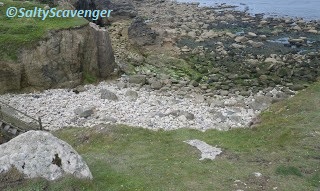
Steep cliffs surround the bay, the lower craggy edges covered in lichens. The cliff bases and steeper bedrock transition between the lichen and barnacle communities with limpets, periwinkles and whelks. Boulders and bedrock on the shore host a similar barnacle community plus a variety of seaweeds, including where sand scour is event, ephemeral seaweeds. Rockpools occur sporadically throughout the shore, and a river flows downs from the cliffs.

The bay experiences a dynamic regime, alternating between periods of erosion (stony) and deposition (sandy).The underlying substrate is boulders and bedrock, however, variable amounts of sand may be deposited on top, sourced from the sand bar situated offshore. The communities encountered reflect the alternation between these regimes.


Please see previous blog posts:
http://thesaltyscavenger.blogspot.co.uk/2016/06/rockpooling-destination-lands-end.html
http://thesaltyscavenger.blogspot.co.uk/2015/10/rockpooling-destination-revisit-to.html
http://thesaltyscavenger.blogspot.nl/2015/07/rockpooling-destination-revisit-lands.html
http://thesaltyscavenger.blogspot.nl/2014/05/revisit-lands-end-peninsular-april-2014.html
http://thesaltyscavenger.blogspot.nl/2014/02/rockpooling-destination-lands-end.html


For the past 21 months the shore has been stony and a series of rockpooling visits has documented the slow colonisation and succession of the sea shore communities of the newly available substrate. Now the shore is experiencing increased sand deposition which is influencing the communities previously documented. Notably, increased sand deposition and reduced seaweed cover and the infill of many of the sediment filled rockpools.


Below are images showing the change in sediments and habitats observed since April 2015/ March 2016.


 The shore in June 2016, shows an increased fucoid and ephemeral seaweed cover since March, 2015.

The rocky shore in March 2016 exhibits increased sand deposition, reduced seaweed cover and rockpool occurrence since June 2015.

The shore in June 2015 is predominantly comprised of bedrock and boulders and has an increased seaweed cover and rockpool occurrence. 

This photograph taken in September 2015 shows the typical Fucoid and ephemeral seaweed communities that covered the bedrock and boulders of the shore which has now  been mostly covered by sand.
Rather than fucoid seaweeds ephemeral seaweeds are now the dominant seaweed on this section of the shore.

This photograph taken in June, 2015 shows an area of the shore before the sand was deposited. 
Now sand has covered much of this habitat.

Sand continues to be deposited on the shore, covering the fucoid habitat.


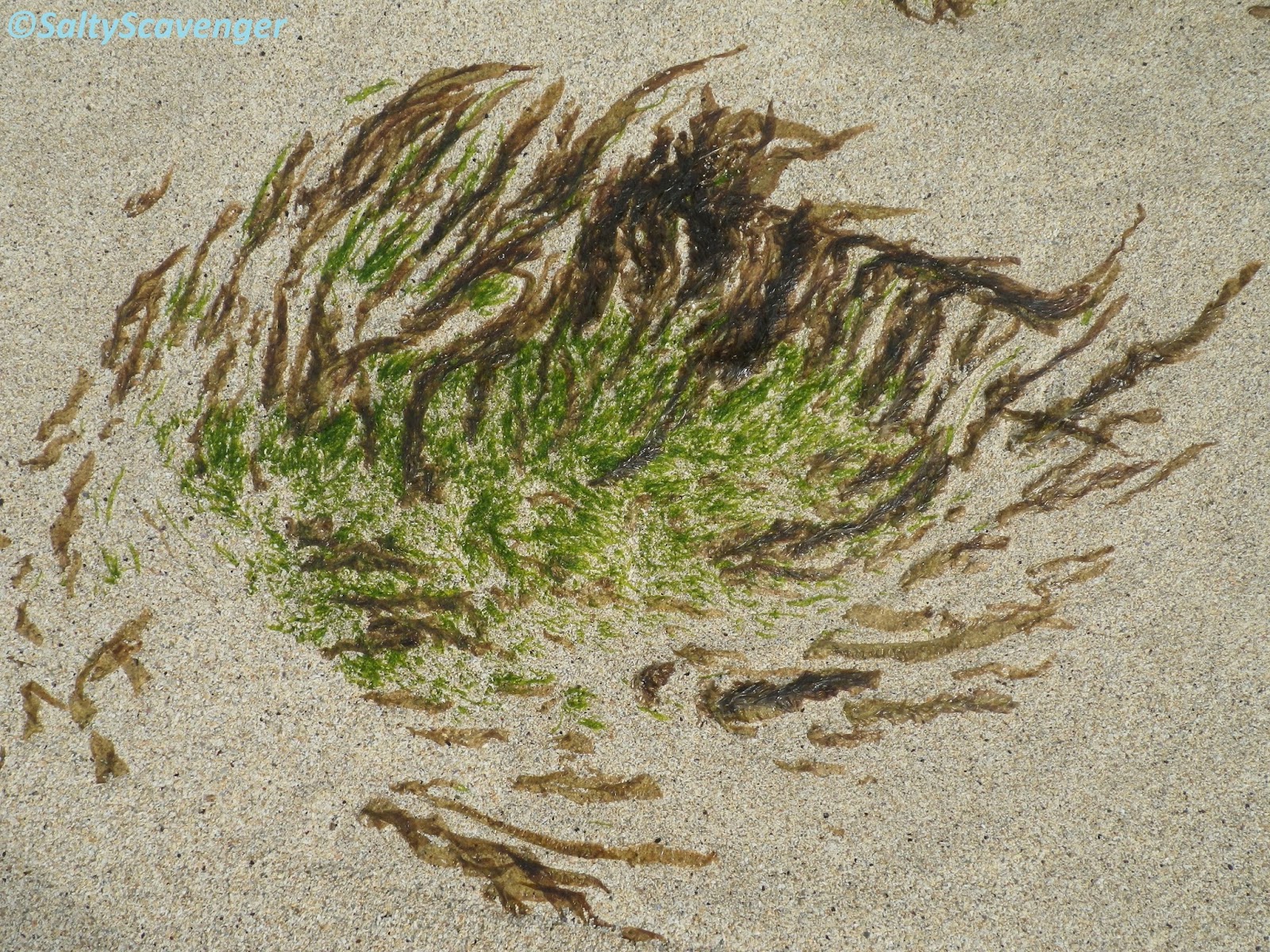
Ephemeral seaweeds such as Porphyra sp cover rocks of the lower shore.


Monday, 15 December 2014

Rockpooling destination: Shetland September 2014

The shore comprises a small sheltered bay of cobbles and pebbles into which a river flows. A quay provides a further anthropogenic hard substrate.

Habitat classification:

Substrate
LR (Littoral rock)
Habitat
LLR (Low energy littoral rock)
LR.FLR (Features of ilttoral rock)
Biotope complex
LR.LLR.F (Fucoids on sheltered marine shores)
LR.FLR.Eph (Ephemeral green or red seaweed communities
Biotope

LR.FLR.Eph (Ephermeral green or red seaweeds (Fresh water or sand influenced)

Below are images of organisms that you may encounter whilst rockpooling in these habitats:


The rocky shore is comprised of cobbles and pebbles. The swathe of green marks where ephermeral green seaweeds grow under the influences of the fresh water influx from the river. Habitat classification: LR.FLR.Eph (Ephermeral green or red seaweeds (Fresh water or sand influenced).
Ephermeral green seaweed - 'Gut weed' (Ulva sp formally Entomorpha sp ) grows prolifically on the shore where there is fresh water influence.


Barnacles grow on the quay side.


Barnacles and  Gut weed (grow on the quay side.


Pebbles and shell fragments make up the substrate in the middle of the bay.


Beyond the bay are fish farms that are marked by bouys that become covered in mussels, which is turn are scraped off and end up as part of the substrate of the bay.


Monday, 27 October 2014

Rockpooling destintation: North Shetland, September 2014

The rocky shore comprises exposed bedrock outcrops with boulder filled gullies, crevices and rock pools.
Lichens occur throughout the littoral fringe and upper shore interspersed with shallow rockpools.  The extensive Verrucaria maura biotope is the defining feature of this shore. Faunal diversity is low and sparse being confined to the sheltered rock sides, crevices and gullies. Periwinkles are found throughout the shore, whilst seaweeds and other mobile fauna are found within the rockpools and gullies. The rockpools of the shore vary depending on their relative altitude and wave exposure. Coralline rockpools occur in the mid shore and deeper species rich rockpools of the lower shore gullies.


Habitat classification:

Substrate

Habitat
FLR (Features of littoral rock)
Biotope complex
LR.FLR.Lic (Lichens on supralittoral rock)
LR.FLR.Rkp (Rockpools)
Biotope
LR.FLR.Lic.YG Yellow and grey lichens on supralittoral rock
LR.FLR.Lic.Ver (Verrucaria maura on littoral fringe rock)
LR.FLR.Rkp.G        (Green seaweeds (Entomorpha spp. and Cladophora spp.) in shallow upper shore rock pools)
LR.FLR.Rkp.Cor (Coralline crust dominated shallow eulittoral rockpools)
LR.FLR.Rkp.FK Fucoids and kelp in deep eulittoral rockpools


Below are images of organisms you may encounter whilst rockpooling in these habitats:
  The rocky shore comprises bedrock outcrops with boulder filled gullies, crevices and rockpools. Habitat classification: LR.FLR.Lic (Lichens on supralittoral rock) and LR.FLR.Rkp (Rockpools).

Sea pinks occur in crevices amongst Yellow and grey lichens in the littoral fringe. Habitat classification: LR.FLR.Lic.YG (Yellow and grey lichens on supralittoral rock).

Lichens in the littoral fringe.

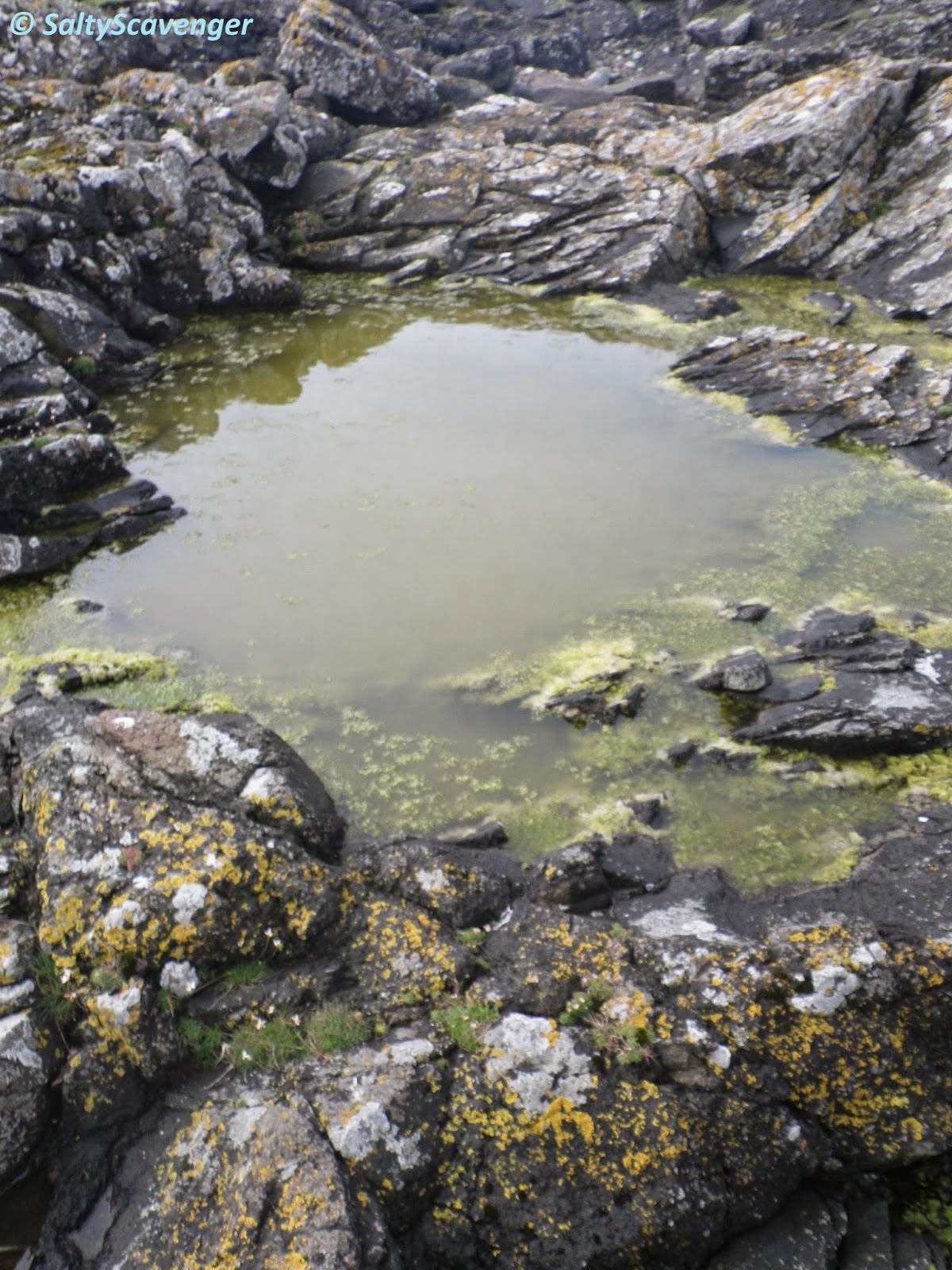
 A shallow rock pool dominated by green algae and surrounded by lichens. Habitat classification: LR.FLR.Rkp.G (Green seaweeds (Entomorpha spp. and Cladophora spp.) in shallow upper shore rock pools).

  A shallow rock pool in the upper shore that has become increasingly stagnant, through the decomposition of ephemeral green seaweed.

Tar lichen (Verrucaria maura) covers the majority of the rocky shore. Habitat classification: LR.FLR.Lic.Ver (Verrucaria maura on littoral fringe rock)  

  Rough periwinkles (Littorina sp) are sparesly distributed throughout the V. maura biotope.

  A shallow rock pool with Ulva sp (previously Entomorpha )within the V. maura biotope. Habitat classification: LR.FLR.Rkp.G (Green seaweeds (Entomorpha spp. and Cladophora spp.) in shallow upper shore rock pools).

   A shallow rock pool with Ulva sp (previously Entomorpha )within the V. maura biotope. The rockpools of the upper shore experience fluctuations in salinity and temperature that restrict gastropod density allowing the prolific growth of ephemeral green seaweeds.

    In the sheltered gullies, channel wrack (Pelvetia canaliculata) grows within the V. maura biotope.

   A coralline rock pool within the mid shore with Corallinaceae crusts, coral weed (Corallina officinalis) limpets (Patella sp), periwinkles, common blue mussel (Mytilus edulis) and the green seaweed Codium sp. Habitat classification: LR.FLR.Rkp.Cor (Coralline crust dominated shallow eulittoral rockpools)

   Limpets (Patella sp) covered by filamentous greens in a coralline rock pool.

Limpets (Patella sp) and filamentous seaweeds in a coralline rock pool

Corallinaceae crusts and barnacles within a coralline rock pool.

A rock pool of the lower shore gullies with Spiral wrack (Fucus spiralis), Serrated wrack (Fucus serratus), Ulva sp, Corallinaceae crusts and limpets (Patella sp). Habitat classification: LR.FLR.Rkp.FK Fucoids and kelp in deep eulittoral rockpools.

Codium sp

A shore crab (Carcinus maenas) within a rich seaweed rock pool.