Showing posts with label cornwall rockpooling. Show all posts

Wednesday, 20 July 2016

Rockpooling Destination: Revisit Lands End Peninsula, June 2016

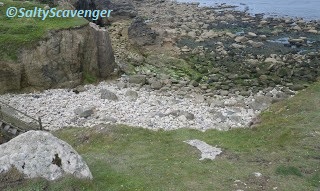
Steep cliffs surround the bay, the lower craggy edges covered in lichens. The cliff bases and steeper bedrock transition between the lichen and barnacle communities with limpets, periwinkles and whelks. Boulders and bedrock on the shore host a similar barnacle community plus a variety of seaweeds, including where sand scour is event, ephemeral seaweeds. Rockpools occur sporadically throughout the shore, and a river flows downs from the cliffs.

The bay experiences a dynamic regime, alternating between periods of erosion (stony) and deposition (sandy).The underlying substrate is boulders and bedrock, however, variable amounts of sand may be deposited on top, sourced from the sand bar situated offshore. The communities encountered reflect the alternation between these regimes.


Please see previous blog posts:
http://thesaltyscavenger.blogspot.co.uk/2016/06/rockpooling-destination-lands-end.html
http://thesaltyscavenger.blogspot.co.uk/2015/10/rockpooling-destination-revisit-to.html
http://thesaltyscavenger.blogspot.nl/2015/07/rockpooling-destination-revisit-lands.html
http://thesaltyscavenger.blogspot.nl/2014/05/revisit-lands-end-peninsular-april-2014.html
http://thesaltyscavenger.blogspot.nl/2014/02/rockpooling-destination-lands-end.html


For the past 21 months the shore has been stony and a series of rockpooling visits has documented the slow colonisation and succession of the sea shore communities of the newly available substrate. Now the shore is experiencing increased sand deposition which is influencing the communities previously documented. Notably, increased sand deposition and reduced seaweed cover and the infill of many of the sediment filled rockpools.


Below are images showing the change in sediments and habitats observed since April 2015/ March 2016.


 The shore in June 2016, shows an increased fucoid and ephemeral seaweed cover since March, 2015.

The rocky shore in March 2016 exhibits increased sand deposition, reduced seaweed cover and rockpool occurrence since June 2015.

The shore in June 2015 is predominantly comprised of bedrock and boulders and has an increased seaweed cover and rockpool occurrence. 

This photograph taken in September 2015 shows the typical Fucoid and ephemeral seaweed communities that covered the bedrock and boulders of the shore which has now  been mostly covered by sand.
Rather than fucoid seaweeds ephemeral seaweeds are now the dominant seaweed on this section of the shore.

This photograph taken in June, 2015 shows an area of the shore before the sand was deposited. 
Now sand has covered much of this habitat.

Sand continues to be deposited on the shore, covering the fucoid habitat.


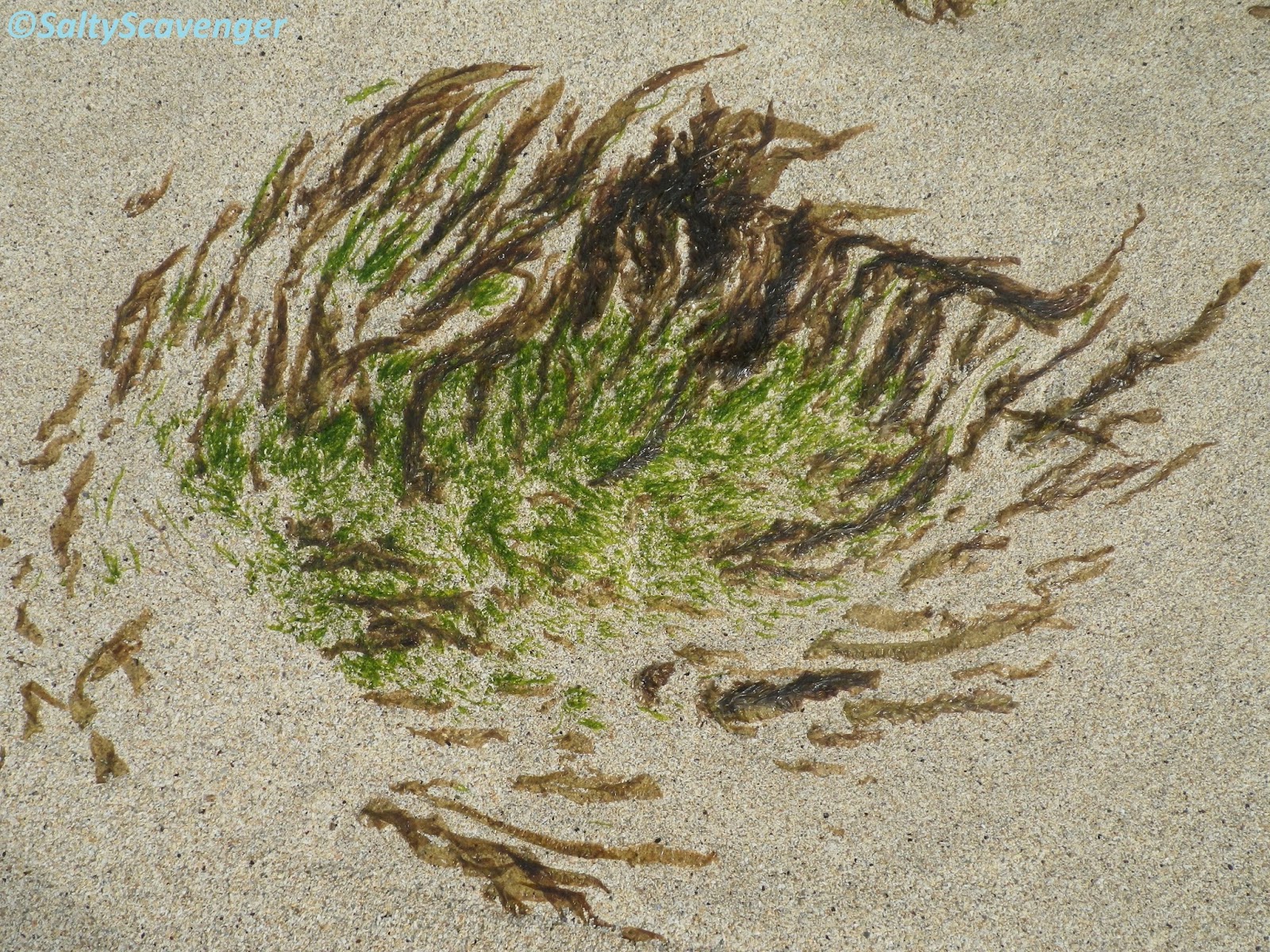
Ephemeral seaweeds such as Porphyra sp cover rocks of the lower shore.


Friday, 2 October 2015

Rockpooling Destination: Revisit to Lands End Peninsula Sept 2015


As seen in the previous post the bay has experienced some recent changes in deposition and erosion, resulting in the formation of a strandline and winnowing of finer material from the uppershore cobble beach. However, these are not the only changes to have occurred as this post will reveal...


As seen in the previous post a strandline has formed on the upper extent of the cobble beach. The newly formed strandline is important as it provide a resource for food and shelter, on an otherwise barren upper cobble and boulder beach.

This photograph taken in June, 2015 shows the absence of a strandline on this section of the shore. See post http://thesaltyscavenger.blogspot.co.uk/2015/08/rockpooling-destination-revisit.html 
This photograph taken in June, 2015 shows much of the upper shore bedrock and boulders covered by seaweed. See post http://thesaltyscavenger.blogspot.co.uk/2015/08/rockpooling-destination-revisit.html


However, by September, 2015 the percentage cover of seaweed on upper shore boulders and bedrock has reduced. 

Bedrock that was covered in ephemeral green seaweeds are now bare, whilst the Fucus sp is reduced to stumps.

There is a distinct lack of 'green' in this photograph compared to the photograph below that was taken in June, 2015.

Fucus sp cover the boulders, whist ephemeral green seaweed lace the diluted and sand scoured rockpools. June, 2015. See post http://thesaltyscavenger.blogspot.co.uk/2015/08/rockpooling-destination-revisit.html


What could have caused this change? Abrasion from the winnowed sediment? Seasonal die back or grazing? Since June there has been an increase in limpet abundance, c. Could their grazing be accountable?

Limpet density is higher than in June, could it be that individuals moved with the changing season. Seasonal migrations are noted in limpet species of British species (http://www.marlin.ac.uk/biotic/browse.php?sp=4220) or, were  the limpets swept in with  the fronds of the strandline , as noted for limpets in Advances in Marine Biology vol 16 or, maybe population abundance has peaked as a feature of the limpet life histories?
Topshell density had also increased behind the stack.

There were no signs of the tube dwelling amphipods among the seaweeds of the sediment filled pools, only the cases of thier tubes remained.


In June many amphipods were observed occupying tubes which were in  turn enveloped among the green seaweed. See post http://thesaltyscavenger.blogspot.co.uk/2015/08/rockpooling-destination-revisit.html


All other seaweeds except the fucoids exhibited no or little seasonal die back at this time and the remaining habitats remained largely unchanged since June, 2015.


Sunday, 13 September 2015

Revisit: Land's End Peninsular September 2015

The bay experiences a dynamic regime, alternating between periods of erosion (stony) and deposition (sandy).The underlying substrate is boulders and bedrock, however, variable amounts of sand may be deposited on top, sourced from the sand bar situated offshore. The communities encountered reflect the alternation between these regimes.


Please see previous blog posts:
http://www.thesaltyscavenger.blogspot.co.uk/2015/08/rockpooling-destination-revisit.html
http://thesaltyscavenger.blogspot.nl/2015/07/rockpooling-destination-revisit-lands.html
http://thesaltyscavenger.blogspot.nl/2014/05/revisit-lands-end-peninsular-april-2014.html
http://thesaltyscavenger.blogspot.nl/2014/02/rockpooling-destination-lands-end.html

On my most recent visit in September, 2015 the shore was starting to show the signs of Autumn with winnowing of finer sediments from the upper shore and an increased strandine reaching across the entire cobble and boulder beach. Some seaweeds also showed signs of seasonal die back.


The rocky shore during the current visit in September, 2015 shows little variation from June, 2015 except in the upper shore, where there has been erosion and winnowing of finer sediments and the formation on a strandline across the entire cobble and boulder beach.


The rocky shore in June 2015, does not support a strandline across the entire cobble and boulder beach.
The strandline that filled the cave in June, 2015 is no longer visible, only a wedge of seaweed behind the boulder can be seen. However, the height of the sand in relation to the boulder suggests that there has been increased deposition of sand within the cave since June and it may be that this sand has covered the strandline that was present or, the seaweed has now been washed up to form the strandline across the cobble and boulder beach?


The strandline present within the cave in June 2015. 


Again the strandline present on this section of the shore in June, 2015 has now gone and the finer sediments present in June and April, 2015 have been winnowed from between the cobbles and boulders.
Seaweed in June, 2015 had been washed up among the boulders of this part of the shore. 


This photograph taken in April 2015, shows the finer material that once occurred on this part of the shore and has now been winnowed away.


Fucoids begin to show seasonal die back. The lost fronds contribute to the strand line.

Monday, 11 August 2014

Rockpooling destination: St. Martins, April 2014

The rocky shore occurs throughout the mid and lower shore of a large, sheltered sweeping bay, and comprises boulders and cobbles lying on sand or, bed rock.

Fucoid seaweeds dominate the rocky shore habitat, exhibiting zonation, whilst other organisms live and seek refuge amongst the fucoid understory, in crevices, under boulders and within rockpools.

The mosaic of boulders and cobbles on sand or, bedrock 

provides a variety of micro habitats which in turn enables more organisms to co-exist. For 

example, the organisms living on top of the boulder will vary to those living underneath.

Habitat classification:

Substrate
LR (Littoral rock)
Habitat
LLR (Low energy littoral rock)
FLR (Features of littoral rock)
Biotope complex
LR.LLR.F (Fucoids on sheltered marine shores)
Rkp (Rockpools)
Biotope
LR.LLR.F.Fserr (Fucus serratus on sheltered lower eulittoral rock)

Sub Biotope
LR.MLR.BF.Fser.Bo Fucus serratus and under-boulder fauna on lower eulittoral rocks.


Below are images of organisms you may encounter whilst rock pooling in these habitats:

The rocky shore comprises boulders and cobbles on bedrock and sand. Fucoid seaweeds form a blanket covering the rock and are a characteristic feature of the different sub habitats within the broad habitat, fucoids on sheltered marine shores (LR. LLR. F).

Bladder wrack (Fucus vesiculosus) amongst serrated wrack (Fucus serratus). A blanket of fucoids covers the shore. Habitat classification: LR. LLR.F (Fucoids on sheltered marine shores).

Common limpets (Patella vulgata) with a covering of the brown encrusting seaweed, Thick topshell (Osilinus lineatus) and barnacles occur on a boulder amongst the blanket of fucoids on the lower shore. 


Turning over the boulders reveals a different group of organisms to that above including, Berthella plumula, young whelks, cushion star (Asterina gibbosa) and Broad-clawed porcelain crab (Porcellana platycheles).Habitat classification: LR.MLR.BF.Fser.Bo Fucus serratus and under-boulder fauna on lower eulittoral rocks.

An under-boulder community of young topshells, cushion star (Asterina gibbosa), Broad-clawed porcelain crab (Porcellana platycheles) and encrusting seasquirts and bryozoans.

An under-boulder community of green sea urchin (Psammechinus miliaris), grey topshell (Gibbula cineraria) and flat topshell (Gibbula umbilicus).

Green shore crab (Carcinus maenas).

Brittlestar  and spirorbid polychaetes are both filter feeders that are found amongst the under-boulder community.

A colonial seasquirt.

Anemones occur throughout the lower shore rockpools. Habitat classification: LR.FKR.Rkp (Rockpools).

Anemones occur throughout the lower shore rockpools. 

Hermit crabs can also be found foraging amongst the rockpools.


Wednesday, 9 April 2014

An introduction to common habitats........


Whilst rock pooling you may encounter a range of organism living on a variety of substrates.

Some organisms are only found where you have hard substrate because they need a hard surface on which to attach and grow; whilst, others need to be able to burrow and are therefore confined to sediments.


Often a reoccurring group of organism will be found on a particular type of substrate at a particular position on the shore. This is because the substrate type and its location on the shore correlate with many other environmental variables that all interact to determine the distribution of organisms on the shore.

One of the man influencing environmental variables is the degree to which organisms are sheltered from waves and tidal currents, as this in turn affects the deposition of sediments and determines the characteristic substrate type, which in turn will determine which organisms can survive in that particular area. Waves also have a direct impact on organisms, as large waves can dislodge organisms. Consequently only those organisms that have adaptations to reduce their chances of becoming dislodged are found in these environments.


 Habitat classifications use the associations between reoccurring groups of organisms, substrate type and wave exposure to describe variations in the communities found on the shore.

In the posts that follow are images of habitats based on the JNCC habitat classification hierarchy with a brief description of each, with emphasis on rocky shores.


Monday, 10 February 2014

Rockpooling destination: West Penwith, Cornwall September 2013

The rocky shore is a high energy environment comprised of boulders and bedrock with rock pools and gullies on the lower shore.


Fauna are relatively sparse amongst the boulder field, with the upper most shore characterised by lichens, below which periwinkles seek refuge amongst boulder crevices. Further down the shore barnacles increase in abundance and anemones and mussels occur within crevices with damper crevices and shallow rockpools characterised by coralline algae. At the low water mark deeper rockpools and gullies are characterised by a variety of wave tolerant seaweeds. 

Habitat classification:


Substrate
LR (Littoral rock)
Habitat
LR.HLR (High energy littoral rock)
LR.FLR (Features of littoral rock)
Biotope complex
LR.HLR. MusB (Mussel and/or barnacle communities)
LR.FLR.Lic.(Lichens on supralittoral and littoral fringe rock).

LR.FLR.Rkp (Rockpools)
Biotope

LR.FLR.Lic.Ver (Verrucaria Maura on littoral fringe rock)
LR.FLR.Lic.YG (Yellow and grey lichens on supralittoral rock)
LR.FLR.Rkp.Cor (Coralline crust dominated shallow eulittoral rockpools)
SubBiotope


LR.FLR.Rkp.Cor.Bif (Bifurcaria bifurcata in shallow eulittoral rockpools)


Below are images of the organisms you may encounter in this habitat:

The rocky shore is comprised of boulders and bedrock with rock pools and gullies in the lower shore. Habitat Classification: LR.HLR (High energy littoral rock) and LR.FLR.Rkp (Rockpools).
The supralittoral shore is characterised by yellow and green lichens. Habitat classification: LR.FLR.Lic.YG (Yellow and grey lichens on supralittoral rock).

Sea ivory (Ramalina siliquosa) and common orange lichen (Xanthoria parietina).

Orange and Tar lichens (Verrucaria Maura) form a sparse covering over a boulder in the upper shore. The presence of Verrucaria Maura characterises the habitat LR.FLR.Lic.Ver (Verrucaria Maura on littoral fringe rock).

Fauna in the upper shore is relatively sparse. 

In this high energy environment fauna seek refuge within crevices or depressions of the boulders. Rough periwinkles (Littorina saxatilis agg.) and the small periwinkle (Melarhaphe neritoides) seek refuge within a crevice. 


Rough periwinkles (Littorina saxatilis agg.) and the small periwinkle (Melarhaphe neritoides) seek refuge within a crevice.

Small periwnkles (Melarhaphe neritoides) seek refuge within a depression of a boulder. 

Small periwnkles (Melarhaphe neritoides) seek refuge within a depression of a boulder. 

The distribution of barnacles is patchy and sparse. 

A Rough periwinkle (Littorina saxatilis agg.).

The mid shore is characterised by an increased abundance of barnacles with patches of Lichina pygmaea Habitat classification: LR.HLR. MusB (Mussel and/or barnacle communities

Small periwinkles (Melarhaphe neritoides) aggregated amongst the Lichina pygmaea. 

Barnacles and limpets (Patella vulgata) are characteristic of barnacle communities.

Barnacles, Small periwinkles (Melarhaphe neritoides), Rough periwinkles (Littorina compressa var. nigrolineata) and limpets (Patella vulgata) occur together in the mid shore.

The distribution of fauna reflects the high energy regime of the shore. Limpets show an aggregated distribution on the leeward side of boulders where they gain shelter from wave exposure. 

Limpets (Patella vulgata), anemones (Actinia equina) and thick topshells (Osilinus lineatus) occur in crevices and pits of the bed rock. Barnacles are less prolific due to increased predation of settling juveniles by grazing molluscs. Habitat classification: LR.HLR. MusB (Mussel and/or barnacle communities).

A damp crevice provides suitable habitat for coral weed (Corallina officinalis), Common mussels (Mytilus edulis), Rough periwinkles (Littorina sp), limpets and barnacles.


Dog whelks (Nucella lapillus) predate barnacles and mussels on the shore. 

Rock pools occur throughout the bedrock of the lower shore, but their altitude makes environmental conditions more like mid shore rock pools. Habitat classification: LR.FLR.Rkp (Rockpools).

These small shallow rock pools are dominated by coralline crusts. Habitat classification: LR.FLR.Rkp.Cor (Coralline crust dominated shallow eulittoral rockpools).

Small common mussels (Mytilus edulis) and beadlet anemones (Actinia equina) occur in crevices of larger coralline rock pools. Limpets and gastropods graze the coralline rock pool so that foliose seaweeds are restricted; ephemeral green seaweeds are able to grow by using limpet shells as a refuge from predation. 

A coralline dominated rock pool.

Deeper coralline pools support a wider variety of seaweeds, including ephemeral green seaweeds, foliose reds and an increased abundance of Coral weed (Corallina officinalis),Common mussel (Mytilus edulis) and limpets.

Lower down the shore the brown seaweed Bifurcaria bifurcata comes to co- dominate the coralline rockpools. A variant of the coralline biotope called LR.FLR.Rkp.Cor.Bif (Bifurcaria bifurcata in shallow eulittoral rockpools).


Rock pools on the lower shore Habitat classification. LR.FLR.Rkp (Rockpools).

 A rockpooling trip in July enabled further exploration of the lower shore rock pools.

July 2013
The lower shore rock pools are deeper accommodating more seaweed species Corallinaceae crusts still blankets the rock pools, becoming bleached white when exposed to the air as the water level of the rock pools drop. Habitat classification: LR.FLR.Rkp.Cor.Bif (Bifurcaria bifurcata in shallow eulittoral rockpools).
 Corallinacea crusts cover the rock surface of the coralline rock pools. Habitat classification: LR.FLR.Rkp.Cor.Bif (Bifurcaria bifurcata in shallow eulittoral rockpools).
Bifurcaria bifurcata in a  coraline rock pool. Habitat classification: LR.FLR.Rkp.Cor.Bif (Bifurcaria bifurcata in shallow eulittoral rockpools).
Corallina officinalis forms dence turfs in the rockpools. Habitat classification: LR.FLR.Rkp.Cor.Bif (Bifurcaria bifurcata in shallow eulittoral rockpools).

Corallina officinalis forms dence turfs amongst which emphermal green algae grows. Habitat classification: LR.FLR.Rkp.Cor.Bif (Bifurcaria bifurcata in shallow eulittoral rockpools).
Corallina officinalis, emphermal green algae Ulva sp, jap weed (Sargassum muticum) and Bifurcaria bifurcata within a coralline rockpool. Habitat classification: LR.FLR.Rkp.Cor.Bif (Bifurcaria bifurcata in shallow eulittoral rockpools).

Thick top shells (Osilinus lineatus) graze within the rock pools. Habitat classification: LR.FLR.Rkp.Cor.Bif (Bifurcaria bifurcata in shallow eulittoral rockpools).