The rocky shore is a high energy environment comprised of
boulders and bedrock with rock pools and gullies on the lower shore.
Fauna are relatively sparse amongst the boulder field, with
the upper most shore characterised by lichens, below which periwinkles seek
refuge amongst boulder crevices. Further down the shore barnacles increase in
abundance and anemones and mussels occur within crevices with damper
crevices and shallow rockpools characterised by coralline algae. At the low
water mark deeper rockpools and gullies are characterised by a variety of wave
tolerant seaweeds.
Habitat classification:
Substrate
|
LR (Littoral rock)
|
Habitat
|
LR.HLR (High energy littoral rock)
|
LR.FLR (Features of littoral rock)
|
Biotope complex
|
LR.HLR. MusB (Mussel and/or barnacle communities)
|
LR.FLR.Lic.(Lichens on supralittoral
and littoral fringe rock).
|
LR.FLR.Rkp (Rockpools)
|
Biotope
|
|
LR.FLR.Lic.Ver (Verrucaria Maura on
littoral fringe rock)
|
LR.FLR.Lic.YG (Yellow and grey
lichens on supralittoral rock)
|
LR.FLR.Rkp.Cor (Coralline crust
dominated shallow eulittoral rockpools)
|
SubBiotope
|
|
|
|
LR.FLR.Rkp.Cor.Bif (Bifurcaria bifurcata in
shallow eulittoral rockpools)
|
Below are images of the organisms you may encounter in this
habitat:
 |
| The rocky shore is comprised of boulders and bedrock with rock pools and gullies in the lower shore. Habitat Classification: LR.HLR (High energy littoral rock) and LR.FLR.Rkp (Rockpools). |
 |
| The supralittoral shore is characterised by yellow and green lichens. Habitat classification: LR.FLR.Lic.YG (Yellow and grey lichens on supralittoral rock). |
 |
| Sea ivory (Ramalina siliquosa) and common orange lichen (Xanthoria parietina). |
 |
| Orange and Tar lichens (Verrucaria Maura) form a sparse covering over a boulder in the upper shore. The presence of Verrucaria Maura characterises the habitat LR.FLR.Lic.Ver (Verrucaria Maura on littoral fringe rock). |
 |
| Fauna in the upper shore is relatively sparse. |
 |
| In this high energy environment fauna seek refuge within crevices or depressions of the boulders. Rough periwinkles (Littorina saxatilis agg.) and the small periwinkle (Melarhaphe neritoides) seek refuge within a crevice. |
 |
| Rough periwinkles (Littorina saxatilis agg.) and the small periwinkle (Melarhaphe neritoides) seek refuge within a crevice. |
 |
| Small periwnkles (Melarhaphe neritoides) seek refuge within a depression of a boulder. |
 |
| Small periwnkles (Melarhaphe neritoides) seek refuge within a depression of a boulder. |
 |
| The distribution of barnacles is patchy and sparse. |
 |
| A Rough periwinkle (Littorina saxatilis agg.). |
 |
| The mid shore is characterised by an increased abundance of barnacles with patches of Lichina pygmaea Habitat classification: LR.HLR. MusB (Mussel and/or barnacle communities |
 |
| Small periwinkles (Melarhaphe neritoides) aggregated amongst the Lichina pygmaea. |
.JPG) |
| Barnacles and limpets (Patella vulgata) are characteristic of barnacle communities. |
 |
| Barnacles, Small periwinkles (Melarhaphe neritoides), Rough periwinkles (Littorina compressa var. nigrolineata) and limpets (Patella vulgata) occur together in the mid shore. |
 |
| The distribution of fauna reflects the high energy regime of the shore. Limpets show an aggregated distribution on the leeward side of boulders where they gain shelter from wave exposure. |
 |
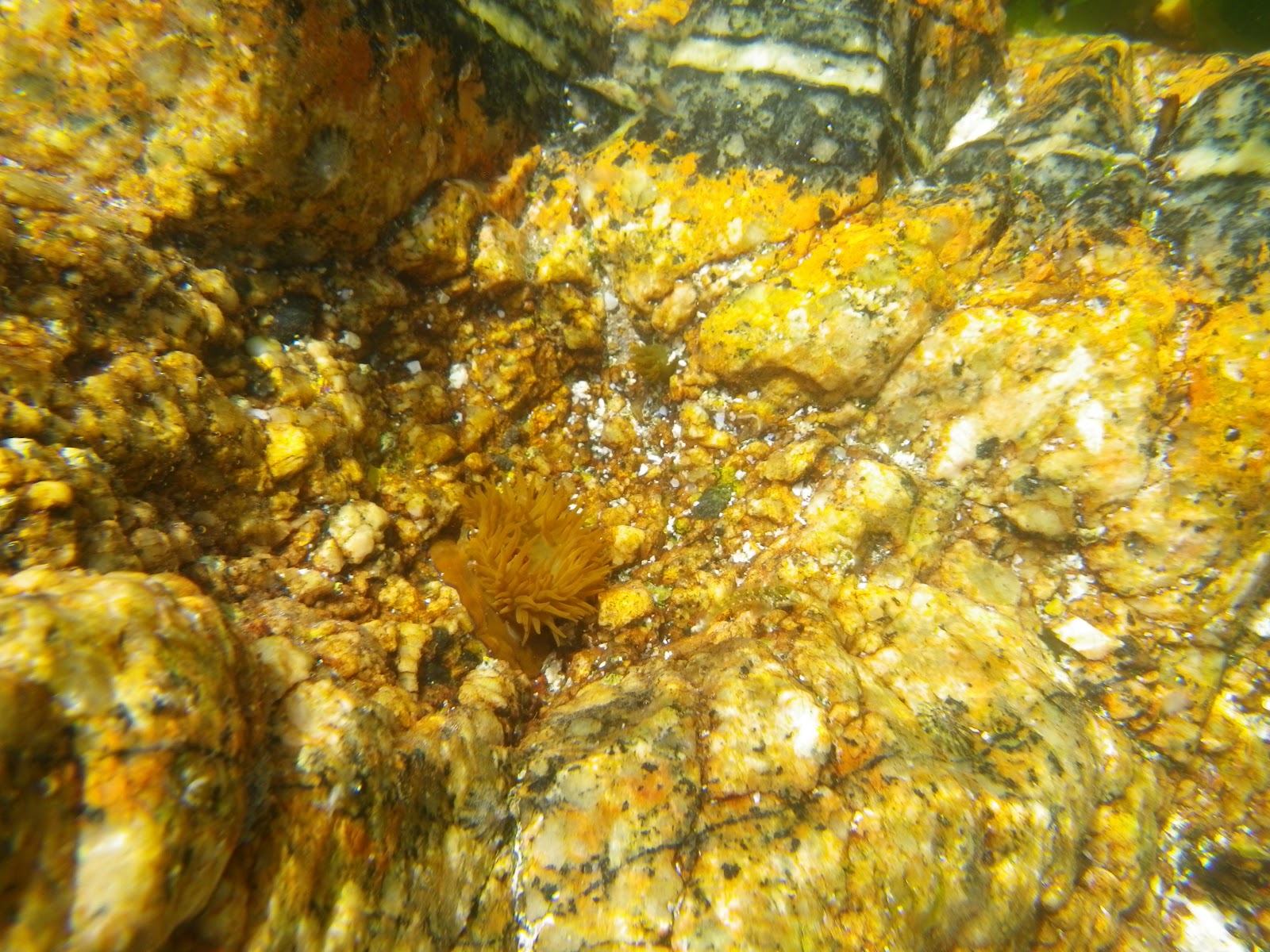
| Limpets (Patella vulgata), anemones (Actinia equina) and thick topshells (Osilinus lineatus) occur in crevices and pits of the bed rock. Barnacles are less prolific due to increased predation of settling juveniles by grazing molluscs. Habitat classification: LR.HLR. MusB (Mussel and/or barnacle communities). |
 |
| A damp crevice provides suitable habitat for coral weed (Corallina officinalis), Common mussels (Mytilus edulis), Rough periwinkles (Littorina sp), limpets and barnacles. |
 |
| Dog whelks (Nucella lapillus) predate barnacles and mussels on the shore. |
 |
| Rock pools occur throughout the bedrock of the lower shore, but their altitude makes environmental conditions more like mid shore rock pools. Habitat classification: LR.FLR.Rkp (Rockpools). |
 |
| These small shallow rock pools are dominated by coralline crusts. Habitat classification: LR.FLR.Rkp.Cor (Coralline crust dominated shallow eulittoral rockpools). |
.JPG) |
| Small common mussels (Mytilus edulis) and beadlet anemones (Actinia equina) occur in crevices of larger coralline rock pools. Limpets and gastropods graze the coralline rock pool so that foliose seaweeds are restricted; ephemeral green seaweeds are able to grow by using limpet shells as a refuge from predation. |
 |
| A coralline dominated rock pool. |
 |
| Deeper coralline pools support a wider variety of seaweeds, including ephemeral green seaweeds, foliose reds and an increased abundance of Coral weed (Corallina officinalis),Common mussel (Mytilus edulis) and limpets. |
 |
Lower down the shore the brown seaweed Bifurcaria bifurcata comes to co- dominate the coralline rockpools. A variant of the coralline biotope called LR.FLR.Rkp.Cor.Bif (Bifurcaria bifurcata in shallow eulittoral rockpools).
|
 |
Rock pools on the lower shore Habitat classification. LR.FLR.Rkp (Rockpools).
|
|
A rockpooling trip in July enabled further exploration of the lower shore rock pools.
July 2013
 |
The lower shore rock pools are deeper accommodating more seaweed species Corallinaceae crusts still blankets the rock pools, becoming bleached white when exposed to the air as the water level of the rock pools drop. Habitat classification: LR.FLR.Rkp.Cor.Bif (Bifurcaria bifurcata in shallow eulittoral rockpools).
|
 |
Corallinacea crusts cover the rock surface of the coralline rock pools. Habitat classification: LR.FLR.Rkp.Cor.Bif (Bifurcaria bifurcata in shallow eulittoral rockpools).
|
 |
Bifurcaria bifurcata in a coraline rock pool. Habitat classification: LR.FLR.Rkp.Cor.Bif (Bifurcaria bifurcata in shallow eulittoral rockpools).
|
 |
Corallina officinalis forms dence turfs in the rockpools. Habitat classification: LR.FLR.Rkp.Cor.Bif (Bifurcaria bifurcata in shallow eulittoral rockpools).
|
 |
Corallina officinalis forms dence turfs amongst which emphermal green algae grows. Habitat classification: LR.FLR.Rkp.Cor.Bif (Bifurcaria bifurcata in shallow eulittoral rockpools).
|
 |
Corallina officinalis, emphermal green algae Ulva sp, jap weed (Sargassum muticum) and Bifurcaria bifurcata within a coralline rockpool. Habitat classification: LR.FLR.Rkp.Cor.Bif (Bifurcaria bifurcata in shallow eulittoral rockpools).
|
 |
| Thick top shells (Osilinus lineatus) graze within the rock pools. Habitat classification: LR.FLR.Rkp.Cor.Bif (Bifurcaria bifurcata in shallow eulittoral rockpools). |