Showing posts with label Mastocarpus stellatus. Show all posts

Monday, 13 July 2015

Rockpooling destination: Revisit Land's End peninsular: Scour tolerant and robust fucoid/red seaweed habitats

Steep cliffs surround the bay, the lower craggy edges covered in lichens. The cliff bases and steeper bedrock transition between the lichen and barnacle communities with limpets, periwinkles and whelks. Boulders and bedrock of the mid and lower shore host a similar barnacle community plus a variety of seaweeds, including where sand scour is event, ephemeral seaweeds. Rockpools occur throughout the shore, and a river flows downs from the cliffs.

The bay experiences a dynamic regime, alternating between periods of erosion and deposition. The underlying substrate is boulders and bedrock, however, variable amounts of sand may be deposited on top, sourced from the sand bar situated offshore. The communities encountered reflect the alternation between these regimes.


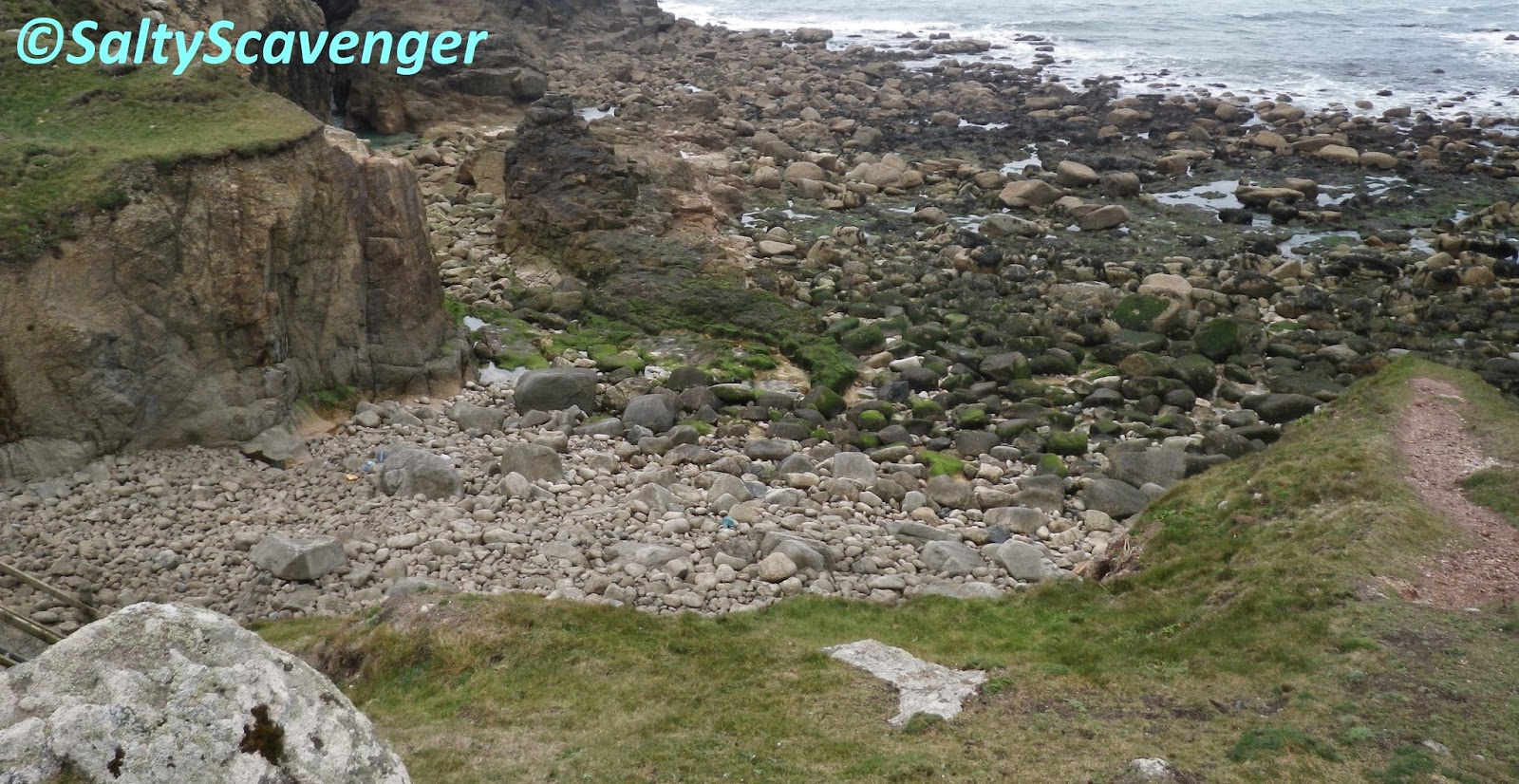
The shore alternates between periods of deposition (sandy)  and erosion (stony).
April 2015


September 2013                    January 2014
The overlaying sand has been eroded to reveal the boulders beneath.
At the time of visitation the cove was comprised of boulders and bedrock with an occasional thin veneer of sand.


Habitat classification:


Substrate
LR (Littoral rock)
Habitat


LR.HLR (High energy littoral rock)
LR.MLR (Moderate energy littoral rock)
LR.FLR (Features of ilttoral rock)
Biotope complex
LR. 


HLR.MusB (Mussels and/or barnacles on high energy littoral rock)
LR.MLR.BF (Barnacles and fucoids on moderately exposed shores)
LR.FLR.Lic.(Lichens on supralittoral and littoral fringe rock).
LR.FLR.Rkp (Rockpools)
LR.FLR.Eph (Ephemeral green or red seaweed communities
LR.FLR.CvoV (Littoral caves and overhangs).
Biotope


LR.MLR.BF.Fser (Fucus serratus on   moderately exposed eulittoral rock)


LR.MLR.BF.Rho (Rhodothamniella floridula on sand scoured lower eulittoral rock)
LR.FLR.Lic.Ver (Verrucaria Maura on littoral fringe rock)
LR.FLR.Rkp.Cor (Coralline crust-dominated shallow eulittoral rockpools)
 LR.FLR.Rckp.SwSed (Seaweeds in sediment- floored eulittoral rockpools).
LR.FLR.Eph (Ephermeral green or red   seaweeds (Fresh water or sand influenced)
LR.FLR.Eph.EntPor (Porphyra purpurea and Entomorpha spp. on sand scoured mid to  lower eulittoral rock)

Sub Biotope


LR.MLR.BF.Fser.R (Fucus serratus and red seaweeds on moderately exposed lower eulittoral rock)


LR.FLR.Rkp.Cor.Cor (Corallina officinalis and coralline crusts in shallow eulittoral rockpools)


Below are images of organisms you may encounter whilst rockpooling among the lower shore habitats:

The influences of subtidal sand scour increases on the lower shore, influencing the species found. Sand scour tolerant  seaweeds flourish, including the red seaweed, sand binder (Rhodothamniella floridula) and the ephemeral green Cladophora spp.

Sand binder (Rhodothamniella floridula) can attain high abundance on the shore. Habitat classification: LR.MLR.BF.Rho (Rhodothamniella floridula on sand scoured lower eulittoral rock)
Among the sandbinder covered rock are rockpools filled with sand . These sediment filled rockpools support a variety of  red and ephemeral green seaweeds  including, Corallina officinalis, Ahnfeltia plicata and Lomentaria articulata.  LR.FLR.Rkp.SwSed (Seaweeds in sediment-floored eulittoral rockpools) EUNIS:A1.413.


Rhodophtya within a sand filled rockpool of the lower shore.

Rhodophtya within a sand filled rockpool of the lower shore.


Rhodophtya (Polyides rotundus) within a sand filled rockpool of the lower shore.

Ulva spp
A sea hare (Aplysiomorphaand anemone within a sand filled rockpool of the lower shore.

The green seaweed, Bryopsis spp

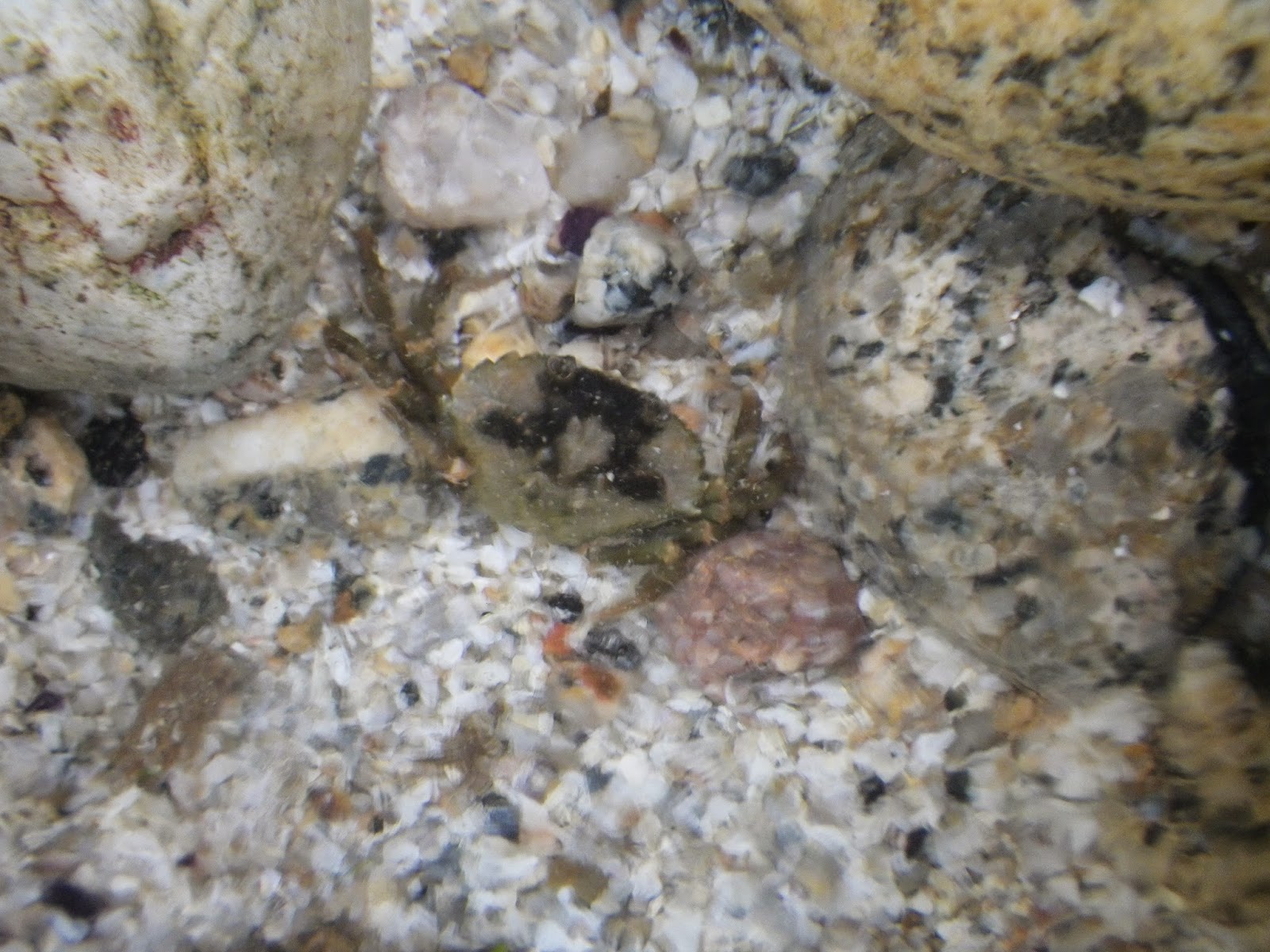
A juvenile crab


Anemonia viridis

The ephemeral green seaweed, Cladophora rupestris.


Seaweed abundance within the sediment filled rockpools, especially that of ephemeral greens is not as extensive as observed in October, 2014. (See blog post  http://thesaltyscavenger.blogspot.co.uk/2015/03/rockpooling-destination-revisit-of.html )


Where sand scour is reduced  serrated wrack and red seaweeds increase in abundance to form patches among the sand binder. Habitat classification: LR.MLR.BF.Fser.R (Fucus serratus and red seaweeds on moderately exposed lower eulittoral rock) and LR.MLR.BF.Rho (Rhodothamniella floridula on sand scoured lower eulittoral rock.
 The seaweeds of  LR.MLR.BF.Fser.R (Fucus serratus and red seaweeds on moderately exposed lower eulittoral rock)  include Lomentaria articulata, Mastocarpus stellatus, Fucus serratus, Chondrus crispus, Rhodothamniella floridula and Osmundea Spp.

Grey topshell (Gibbula cineraria)
Eventually Fucus cover gives way to robust reds and Himanthalia elongata. Habitat classification: LR.HLR.FR (Robust fucoids and/or red seaweed communities) EUNIS: A1.12.


Corallina officinalis forms a turf on the bedrock with robust reds, Himanthalia elongata and Laminaria spp.

Corallina officinalis forms a turf on the bedrock.
Mastrocarpus stellatus,  Rhodothamniella floridula, Laminaria spp and Himnathlia elongata.


Osmundea spp, Corallina spp  and Himnathlia elongata.


Rhodophyta


Rhodophyta


Bifurcaria bifurcata
Chondracanthus acicularis
A turf of robust reds, dominated by Mastrocarpus stellatus,  Laminaria spp and Himnathlia elongata.


Himnathlia elongata.


Edible crab (Cancer pagurus)


Sea caves on the shore provide shade allowing species who are more sensitive to sunlight  to extend their occurrence beyond that of the rockpools. Habitat classification: LR.FLR.CvoV (Littoral caves and overhangs) EUNIS: A1.44.
Corallinaceae crusts occur within and extend beyond the rockpools of the cave entrance due to the shade provided by the overhanging cliff.


Cladophora spp and Coralinaceae crusts live in the shaded entrance of the sea cave.


Corallinaceae crusts occur within a rockpool of the cave cliff edge.

Wednesday, 25 March 2015

Rockpooling Destination: Revisit of Land's End Peninsular, October 2014


The bay experiences a dynamic regime, alternating between periods of erosion and deposition. The underlying substrate is boulders and bedrock, however, variable amounts of sand may be deposited on top, sourced from the sand bar situated offshore. The communities encountered reflect the alternation between these regimes.


September, 2013
 The shore alternates between periods of deposition, sandy  and erosion, stony.
October, 2014

At the time of visitation the cove was comprised of boulders and bedrock with an occasional thin veneer of sand.


Steep cliffs surround the bay, the lower craggy edges covered in lichens. The cliff bases and steeper bedrock transition between the lichen and barnacle communities with limpets, periwinkles and whelks. Boulders and bedrock of the mid and lower shore host a similar barnacle community plus a variety of seaweeds, including where sand scour is event, ephemeral seaweeds. Rockpools occur throughout the shore, and a river flows downs from the cliffs.


Habitat classification:


Substrate
LR (Littoral rock)
Habitat


LR.HLR (High energy littoral rock)
LR.MLR (Moderate energy littoral rock)
LR.FLR (Features of ilttoral rock)
Biotope complex
LR. 


HLR.MusB (Mussels and/or barnacles on high energy littoral rock)
LR.MLR.BF (Barnacles and fucoids on moderately exposed shores)
LR.FLR.Lic.(Lichens on supralittoral and littoral fringe rock).
LR.FLR.Rkp (Rockpools)
LR.FLR.Eph (Ephemeral green or red seaweed communities
LR.FLR.CvoV (Littoral caves and overhangs).
Biotope


LR.MLR.BF.Fser (Fucus serratus on moderately exposed eulittoral rock)


LR.MLR.BF.Rho (Rhodothamniella floridula on sand scoured lower eulittoral rock)
LR.FLR.Lic.Ver (Verrucaria Maura on littoral fringe rock)
LR.FLR.Rkp.Cor (Coralline crust-dominated shallow eulittoral rockpools)
 LR.FLR.Rckp.SwSed (Seaweeds in sediment- floored eulittoral rockpools).
LR.FLR.Eph (Ephermeral green or red seaweeds (Fresh water or sand influenced)
LR.FLR.Eph.EntPor (Porphyra purpurea and Entomorpha spp. on sand scoured mid to  lower eulittoral rock)

Sub Biotope


LR.MLR.BF.Fser.R (Fucus serratus and red seaweeds on moderately exposed lower eulittoral rock)


LR.FLR.Rkp.Cor.Cor (Corallina officinalis and coralline crusts in shallow eulittoral rockpools)


Below are images of organisms you may encounter whilst rockpooling within these habitats:


Since April, 2014 the cove has comprised bedrock, boulders and cobbles. 


The littoral fringe bedrock supports a community of  tar lichen  (Verrucaria maura), periwinkles and occasional limpets and barnacles. Habitat classification: LR.FLR.Lic.Ver (Verrucaria maura on littoral fringe rock) EUNIS: B3.113.
Bedrock and boulders that a year ago were covered by sand are now slowly being colonized by fauna, many of whom appear to have moved down the rock from the Verrucaria maura and ephemeral green seaweed communities. Small periwinkles (Melarhaphe neritoides), Rough periwinkles (Littorina sp) and limpets occur on the gully sides, whilst rockpools and boulders are becoming colonised by ephemeral greens.
Periwinkles occur on the shore and are one of the most prominent mobile fauna of the littoral fringe and upper shore.
Small periwinkles (Melarhaphe neritoides).


Rough periwinkles (Littorina sp).
Rough periwinkle (Littorina compressa).
Rough periwinkle (Littorina sp).
Rough periwinkle (Littorina compressa nigrolineata).

Rough periwinkles (Littorina saxatilis agg and Littorina compressa nigrolineata).


Rough periwinkles (Littorina saxatilis agg and Littorina compressa nigrolineata).


Previously high levels of sand scour have limited species colonisation of the bedrock. Barnacles are scarce and organisms such as limpets (Patella valgata) and periwinkles are confined to crevices and leeward enclaves that offer protection from the waves and sand scour. Fucoids grow in occasional clumps, which are currently exhibiting seasonal die back. 


The cliff bases enable organisms to move up and down in response to the sediment regime and sand scour, as a result they support more stable barnacle communities with limpets, periwinkles, mussels and whelks. In the case of limpets the spray from the waves of this high energy shore, enable them to live far up the cliff base.Habitat classification: LR.HLR.MusB (Mussels and/or barnacles on high energy littoral rock) EUNIS: A1.11. 


Barnacles, Limpets (Patella Sp) and small periwinkles (Melarhaphe neritoides) cover the bases of the cliffs.


Small periwinkles (Melarhaphe neritoides) and barnacles.


Barnacles density is lower on the readily covered substrate of the lower cliff bases.

Common blue mussels (Mytilus edulis) cluster together in a leeward crevice of the cliff base.

M. edulis  and Limpets (Patella sp) aggregate in a leeward crevice of the cliff base.

M. edulis and a dog whelk (Nucella lapillus) within a crevice. 


Limpets (Patella sp), barnacles and N. lapillus.

N. lapillus
Beadlet anemones (Actina equina)  and Limpets (Patella sp) within a crevice.


The cliff bases hold a number of small coralline rockpools that support corallinaceae crusts, limpets and red seaweeds. Habitat classification: LR.FLR.Rkp.Cor (Coralline crust-dominated shallow eulittoral rockpools) EUNIS: A1.411
A coralline rockpool with limpets, corallinaceae crusts and ephemeral green seaweeds.
A deeper coralline rockpool further down the shore, with red seaweeds, including Corallinaceae crusts, Corallina officinalis and bootlace weed (Himanthalia elongata).


C. officinalis within a coralline rockpool.


A china limpet (Patella ulyssiponensis) which favours coralline rockpools.
Rhodophyta within a coralline rockpool.


Corallinaceae crusts are beginning to grow within the newly available rockpools.


A blenny  (Lipophrys pholiswithin a rockpool. Habitat classification: LR.FLR.Rkp (Rockpools) EUNIS: A1.41.


The distribution of fauna in the mid and lower shore is influenced by wave exposure, subtidal sand scour, fresh water runoff and desiccation. The result is a patchwork of biotopes that are not distributed evenly down the shore. Here the mid shore boulders are covered in ephemeral greens and the lower shore boulders are colonised by a patchwork of barnacles and fucoids. Habitat classification: LR.MLR. BF (Barnacles and fucoids on moderately exposed shores) and LR.FLR.Eph (Ephermeral green or red seaweeds (Fresh water or sand influenced).
This image of the shore taken in September, 2013 shows that there has since been extensive sand erosion, increasing the available hard substrate and abundance of ephemeral greens.  http://thesaltyscavenger.blogspot.co.uk/2014/02/rockpooling-destination-lands-end.html

By October, many of the perennial seaweeds are exhibiting seasonal dieback.


 The longer lived seaweeds of this shore have to endure periodic sand cover and scour.


The same general area in September, 2013 shows the seaweed covered by sand.
Blog post http://www.thesaltyscavenger.blogspot.co.uk/2014/02/rockpooling-destination-lands-end.html.
Thick topshell (Osilinus lineatus)


O. lineatus.


Ephemeral green algae (Entomorpha/Ulva sp) cover the relatively newly available boulders.Habitat classification: LR.FLR.Eph (Ephemeral green or red seaweed communities) EUNIS: A1.45.


The cliff bases  and boulders of the mid and lower shore that experience sand scour are also covered in Ephemeral green algae.  Habitat classification: LR.FLR.Eph.EntPor (Porphyra urpurea or Entomorpha spp. on sand scoured mid to  lower eulittoral rock). EUNIS A1.452


Ephemeral green algae and Porphyra sp cover mid and lower shore sand scoured boulders.

 In areas of the lower shore that experience sand scour the scour tolerant, sand binder (Rhodothamniella floridula) occurs. Habitat classification: LR.MLR.BF.Rho (Rhodothamniella floridula on sand scoured lower eulittoral rock)

The scour tolerant, R. floridula and ephemeral green algae (Entomorpha sp).


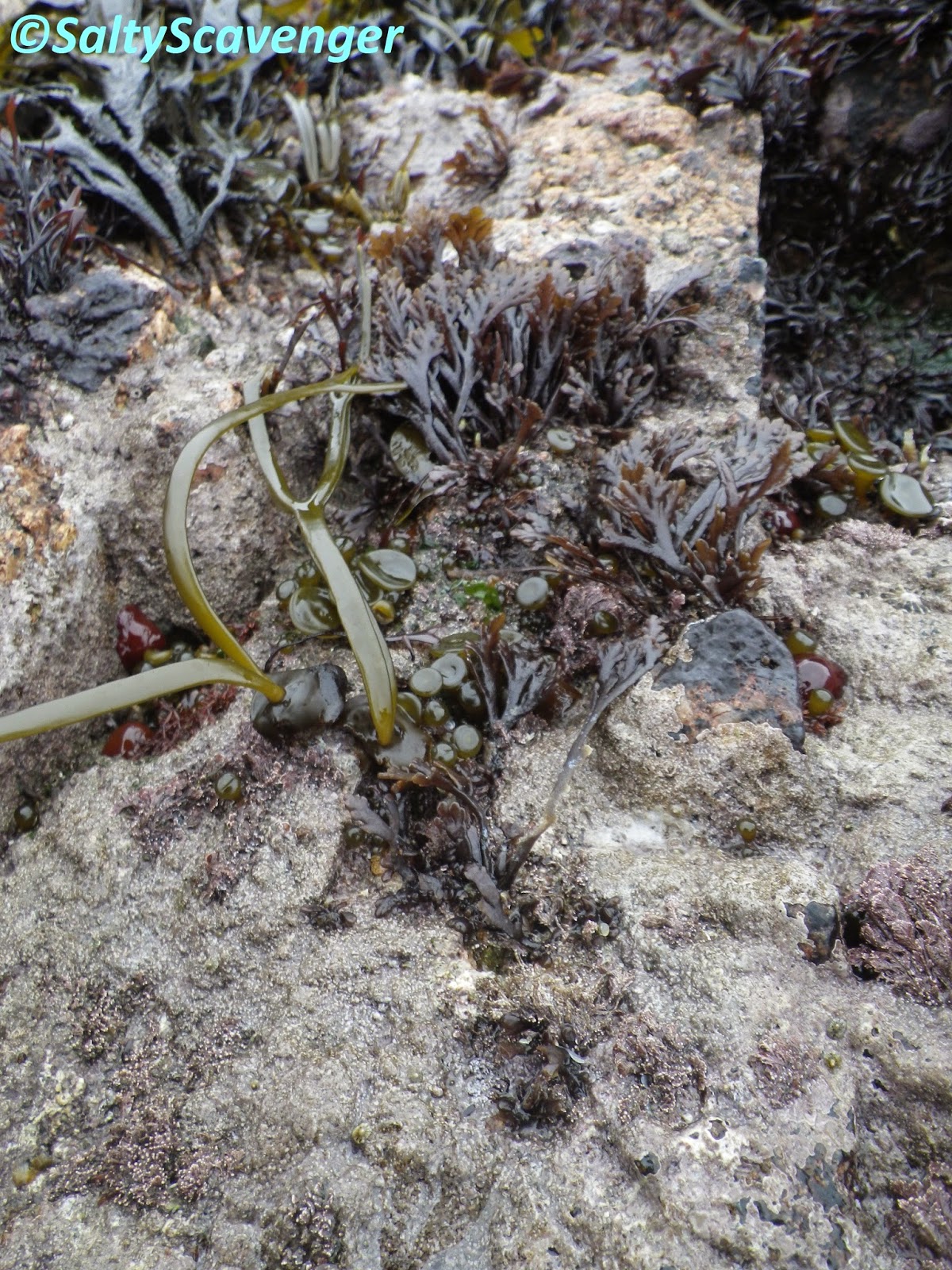
Mastocarpus stellatus, F. serratusR. floridula and the ephemeral green seaweed, Cladophora rupestris.


Where sand scour is reduced, barnacles, dog whelks (N. lapillus) and limpets cover the larger, more exposed boulders, whilst fucoid and red seaweeds colonise rock and boulders below. Habitat classification: LR.MLR.BF.Fser.R (Fucus serratus and red seaweeds on moderately exposed lower eulittoral rock).

M. stellatus forms a mosaic distribution with F. serratus. which is characteristic of the biotope LR.MLR.BF.Fser.R (Fucus serratus and red seaweeds on moderately exposed lower eulittoral rock).

F. serratusM. stellatus and C. rupestris with F. serratus showing seasonal die back.
The ephemeral green seaweed, Cladophora rupestris


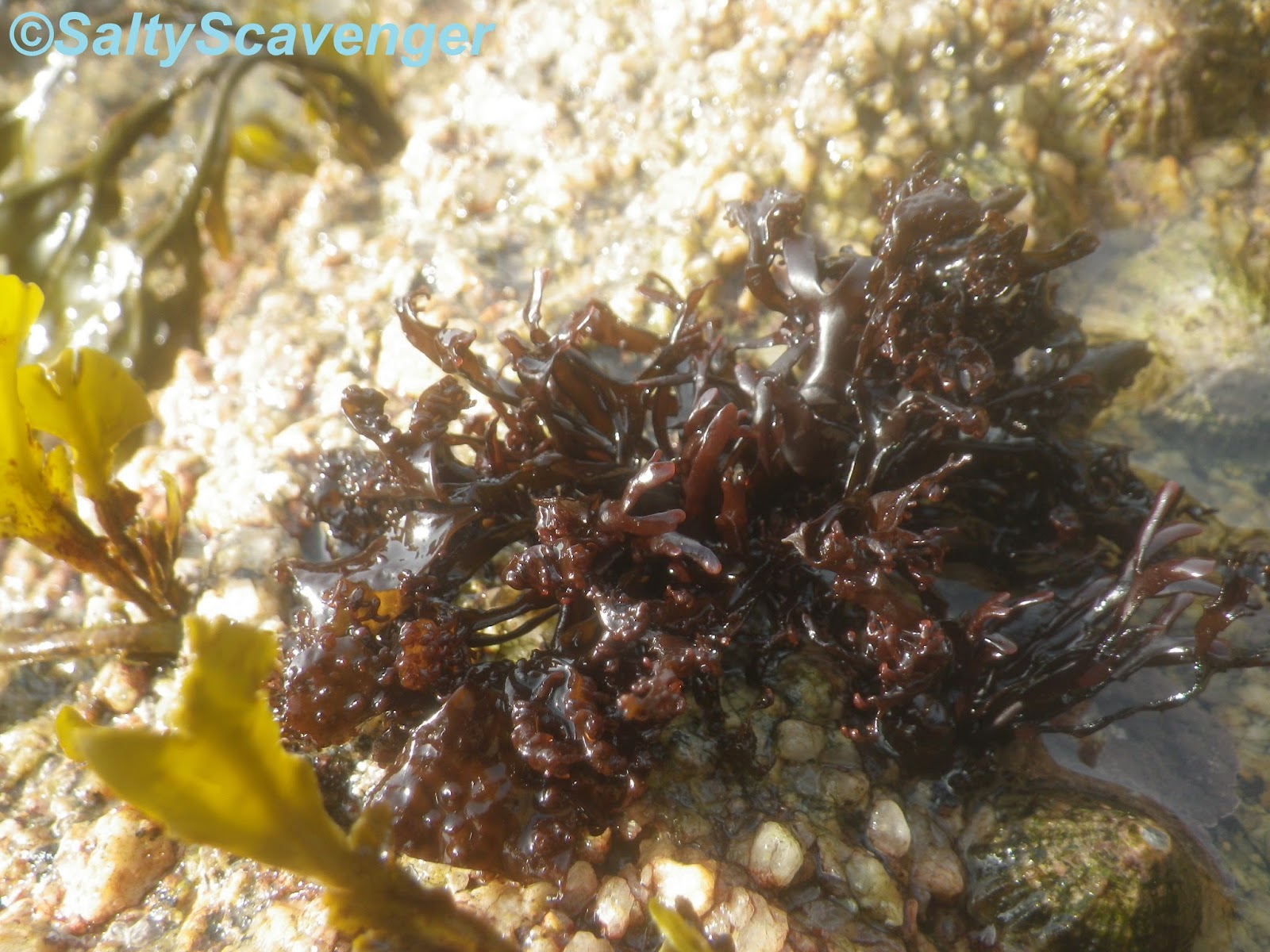
Mastocarpus stellatus
M. stellatus


M. stellatus and the brown forking weed ( Bifurcaria bifurcata).

Blue raid limpet (Helcion pellucidum).

A polychaete on the lower shore.


Between the boulders of the lower shore are sediment filled rockpools which support a variety of seaweeds species including,  F. serratus and  red seaweeds including, C. officinalis, R. floridula and ephemeral greens.  LR.FLR.Rkp.SwSed (Seaweeds in sediment-floored eulittoral rockpools) EUNIS:A1.413.

Sand binder (Rhodothamniella floridula)
Rhodophtya
Possible black scour weed (Ahnfeltia plicata).
Rhodophyta

Coral weed (Corallina sp)


Combweed (Plocamium cartilagineum)


Lomentaria articulata


A hydrozoa

Gibbula umbilicus

A chiton
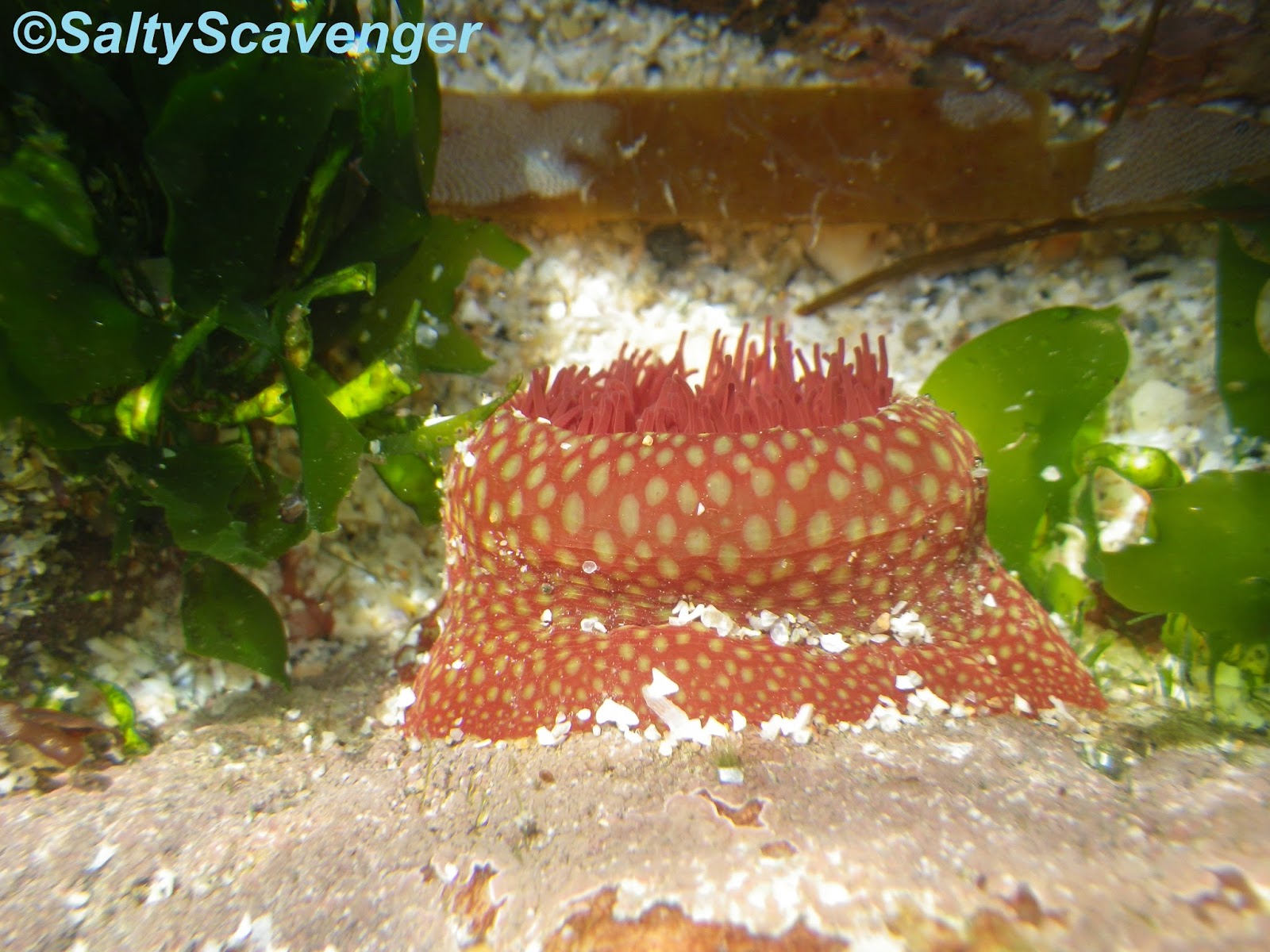
                                    A strawberry anemone (Actina fragacea).


 A. fragacea


Sea caves on the shore provide shade allowing species who are more sensitive to sunlight  to extend their occurrence beyond that of the rockpools. Habitat classification: LR.FLR.CvoV (Littoral caves and overhangs) EUNIS: A1.44.
M. stellatus, A.equina and coralinaceae crusts live in the shaded entrance of the sea cave.

Corallinaceae crusts occur within and extend beyond the rockpools of the cave entrance due to the shade provided by the overhanging cliff.


A raven looks among the shore......