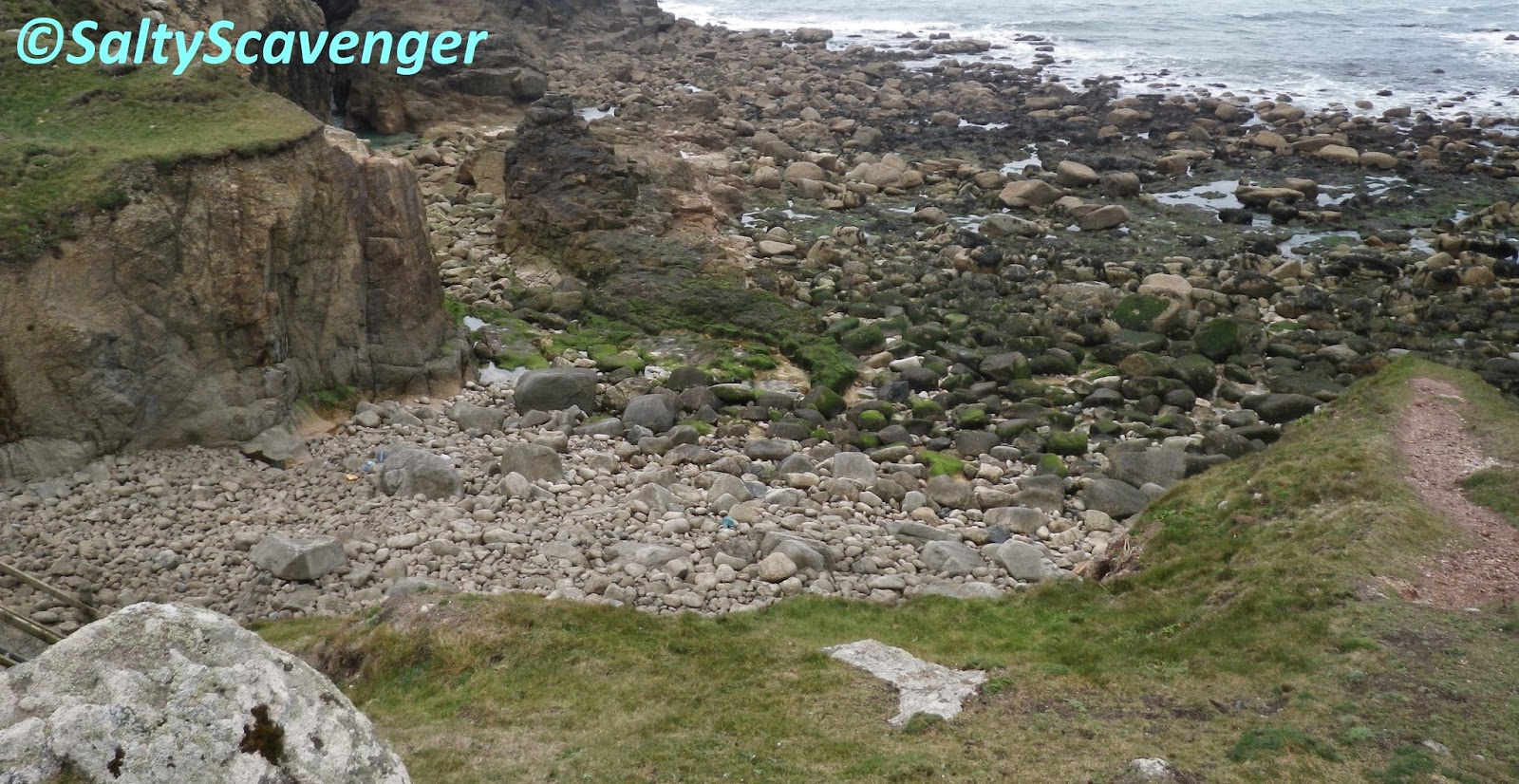
The shore is a high energy environment, comprised of boulders and bedrock, with crevices, rock pools and gullies.
Fauna are relatively sparse among the supralittoral and little fringe boulders, increasing on stable bedrock of the upper shore and within the rockpools, crevices and gullies of the mid and lower shore.
The supralittoral and littoral fringe rock is charecterised by lichen communities, whilst barnacle communities occur across the rest of the shore, inter-dispersed by rockpools. As the lower shore is reached, robust wracks and red seaweeds come to dominate.
A river flows onto the shore and beneath the boulders.
Where conditions are sheltered enough, a seasonal strandline forms.
Habitat classification:
|
Habitat
|
LR.HLR (High energy littoral rock)
|
FLR (Features of littoral rock)
|
|||||
|
Biotope complex
|
LR.HLR. MusB (Mussel and/or barnacle
communities)
|
LR.HLR.FR (Robust fucoid and/or red
seaweed communities)
|
LR.FLR.Lic.(Lichens on supralittoral
and littoral fringe rock).
|
LR.FLR.Rkp (Rockpools)
|
|||
|
Biotope
|
LR.HLR.MusB.Cht (Chthamalus spp.
on exposed eulittoral rock)
|
LR.HLR.FR.Him (Himanthalia
elongata) and red seaweeds on exposed to moderately exposed lower
eulittoral rock
|
LR.FLR.Lic.YG (Yellow and grey
lichens on supralittoral rock)
|
LR.FLR.Lic.Ver (Verrucaria Maura
on littoral fringe rock)
|
LR.FLR.Rkp.Cor (Coralline crust
dominated shallow eulittoral rockpools)
|
LR.FLR.Rkp.FK (Fucoids and kelp in deep eulittoral rockpools)
|
|
|
Sub Biotope
|
LR.HLR.MusB.Cht.Cht (Chthamalus spp. on exposed upper
eulittoral rock)
|
|
|
LR.FLR.Liv.VerB (Verrucaria maura and sparse barnacles on
exposed littoral fringe rock)
|
LR.FLR.Rkp.Cor.Cor Coralline crusts
and Corallina officinalis in shallow eulittoral rockpools
|
LR.FLR.Rkp.Cor.Bif (Bifurcaria bifurcata in shallow
eulittoral rockpools)
|
|
Below are images of the habitats and organisms you may encounter on this shore:
 |
The
exposed nature of the shore leads to an extended lichen zone; within this zone
the boulder field is comparatively barren, characterised by
lichen communities and periwinkles. At the lower extent of the splash zone
barnacles occur at low density. Habitat classification: Biotope complex:
LR.FLR.Lic.(Lichens on supralittoral and littoral fringe rock) ENUIS: B3.11
containing the biotopes: LR.FLR.Lic.YG (Yellow and grey lichens on
supralittoral rock) EUNIS: B3:111 and LR.FLR.Lic.Ver (Verrucaria maura on
littoral fringe rock) EUNIS: B3:113 the latter also contains the sub
biotope: LR.FLR.Liv.VerB (Verrucaria maura and sparse barnacles on
exposed littoral fringe rock) EUNIS: B3:1131.
|
 |
| Upper shore boulders support barnacles and a range of gastropods including limpets (Patella spp), thick topshells (Osilinus lineatus) and periwinkles (Littorina spp). The seaweeds Fucus sp and Catenella caespitosa and the lichen Verrucaria mucosa occur as patches on the boulders. Habitat classification: Biotope complex LR.HLR.MusB (Mussel and/or barnacle communities) EUNIS: A1.11. |
 |
The
upper shore bedrock is covered in dense barnacles (predominantly Cthamalus spp) interspersed by
limpets (Patella vulgata) and patches of Lichina pygmaea. Habitat
classification: LR.HLR.MusB.Cht.Cht (Chthamalus spp. on exposed upper
eulittoral rock) EUNIS: A1:1121.
|
 |
Within
the barnacle communities tufts of fucoids are able to grow where there is
sufficient shelter from wave exposure. Seaweed species also thrive within the
rockpools that punctuate the shore. Small shallow coralline rockpools are
covered by pink corallinaceae crusts which are in turn overgrown by ephemeral
greens (Ulva spp) and a variety
of reds including, coral weed (Corallina
officinalis). China limpets (Patella
ulyssiponensis) and juvenile blenny (Lipophrys
pholis) also occur within the rockpools. Habitat classification:
LR.FLR.Rkp.Cor.Cor (Coralline crusts and Corallina officinalis in shallow eulittoral
rockpools) EUNIS: A1.4111.
|
 |
| Deeper coralline rockpools support a higher abundance and diversity of seaweeds. Including ephemeral greens (Ulva spp and Cladophora spp), a variety of reds including, Corallinaceae crusts, Corallina sp, Mesophyllum lichenoides and the invasive brown seaweed, Sargassum muticum. S. muticum can have detrimental effects on coralline rockpools because it grows and blocks out the light, changing the environmental conditions from that which the indigenous seaweed species are adapted. Habitat classification: Habitat classification: LR.FLR.Rkp.Cor (Coralline crust dominated shallow eulittoral rockpools) EUNIS: A1.411. |
 |
On the mid and lower shore other seaweed species are also prolific within the coralline rockpools, including (from top right to the left) ephemeral green seaweeds such as Ulva spp and Cladophora spp, the brown forking weed (Bifurcaria bifurcata) and on the lower shore brown wracks and kelp. A range of smaller epiphyte seaweed species also occur. Habitat classification: LR.FLR.Rkp.Cor (Coralline crust dominated shallow eulittoral rockpools) EUNIS: A1.411, LR.FLR.Rkp.Cor.Bif (Bifurcaria bifurcata in shallow eulittoral rockpools) EUNIS: A1.4113 and LR.FLR.Rkp.FK (Fucoids and kelp in deep eulittoral rockpools) EUNIS: A1.412.
|
 |
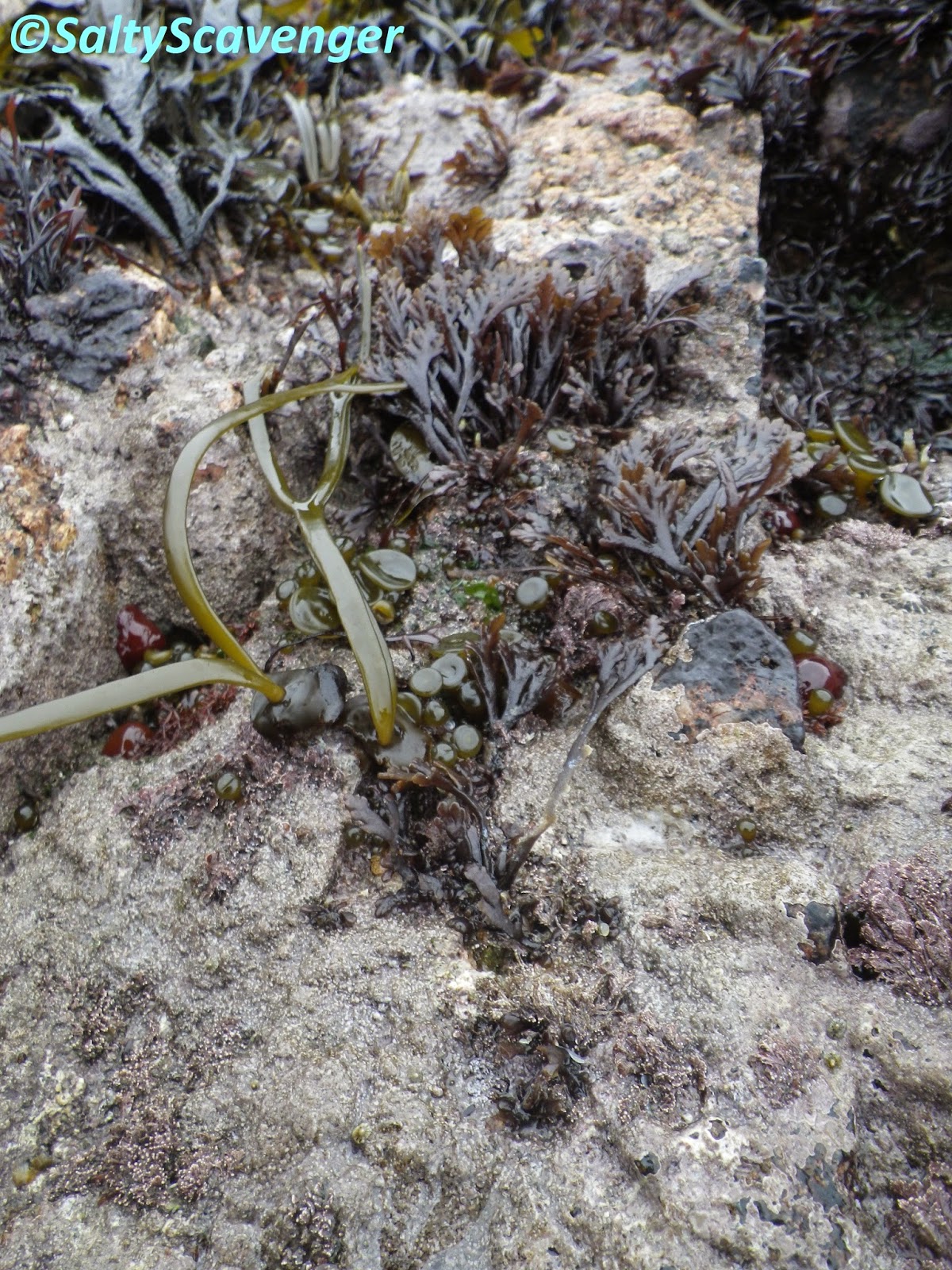
On
the lower shore the seaweeds are no longer confined to the
rockpools. Thong weed (Himanthalia
elongata) and kelp cover the under-storey reds. The remaining bare rock is
covered by barnacles and limpets. Habitat classification: LR.HLR.FR.Him (Himanthalia elongata) and red seaweeds
on exposed to moderately exposed lower eulittoral rock EUNIS: A1.123.
|
 |
Other seaweed
species present include a variety of robust fucoids and reds. (Anticlockwise
from top right) Fucus serratus; kelp (Laminaria sp); Mastrocarpus
stellatus and Codium spp; Cladophora rupestris, reds and Corallinaceae crusts;
and Corallina officinalis. Limpets, grey topshells (Gibbula cineraria)
and a variety of faunal turfs also occur. Habitat classification: Biotope
complex, LR.HLR.FR (Robust fucoid and/or red seaweed communities) EUNIS:
A1.12).
|
 |
Anticlockwise from top right, Gelidium spp and Osmundea spp, Codium spp; Gelidium spp; and Corallina spp.
|
 |
Palmaria palmata and ephemeral green
seaweed (Ulva spp formally Entermorpha spp).
|
 |
Where
conditions allow within the broader biotope complex of robust fucoid and red
seaweed habitat, the robust reds may form turfs. On the lower shore these turfs
are restricted to patches on boulder edges. The turf comprises Corallinaceae
crust, upon which Mastrocarpus
stellatus, Chondus crispus and Corallina officinalis grow,
above Lomentaria
articulata, Gelidium sp and Osmundea sp
occur. That rock not covered by Corallinaceae crust supports barnacles,
limpets and topshells. Habitat classification: Biotope
complex, LR.HLR.FR (Robust fucoid and/or red seaweed communities) EUNIS:
A1.12).
|
 | ||||
At
the low tide mark the red seaweed turfs extend across the rock. Young Himanthalia elongata grow among a turfs of red seaweeds
that comprise, Corallinaceae crusts, Corallina officinalis, Mastrocarpus
stellatus, Chondrus crispus, Osmundea sp, Gelidium sp and Lomentaria articulata.
|


A revisit to an overhang found little change since October 2014, except it was not clear to discern the presence or absence of the fried egg anemones (Actinothoe sphyrodeta).
 |
The same overhang in October 2014. Such overhangs provide shade, enabling subtidal species such as, fried egg anemones (Actinothoe sphyrodeta) to occur within the rockpool and enables Coralline crusts, Serpulid polychaetes and breadcrumb sponge (Halichondria panicea)to extend up the shaded boulder sides; Grey topshells (Gibbula cineraria) also occur.
|