Showing posts with label rockpooling blog. Show all posts

Wednesday, 9 November 2016

Rockpooling destination: Revisit West Penwith, June 2016


The rocky shore is comprised of boulders and bedrock with rockpools, crevices and gullies. Habitat classification: LR.HLR (High energy littoral rock) EUNIS: A1.1 , LR.FLR.Rkp (Rockpools) EUNIS:A1.41 and LR.FLR.Lic.(Lichens on supralittoral and littoral fringe rock) EUNIS: B3.11


The rocky shore is a high energy environment comprised of boulders and bedrock with rock pools, crevices and gullies.


The high energy environment of the shore leads to an extended lichen zone, that descends over much of the boulder field, which apart from Littorinids is relatively barren. Patches of lichens extend further down into the barnacle communities, which dominate from the upper to lower shore, inter-dispersed by shallow coralline rockpools in the mid shore, and deeper cobble filled rockpools on the lower shore. As the low tide mark is reached wave tolerant seaweeds lace the gullies.


Habitat classification:


Substrate
LR (Littoral rock)
Habitat
LR.HLR (High energy littoral rock)
LR.FLR (Features of littoral rock)
Biotope complex
LR.HLR. MusB (Mussel and/or barnacle communities)
LR.HLR.FR (Robust fucoid and/or red seaweed communities)
    LR.FLR.Lic.(Lichens on supralittoral and littoral fringe rock).
LR.FLR.Rkp (Rockpools)
Biotope
LR.HLR.MusB.Cht (Chthamalus sp on exposed upper eulittoral rock)
LR.HLR.MusB.Sem (Semibalanus balanoides on exposed to moderately exposed or vertical sheltered eulittoral rock)

LR.FLR.Lic.Ver (Verrucaria Maura on  littoral fringe rock)
LR.FLR.Lic.YG (Yellow and grey lichens on supralittoral rock)
LR.FLR.Rkp.Cor (Coralline crust dominated shallow eulittoral rockpools)
Below are images of the organisms you may encounter in these habitats:


Among the mobile boulders and bedrock of the littoral fringe are populations of rough and small periwinkles with occasional limpets on the lower littoral. In this high energy environment organisms are confined to crevices and nooks, where they are buffeted from the full force of the waves and potential dislodgement. Habitat classification:  LR.FLR.Lic.(Lichens on supralittoral and littoral fringe rock) EUNIS: B3.11


During winter storms slabs of granite were broken away from the bedrock. Now in June this rock has not yet been colonised. 

The same area of bedrock in March 2016.

The exposed uppershore bedrock is covered in dense barnacles, with crevices jammed by mussels, anemones and coralline seaweeds. Small periwinkles occur among the barnacles, seeking shelter within the dead barnacle tests. The black lichen Lichina pygmaea forms tufts on the upper rock. All these organisms are characteristic of the biotope: LR.HLR.MUSb.CHT (Chthamalus sp on exposed upper eulittoral rock) EUNIS: A1.112. Darted among this habitat are small coralline rockpools. Habitat classification: LR.FLR.Rkp.Cor (Coralline crust dominated shallow eulittoral rockpools) EUNIS:A1.411.
Lichina pygmaea forms tufts of varying density

During the summer months rockpools experience prolific growth of ephemeral green seaweeds.
 The distribution of the ephemeral green seaweeds can be patchy.


In many cases the ephemeral green seaweeds dominate the coralline rockpools.

Ephemeral green seaweeds come to dominate many of the shallow rockpools during the summer months.

The coralline rockpools of the mid and lower eulittoral support a greater diversity of seaweeds than the upper, including Bifurcaria bifurcata, Corallina officinalis, coralinaceae crusts and ephemeral green seaweeds, along with beadlet anemones, china limpets, flat topshells and thick topshells. Habitat classification: LR.FLR.Rkp.Cor.Bif (Bifurcaria bifurcata in shallow eulittoral rockpools) Eunis A1.4113

Bifurcaria bifurcata in a shallow coralline eulittoral rockpool

Compared to March there are a greater diversity of  ephemeral and seasonal seaweeds, including Scytosiphon lomentaria.

On the sections of moderately exposed lower shore the diversity of seaweeds on the exposed bedrock also increases.
In these areas the abundance of barnacles is lower and the abundance of topshells, anemones, limpets, fucoids and red seaweeds increase. Habitat classification: LR.MUSb.Sem (Semibalanus balanoides on exposed to moderately exposed or vertical sheltered eulittoral rock) EUNIS: A1.113.


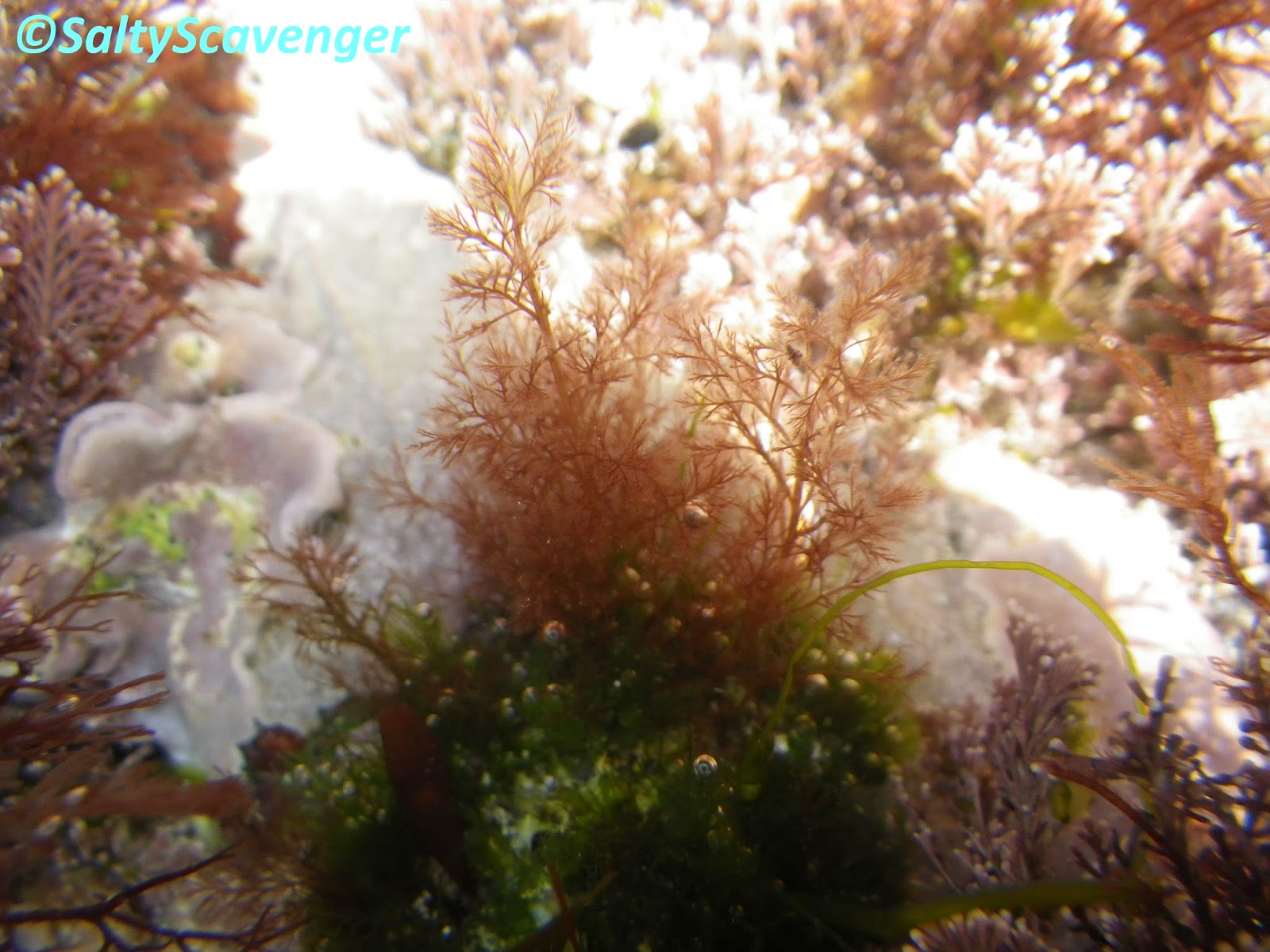
Red seaweed 'turfs' form between damp crevices and beneath overhangs.


The highest diversity of life is still found within the rockpools and on the lower shore were there is an explosion of seaweeds!


As the subtidal pools are reached the abundance of red seaweeds and kelp increase.


Sunday, 13 September 2015

Revisit: Land's End Peninsular September 2015

The bay experiences a dynamic regime, alternating between periods of erosion (stony) and deposition (sandy).The underlying substrate is boulders and bedrock, however, variable amounts of sand may be deposited on top, sourced from the sand bar situated offshore. The communities encountered reflect the alternation between these regimes.


Please see previous blog posts:
http://www.thesaltyscavenger.blogspot.co.uk/2015/08/rockpooling-destination-revisit.html
http://thesaltyscavenger.blogspot.nl/2015/07/rockpooling-destination-revisit-lands.html
http://thesaltyscavenger.blogspot.nl/2014/05/revisit-lands-end-peninsular-april-2014.html
http://thesaltyscavenger.blogspot.nl/2014/02/rockpooling-destination-lands-end.html

On my most recent visit in September, 2015 the shore was starting to show the signs of Autumn with winnowing of finer sediments from the upper shore and an increased strandine reaching across the entire cobble and boulder beach. Some seaweeds also showed signs of seasonal die back.


The rocky shore during the current visit in September, 2015 shows little variation from June, 2015 except in the upper shore, where there has been erosion and winnowing of finer sediments and the formation on a strandline across the entire cobble and boulder beach.


The rocky shore in June 2015, does not support a strandline across the entire cobble and boulder beach.
The strandline that filled the cave in June, 2015 is no longer visible, only a wedge of seaweed behind the boulder can be seen. However, the height of the sand in relation to the boulder suggests that there has been increased deposition of sand within the cave since June and it may be that this sand has covered the strandline that was present or, the seaweed has now been washed up to form the strandline across the cobble and boulder beach?


The strandline present within the cave in June 2015. 


Again the strandline present on this section of the shore in June, 2015 has now gone and the finer sediments present in June and April, 2015 have been winnowed from between the cobbles and boulders.
Seaweed in June, 2015 had been washed up among the boulders of this part of the shore. 


This photograph taken in April 2015, shows the finer material that once occurred on this part of the shore and has now been winnowed away.


Fucoids begin to show seasonal die back. The lost fronds contribute to the strand line.

Friday, 14 August 2015

Rockpooling Destination: Ardnamurchan, Scotland, May 2015


Several inlets comprised of multiple craggy outcrops and swathes of white sand occur along the Ardnamurchan Peninsula. On  such shores the terrestrial habitat abruptly transitions into sand and brackish pools. Further down the shore outcrops of bedrock emerge from the sand, providing a hard substrate for a variety of organisms to grow upon.


The terrestrial habitat abruptly transitions into sand and brackish pools. Habitat classification:LS. LSA (Littoral sand) EUNIS: A.2.


Outcropping bedrock supports lichen communities, sand scour tolerant ephemeral seaweeds and rockpools . Habitat classification: LR.FLR.Lic.YG (Yellow and grey lichens on supralittoral rock) EUNIS: B3.111, LR.FLR.Lic.Ver (Verrucaria maura on littoral firnge rock) EUNIS: B3.113,LR.FLR.Eph (Ephermeral green or red seaweeds (Fresh water or sand influenced)  EUNIS: A2.821, LR.FLR.Rkp (Rockpools) EUNIS: A1.41 and LS. LSA (Littoral sand) EUNIS: A.2.

The sediment floored rockpools support a variety of seaweed species. Habitat classification: LR.FLR.RKP.SwSed (Seaweeds in sediment floored eullitoral rockpools) EUNIS: A1.413.

Seaweeds within a sediment floored rockpool.

Thursday, 6 August 2015

Tadpoles on the shore! Near Kilchoan, Scotland, May 2015


Rockpools located within the transitional zone between the supralittoral and angiosperm dominated terrestrial habitats are often relatively barren of life, but on this occasion the rockpools were filled with tadpoles!


Rockpools located within the transitional zone between the supralittoral and angiosperm dominated terrestrial habitats.


Tadpoles within the rockpool.


Monday, 3 August 2015

Rockpooling Destination: Kilchoan, Scotland, May 2015

The cobble shore at Kilchoan may appear calm, but the shores' sloping angle and step, indicates that it experiences periods of high wave exposure. 


The shore comprises a sloping cobble beach with a stepped profile and strandlines. Fauna are relatively sparse among the cobbles, with increased diversity within the decomposing seaweed of the strandline. Habitat classification: LR.HR (High energy littoral rock) EUNIS: A1.1  LS.Lsa.St (Strandline) EUNIS: A2.21.

The most striking fauna of the cobbles, are the red mites that scurry across the shore.

Friday, 19 June 2015

Rockpooling Destination: Treen Cornwall April 2015

The shore comprises shelving bedrock with gullies and rockpools. Lichens communities dominate large areas of the shore, eventually giving way to barnacle and mussel/fucoid communities. Rockpools occur throughout the shore, varying in species composition depending on their level of exposure to air and wave.

Below are images of the habitats and organisms you  may encounter whilst rockpooling on this shore:


The shore comprises shelving bedrock with gullies and rockpools. Lichens communities dominate large areas of the shore before they give way to barnacle and mussel/fucoid communities. Rockpools occur throughout the shore, varying in species composition depending on their level of exposure to air and wave. Habitat classification: LR.FLR.Lic.YG (Yellow and grey lichens on supralittoral rock) EUNIS B3.111, LR.FLR.Lic.Ver (Verrucaria Maura on littoral fringe rock) EUNIS: B3.113, LR.FLR.Rkp.Cor (Coralline crust dominated shallow eulittoral rockpools)  EUNIS: A1.4111, LR.HLR. MusB (Mussel and/or barnacle communities) EUNIS: A1.11.

Coralline rockpools and lower barnacle/fucoid shore communities:


On the mid to lower shore the coralline rockpools increase in species diversity, including increased numbers of red seaweeds and gastropods. Habitat classification: LR.FLR.Rkp.Cor.Cor (Coralline crusts and Corallina officinalis in shallow eulittoral rockpools) EUNIS: A1.4111.

The coralline rockpools come in a variety of shapes, sizes and depths which in turn influences the species found within.

A large coralline rockpool.
Corallina officinalis forms a turf on the edge of this deeper coralline rockpool.


The coralline rockpools support a variety of species, including Corallinaceae crusts, Mytilus edulis,  Corallina officinalis, Ulva spp and China limpets (Patella ulyssiponensis). The grazing gastropods can reduce the abundance of seaweeds within the rockpool, sometimes to such an extent that only a few non encrusting individuals remain!


Periwinkles (Littorina spp)
A blenny and beadlet anemones (Actina equina)

Corallinaceae crusts and Corallina officinalis.

 Corallina officinalis.
Corallina spp. turf
Barnacles 'peak' out from the surrounding Corallinaceae crusts that envelope them.

A china limpet (Patella ulyssiponensis)

Corallinaceae crusts and sponge.


Snakelocks anemones (Anemonia viridis)

Where seaweeds can avoid grazing pressure a range of filamentous reds occur.
Ceranium spp


Many seaweeds avoid grazing by living on the grazers' shell!
A limpet encrusted by Corallinaceae crust.
Coralline rockpools of the lower shore support a greater number of brown seaweeds, and on this shore are typically characterised by the presence of the brown forking weed (Bifurcaria bifurcata).  Habitat classification: LR.FLR.Rkp.Cor.Bif  (Bifurcaria bifurcata in shallow eulittoral rockpools) EUNIS: A1.41113

Bifurcaria bifurcata  and Corallina officinalis

Young Himanthalia elongata overgrows Bifurcaria bifurcata and could, at this stage of growth, be confused with it.

Kelps may also be present within the deeper lower shore rockpools.

Red seaweed diversity and abundance increase within these deeper lower shore rockpools.

Chondrus crispus


Robust fucoids occur within a discrete band across the bedrock, marking the boundary between the barnacle dominated communities to the barnacle and fucoid communities.
Robust Fucus spp. showing signs of winter die back.

New growth of Fucus spp.

Deep crevices run through the bedrock, these shady areas retain water and contain coralline rockpools.
As the lower shore is reached there is an increase in those species that are more vulnerable to dessication. Beadlet anemones occur at a high abundance and Coralline algae is also able to grow where water seeps down the rock from the rockpools above. Habitat classification: LR.HLR.MusB (Mussel and/or barnacle communities) EUNIS A1.11.

Dog whelk (Nucella lapilus) abundance increase.


Dog whelks (Nucella lapilus), Limpets and barnacles.

Red seaweeds are no longer confined to rockpools and occur within the damp crevices and pits of the bedrock.
Dog whelks (Nucella lapillus)

Small periwinkles (Melarhaphe neritoides) seek refuge among the barnacles
Barnacles

Eventually the low water mark is characterised by Corallinaceae crusts and red seaweeds that cover the lower shore bedrock