Showing posts with label Nucella lapillus. Show all posts

Friday, 21 August 2015

Rockpooling Destination: Revisit to Lerwick, Shetland, April 2015


Waiting for the tide to fall reveals a world of barnacles, seaweeds and rockpools!


The exposed to moderately exposed shore is comprised of sloping bed rock and boulders with crevices, gullies and rockpools. There is freshwater influx from a small waterfall at the base of the cliffs. 

Lichen communities occur throughout the supralittoral and littoral fringe. Below which, barnacle communities 
characterise most of the shore, interspersed by rockpools.

The shore appears similar to that in September, 2014. See blog post: 
http://thesaltyscavenger.blogspot.nl/2015/01/lerwick-shetland-2014-supralittoral-to.html

Habitat classification:
Substrate
LR (Littoral rock)
Habitat
LR.MLR (Moderate energy littoral rock)
LR.FLR (Features of ilttoral rock)
Biotope complex
LR.MLR.BF (Barnacles and fucoids on moderately exposed shores)
LR.FLR.Rkp (Rockpools)
LR.FLR.Lic (Lichens and small green alage on suprallitoral and littoral fringe rock)
Biotope
LR.MLR.BF.FspiB (Fucus spiralis on full salinity exposed to moderately exposed upper eulittoral rock)
LR.FLR.Rkp.Cor (Coralline crust dominated shallow eulittoral rockpools)
LR.FLR.Rkp.FK (Fucoids and Kelp in deep eulittoral rockpools)

LR.FLR.Lic.Ver (Verrucaria Maura on littoral fringe rock)
LR.FLR.Lic.YG (Yellow and grey lichens on supralittoral rock)

Below are images of organisms you may encounter whilst rockpooling in these habitats:

Grey and yellow lichens cover the cliff tops of the supralittoral. Habitat classification: LR.FLR.Lic.YG (Yellow and grey lichens on supralittoral rock) EUNIS: B3.111.
A variety of supralittoral lichens.

Rough periwinkles (Littorina saxatilis agg) seek refuge within a crevice.
Black tar lichen (Verrucaria maura)  and red mites occur in the littoral fringe. Habitat classification: LR.FLR.Lic.Ver (Verrucaria maura on littoral fringe rock) EUNIS: B3.113. 

The littoral fringe is relatively barren of motile life, being characterised by lichens, ephemeral green algae and periwinkles.


A seasonal strandline comprised of many hundreds of crustaceans covers the rock.


Hundreds of crustaceans washed up onto the shore.

Patchy lichens, rough periwinkles (Littorina spp) and sparse barnacles. 
Sparse barnacles and  and a Rough periwinkle (Littorina spp)
Patchy lichens, sparse barnacles and Melarhaphe neritoides.
Sparse barnacles and Melarhaphe neritoides.

Patchy lichens, sparse barnacles and limpets (Patella vulgata).


Barnacles
From the littoral fringe down, the bed rock forms large sloping slabs with gullies, crevices and rockpools. Habitat classification: LR.MLR (Moderate energy littoral rock) EUNIS: A1.2 and LR.FLR.Rkp (Rockpools) EUNIS: A1.41.
Ephemeral green and red seaweeds, including Porphyra spp form seasonal coverings over the rock of the upper shore. 

Fucoids and barnacles form a patchwork across the mid shore interspersed with rockpools. Habitat classification: LR.MLR.BF (Barnacles and fucoids on moderately exposed shores)  EUNIS: A1.21 and LR.FLR.Rkp (Rockpools) EUNIS: A1.41.
Fucoids and barnacles form a patchwork across the mid shore interspersed with rockpools.
Fucus spiralis  is the dominant fucoid. Habitat classification: LR.MLR.BF.FspiB (Fucus spiralis on full salinity exposed to moderately exposed upper eulittoral rock) EUNIS: A1.212.
Dog whelks (Nucella lapillus) can be found across the barnacle community upon which they feed. Dog whelks also feed on common mussels (Mytilus edulis), small individuals of which occur on the shore.
Barnacles
Barnacles and small individuals of the common mussel (Mytilus edulis)
Limpets (Patella vulgata) and barnacles


Nucella lapillus, Mytlius edulis and Fucus spiralis.
Shallow coralline rockpools are interspersed throughout the barnacle communities. Habitat classification: LR.FLR.Rkp.Cor (Coralline crust-dominated shallow eulittoral rockpools) EUNIS: A1.411.
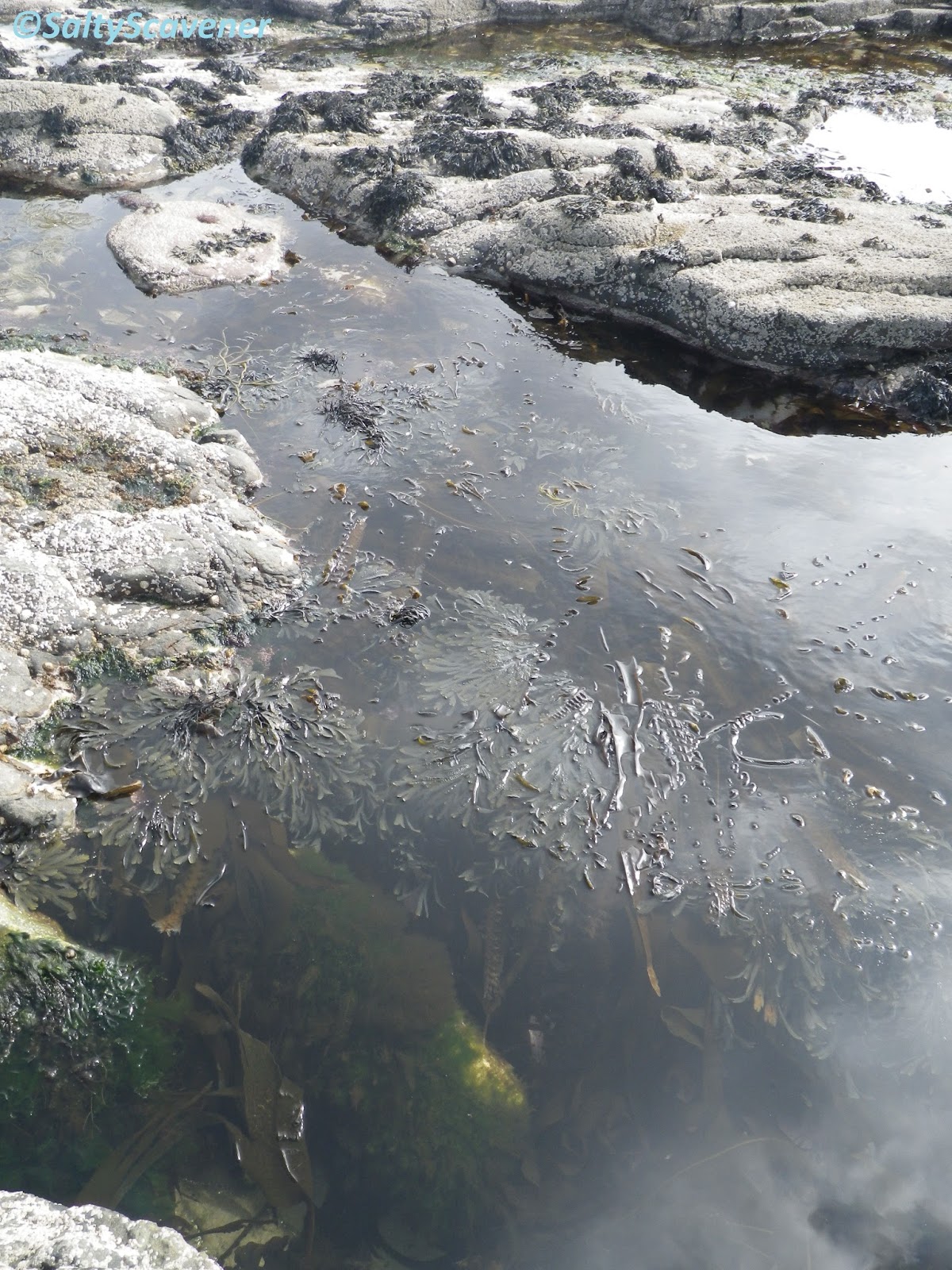
Larger coralline rockpools support more species of coralline seaweeds, Cholorophyta and fucoids.
In cases many Rhodophyta, Cholorphyta and even kelp occur within the coralline rockpools of the mid and lower shore:
Rhodophyta
Rhodophyta
Corallina officinalis
Rhodophyta (Polysiphonia spp) and Gastropods
Rhodophyta (Polysiphonia spp) and Gastropods
Rhodophyta and Gastropods
Nucella lapillus with eggs (on ledge above), sea squirts, Rhodophyta and Corallinaceae crusts.


Nucella lapillus
Limpet (Patella ulyssiponensis)


Edible periwinkle (Littorina littoria)

Edible periwinkles (Littorina littoria) aggregate within a corner of the rockpool.
Dabberlocks (Alaria esculenta) grows attached to a china limpet (Patella ulyssiponensis) as does Osmundea spp, Chlorophyta and Coralinaceae crusts, the latter also encrusts the rockpool bottom encapsulating the barnacles.
The deeper rockpools of the lower shore support kelps and fucoids. Habitat classification: LR.FLR.Rkp.  (Fucoids and kelps in deep eulittoral rockpools) EUNIS: A1.412. 
Alaria esculenta
Alaria esculenta

As the tide returns Turn stones come to feed on the shore.

Monday, 22 June 2015

Rockpooling destination: Revisit Penberth April, 2015

The shore comprises a narrow cove with boulders lining either side of a slipway. There is a river that forms a small waterfall on the upper shore before flowing beneath the boulders to the sea.

The cove experiences high wave exposure and is characterized by an extended splash zone with lichens and periwinkles. Barnacles characterise the mid and lower shore,  with an increased abundance of barnacles, limpets and robust seaweeds towards the low water mark. There are relatively small gravel filled rockpools beneath the boulders and coralline rockpools at the cliff edges.


The tide was lower than during previous visits allowing  a greater variety of lower shore red seaweeds to be photographed. However, time prevented me from looking at the fresh water influenced habitats of the upper shore which, I have photographed previously. 
See blog post:  http://thesaltyscavenger.blogspot.co.uk/2013/11/rock-pooling-destination-penberth.html


Below are images of organisms you may encounter whilst rockpooling in these habitats:


The rocky shore is comprised of boulders and a slip way. A variety of Yellow and grey lichens characterise the supralittoral.  Habitat classification: LR.FLR.Lic (Lichens on supralittoral and littoral fringe rock) EUNIS:B3.111


Blackshields

Plants also occur between the boulders in the supralittoral.


Black tar lichen (Verrucaria maura) markes the transitions from the supralittoral to the littoral fringe habitats. Habitat classification: 
LR.FLR.Lic.Ver (Verrucaria Maura on littoral fringe rock) EUNIS: B3.113
Sparse barnacles occur within the V.maura biotope.
Limpets (Patella vulgata), Periwinkles (Littorina spp.) and sparse barnacles.

Littorina compressa nigrolineata 

Barnacles and periwinkle

Small periwinkles (Melarhaphe neritoides)

Small red mites scurry across the rocks.

An ant on the upper shore. There are a variety of terrestrial insects that you can come across on the shore, especially during the summer months. However, this component of the intertidal ecology is often over looked.

An ant on the top of a coralline rock pool.


Snakelocks anemone (Anemonia viridis) in a coralline rockpool. The rockpools of the shore are confined to the bedrock of the cliff edges, and mainly comprise narrow stretches of water. Habitat classification: LR.FLR.Rkp.Cor (Coralline crust-dominated shallow eulittoral rockpools) EUNIS A1.411


Snakelocks anemone (Anemonia viridis)


China limpets (Patella ulyssiponensis) within a coralline rockpool. 

Thick topshell (Osilinus lineatus)

The lichen, Lichina pygmaea occurs in patches among the barnacles communities of the upper shore. Habitat classification: LR.HLR. MusB (Mussel and/or barnacle communities), EUNIS: A1.11.
The boulders of the mid shore support a community of barnacles, limpets, dog whelks and where conditions allow seaweeds. Habitat classification: LR.HLR. MusB (Mussel and/or barnacle communities), EUNIS: A1.11.
Between the boulders beadlet anemones (Actina equina) and small individual seaweeds can also be found.
Spiral wrack  (Fucus spiralis)
Several of the boulders have patches of a dark green lichen/algae?
Dog whelks (Nucella lapillus)

On the lower shore the density of barnacles increases and Patella depressa is found.
Barnacles on the lower shore.
Volcano barnacles (Balanus perforatus) beneath a boulder overhang if the lower shore.

Grey topshell (Gibbul cineraria) on the lower shore.


A low turf of coralline algae.
As the lower shore is reached there is a proliferation of wracks and red seaweeds. Habitat classification: LR.HLR.FR.Him (Himanthalia elongata and red seaweeds on exposed to moderately exposed lower eulittoral rock).

Osmundea spp and short Corallina spp turfs

Throng weed (Himanthalia elongata) over grows a turf if red seaweeds at the low tide mark.

A variety of red seaweeds co occur in close proximity.
Mastrocarpus stellatus grows among the stypes of Himanthalia elongata.


Chondrus crispus and Osmundea spp


Lomentaria articulata

Young fucoids, greens and plumose reds drape a boulder at the low tide mark.

A seal sleeps whilst I rockpool around the shore.