Showing posts with label Patella depressa. Show all posts

Monday, 22 June 2015

Rockpooling destination: Revisit Penberth April, 2015

The shore comprises a narrow cove with boulders lining either side of a slipway. There is a river that forms a small waterfall on the upper shore before flowing beneath the boulders to the sea.

The cove experiences high wave exposure and is characterized by an extended splash zone with lichens and periwinkles. Barnacles characterise the mid and lower shore,  with an increased abundance of barnacles, limpets and robust seaweeds towards the low water mark. There are relatively small gravel filled rockpools beneath the boulders and coralline rockpools at the cliff edges.


The tide was lower than during previous visits allowing  a greater variety of lower shore red seaweeds to be photographed. However, time prevented me from looking at the fresh water influenced habitats of the upper shore which, I have photographed previously. 
See blog post:  http://thesaltyscavenger.blogspot.co.uk/2013/11/rock-pooling-destination-penberth.html


Below are images of organisms you may encounter whilst rockpooling in these habitats:


The rocky shore is comprised of boulders and a slip way. A variety of Yellow and grey lichens characterise the supralittoral.  Habitat classification: LR.FLR.Lic (Lichens on supralittoral and littoral fringe rock) EUNIS:B3.111


Blackshields

Plants also occur between the boulders in the supralittoral.


Black tar lichen (Verrucaria maura) markes the transitions from the supralittoral to the littoral fringe habitats. Habitat classification: 
LR.FLR.Lic.Ver (Verrucaria Maura on littoral fringe rock) EUNIS: B3.113
Sparse barnacles occur within the V.maura biotope.
Limpets (Patella vulgata), Periwinkles (Littorina spp.) and sparse barnacles.

Littorina compressa nigrolineata 

Barnacles and periwinkle

Small periwinkles (Melarhaphe neritoides)

Small red mites scurry across the rocks.

An ant on the upper shore. There are a variety of terrestrial insects that you can come across on the shore, especially during the summer months. However, this component of the intertidal ecology is often over looked.

An ant on the top of a coralline rock pool.


Snakelocks anemone (Anemonia viridis) in a coralline rockpool. The rockpools of the shore are confined to the bedrock of the cliff edges, and mainly comprise narrow stretches of water. Habitat classification: LR.FLR.Rkp.Cor (Coralline crust-dominated shallow eulittoral rockpools) EUNIS A1.411


Snakelocks anemone (Anemonia viridis)


China limpets (Patella ulyssiponensis) within a coralline rockpool. 

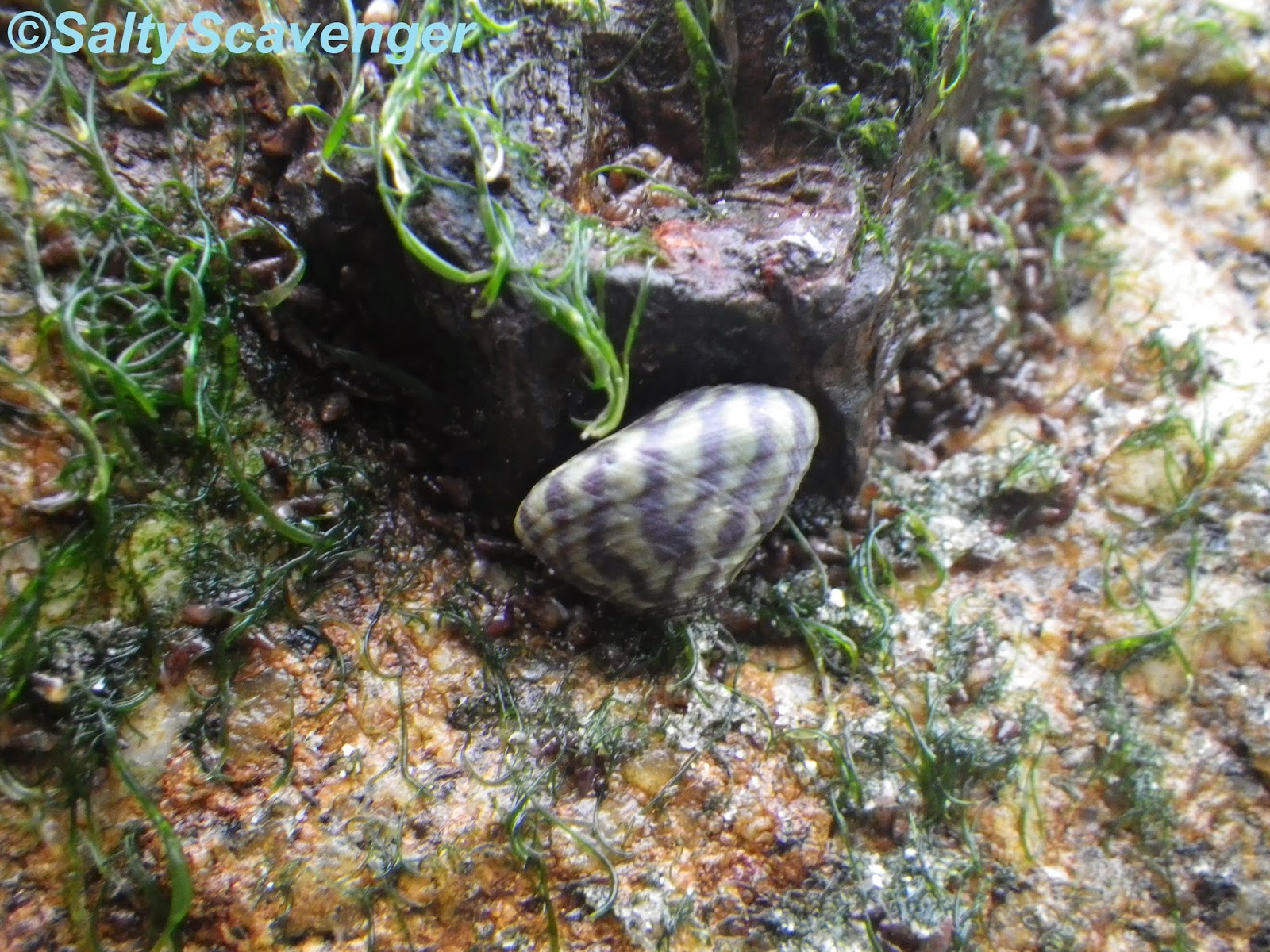
Thick topshell (Osilinus lineatus)

The lichen, Lichina pygmaea occurs in patches among the barnacles communities of the upper shore. Habitat classification: LR.HLR. MusB (Mussel and/or barnacle communities), EUNIS: A1.11.
The boulders of the mid shore support a community of barnacles, limpets, dog whelks and where conditions allow seaweeds. Habitat classification: LR.HLR. MusB (Mussel and/or barnacle communities), EUNIS: A1.11.
Between the boulders beadlet anemones (Actina equina) and small individual seaweeds can also be found.
Spiral wrack  (Fucus spiralis)
Several of the boulders have patches of a dark green lichen/algae?
Dog whelks (Nucella lapillus)

On the lower shore the density of barnacles increases and Patella depressa is found.
Barnacles on the lower shore.
Volcano barnacles (Balanus perforatus) beneath a boulder overhang if the lower shore.

Grey topshell (Gibbul cineraria) on the lower shore.


A low turf of coralline algae.
As the lower shore is reached there is a proliferation of wracks and red seaweeds. Habitat classification: LR.HLR.FR.Him (Himanthalia elongata and red seaweeds on exposed to moderately exposed lower eulittoral rock).

Osmundea spp and short Corallina spp turfs

Throng weed (Himanthalia elongata) over grows a turf if red seaweeds at the low tide mark.

A variety of red seaweeds co occur in close proximity.
Mastrocarpus stellatus grows among the stypes of Himanthalia elongata.


Chondrus crispus and Osmundea spp


Lomentaria articulata

Young fucoids, greens and plumose reds drape a boulder at the low tide mark.

A seal sleeps whilst I rockpool around the shore.

Tuesday, 19 May 2015

Rockpooling Destination: Lamorna, December 2014

The shore is positioned within in a small cove, with a crumbled down harbour wall. Boulders back the cove giving way to sand on the lower shore and a river runs over and under the boulders down to the sea. The harbour wall had relatively recently fallen into disrepair and where the wall has broken down, slabs of rock that were once positioned in the sublittoral have been washed up the shore, to occupy a position in the intertidal. The result is that 'at present' species usually found in the subtidal can be seen in the intertidal.


The shore is comprised of boulders that give way to sand on the lower shore.

A strandline has formed on the sandy shore. Habitat classification: LS.LSa (Littoral sand) and  LS.LSa.St (Strandline) EUNIS: A2.21.


Periwinkles and sparse barnacles aggregate within crevices and pits of the boulders of the upper shore, whilst below ephemeral algae cover boulders that experience sand scour from the adjacent sand below. 

Small periwinkles (Melarhaphe neritoides), rough periwinkles (Littorina sp) and sparse barnacles aggregate in a crevice of a boulder. 
Small periwinkles (Melarhaphe neritoides), rough periwinkles (Littorina sp) and sparse barnacles aggregate in a crevice of a boulder.
Small periwinkles (Melarhaphe neritoides) utilize the pits of the boulder.
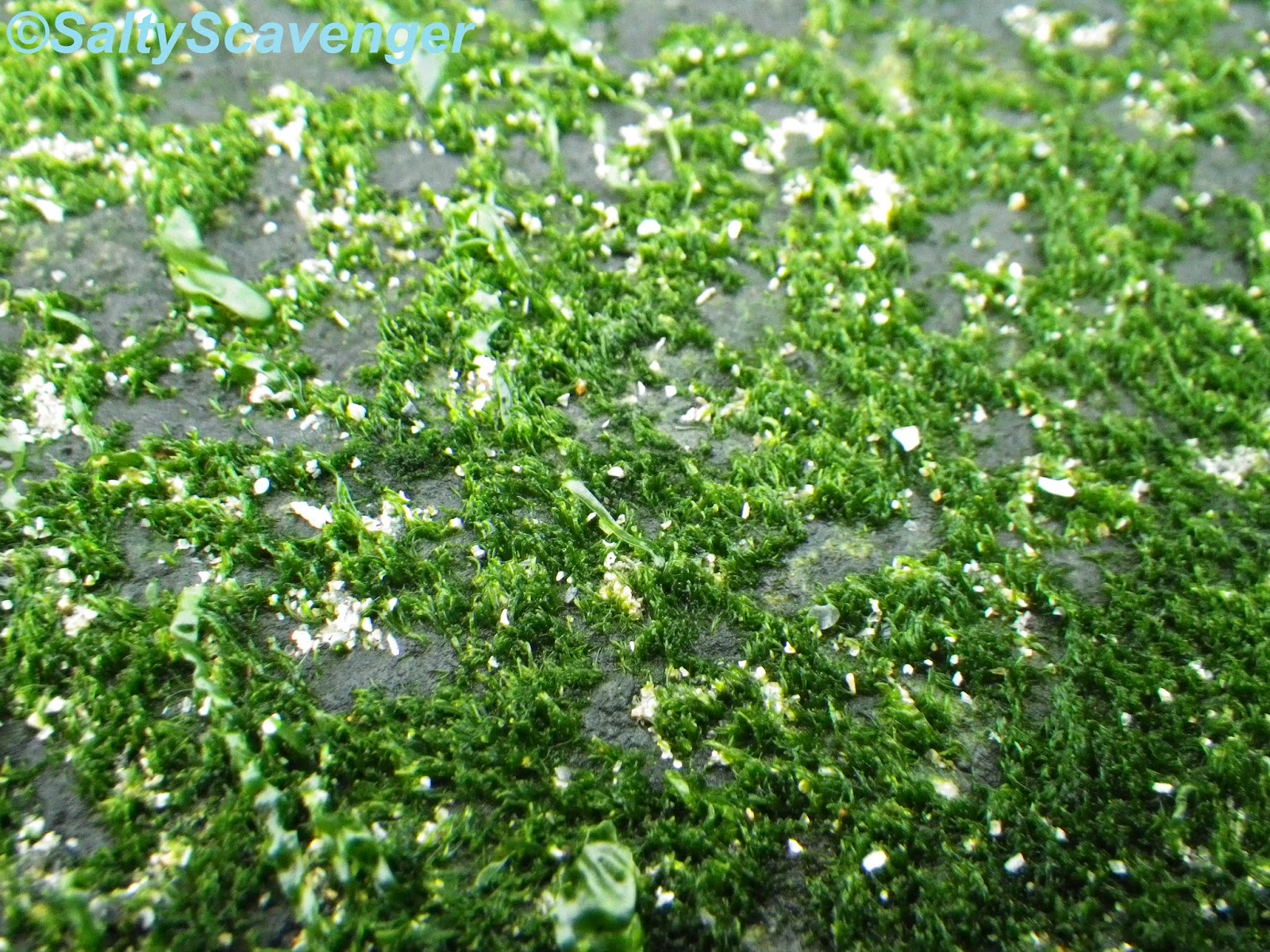
Ephemeral green algae covers the boulders that are adjacent to the sand and experience sand scour. Habitat classification: Eph.FLR.Eph (Ephemeral green or red seaweed communities) EUNIS A1.45.

Ephemeral green algae


The red ephemeral algae, Porphyra sp also grows on the boulders affected by sand scour.

The harbour wall provides a hard substrate upon which organisms can grow and feed.

Damp conditions at the base of the harbour wall facilitate the growth of coralline crusts, red seaweeds, polychaete worm tubes and anemones, whilst above barnacles and mussels occur.
Small periwinkles (Melarhaphe neritoides), rough periwinkles (Littorina compressa) and sparse barnacles.

Limpets (Patella spp) and barnacles are the most prominant species of the harbour wall. Habitat classification: LR.HLR. MusB (Mussel and/or barnacle communities) EUNIS A1.11.


Other organisms are restricted to crevices and damp patches at the base of the harbour wall. Here a common blue mussel (Mytilus edulis)  exploits a crevice of the harbour wall.
         

Red seaweeds occur in patches on the lower extents of the harbour wall, Mastrocarpus stellatus


Mastrocarpus stellatus


A red seaweed


Barnacle and beadlet anemone  (Actina equina) abundance reaches its highest at a height on the wall where exposure and sand scour reach a trade off.

A damp area at the base of the wall facilitates the growth of Coralline crusts and limpets increase in abundance.

Spirobid polychaete worm tubes also occur within this damp patch.


Beadlet anemones (Actina equina) also occur on the cobbles beneath the harbour wall.
On parts of the harbour wall that have been washed up, sublittoral species are now found in the intertidal. Here you can see serpulid polychaete worm tubes.


 A chiton and serpulid polychaete  (Pomatoceros triqueter).


A chiton finds protection within a depression of the rock.


Limpets

A serpulid worm tube (Pomatoceros triqueter)


Serpulid worm tubes  (Pomatoceros triqueter).
Gastropods aggregate within the protection of the serpulid  worm tube  (Pomatoceros triqueter).


Gastropods within Ulva spp.


A blue rayed limpet (Patella pellucida)


A limpet (Patella depressa)


Bryozoan


Flat topshell (Gibbula umbilicus)

Barnacles

Barnacles (Balanus perforatus)
Limpets, rough periwinkles (Littorina compressa v nigrolineata), beadlet anemone (Actina equina), barnacles (Balanus perforatus) and Lomentaria articulata..