Showing posts with label gibbula umbilicus. Show all posts

Saturday, 8 August 2015

Rockpooling Destination: Nr Kilchoan, Scotland, May 2015

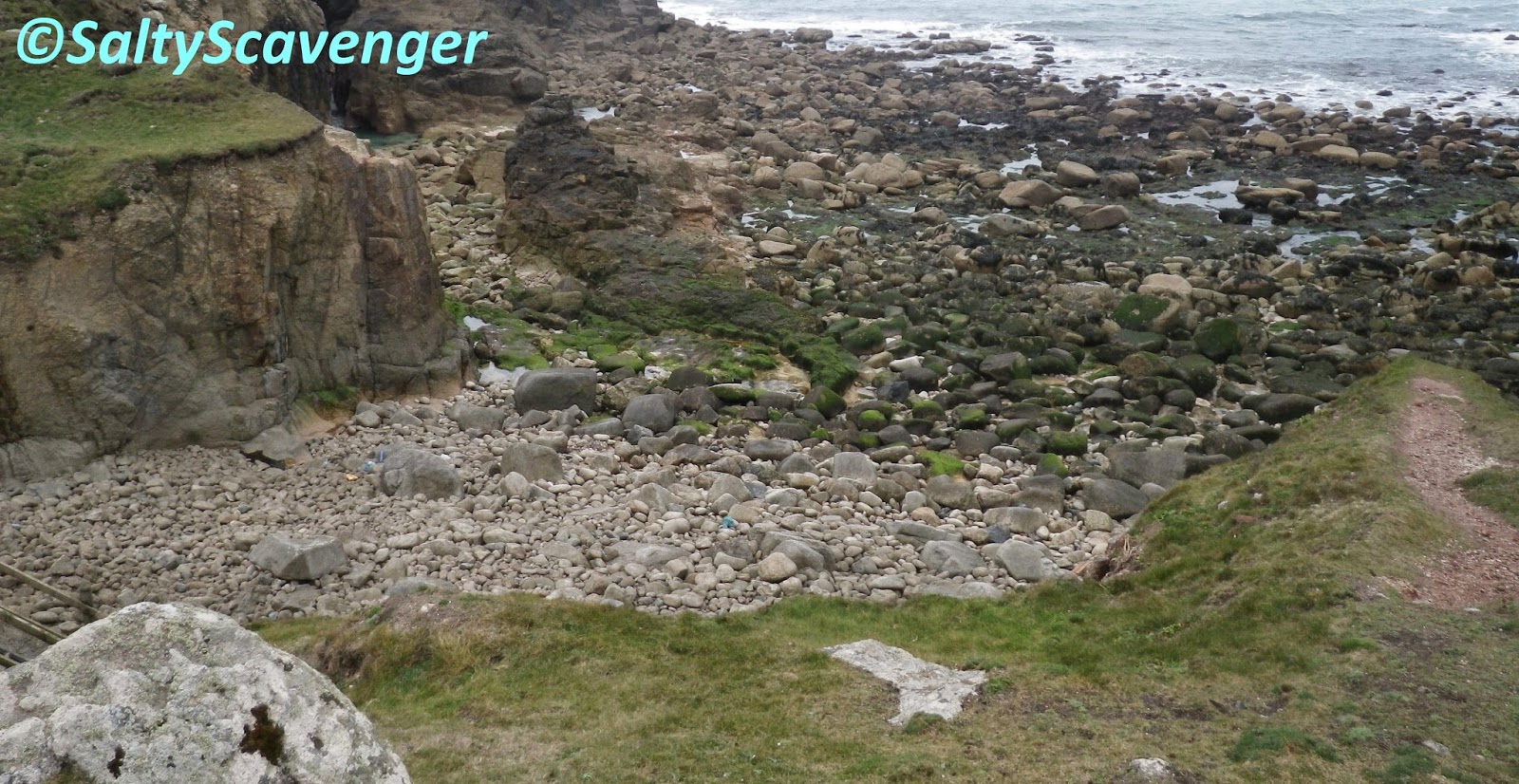
The rocky shore comprises cobbles and boulders on bedrock with multiple gullies, crevices and rockpools. This variable topography has resulted in a patchy distribution of habitats. Lichens characterise the elevated rock with barnacle communities below. Rockpools occur across the shore, supporting variable communities depending on their elevation. 

Habitat classification:

Substrate
LR (Littoral rock)
Habitat

LR.HLR (High energy littoral rock)
LR.MLR (Moderate energy littoral rock)
LR.FLR (Features if littoral rock)
Biotope Complex
LR.HLR.MusB (Mussel and/or barnacle communities)


LR.MLR.BF.PelB (Pelvetia canaliculata,and sparse barnacles on moderately exposed littoral fringe rock)
LR.FLR.Lic (Lichens on supralittoral   and littoral fringe rock)
LR.FLR.Rkp (Rockpools)
Biotope

LR.FLR.Lic.YG (Yellow and grey lichens on supralittoral rock)
LR.FLR.Lic.Ver (Verrucaria maura on littoral fringe rock) 
LR.FLR.Rkp.Cor (Coralline crust-dominated shallow eulittoral rockpools)
LR.FLR.Rkp.Fk (Fucoids and kelp in deep eulittoral rockpools)

Below are images of organisms and habitats you may encounter whilst rockpooling on the shore near Kilchoan:


The rocky shore comprises cobbles, boulders, bedrock and rockpools. Habitat classification: LR.FLR.Lic.YG (Yellow and grey lichens on supralittoral rock) EUNIS: B3.111, LR.FLR.Lic.Ver (Verrucaria maura on littoral firnge rock) EUNIS: B3.113,  LR.MLR.BF.PelB (Pelvetia canaliculata,and sparse barnacles on moderately exposed littoral fringe rock) EUNIS: A1.211 LR.HLR.MusB (Mussel and/or barnacle communities) EUNIS: A1.11 and LR.FLR.Rkp (Rockpools) EUNIS: A1.41.

This photograph taken at the exposed far end of the shore shows how the biotopes on the headlands exhibit distinct distributions. Yellow and grey lichens occur at the highest elevation of the rock in the supralittoral. Below, the rocks of the littoral fringe appear black, from the tar lichen (Verrucaria maura ) with a fringing of  the brown channel wrack (Pelvetia canaliculata); below this are the barnacle communities with patches of Lichina pygmaea. Habitat classification: LR.FLR.Lic.YG (Yellow and grey lichens on supralittoral rock) EUNIS: B3.111, LR.FLR.Lic.Ver (Verrucaria maura on littoral firnge rock) EUNIS: B3.113,  LR.MLR.BF.PelB (Pelvetia canaliculata,and sparse barnacles on moderately exposed littoral fringe rock) EUNIS: A1.211 and LR.HLR.MusB (Mussel and/or barnacle communities) EUNIS: A1.11.


Rough periwinkles (Littorina spp) and sparse barnacles occur among the less stable cobbles of the upper shore. 

Dense barnacle communities cover the stable bedrock of the upper and mid shore, inter-dispersed by shallow coralline rockpools. Habitat classification: LR.HLR.MusB (Mussel and/or barnacle communities) EUNIS: A1.11 and LR.FLR.Rkp.Cor (Coralline crust-dominated shallow eulittoral rockpools) EUNIS: A1.411.

An edible periwinkle (Littorina littoria) within a coralline rockpool.
Mussels grow within the crevices of the coralline rockpools, often becoming covered by Corallinaceae crusts.

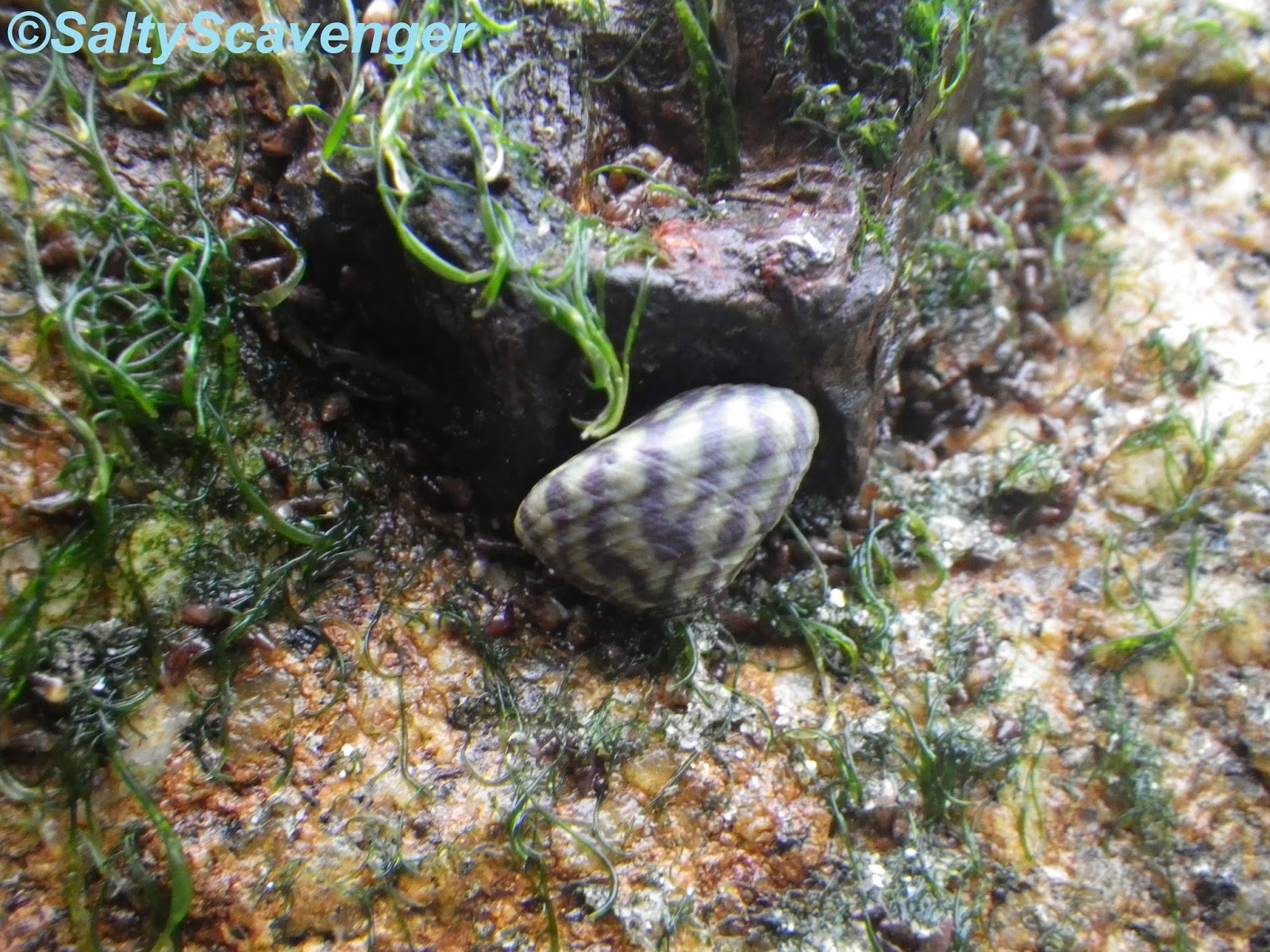
Gibbula umbilicus within a coralline rockpool.


A china limpet (Patella ulyssiponensis) forages within a coralline rockpool.

A green sea urchin (Psammechinus miliaris) uses dead shells and debris from the coralline rockpool as camouflage.

Psammechinus miliaris uses dead shells and debris from the coralline rockpool as camouflage.

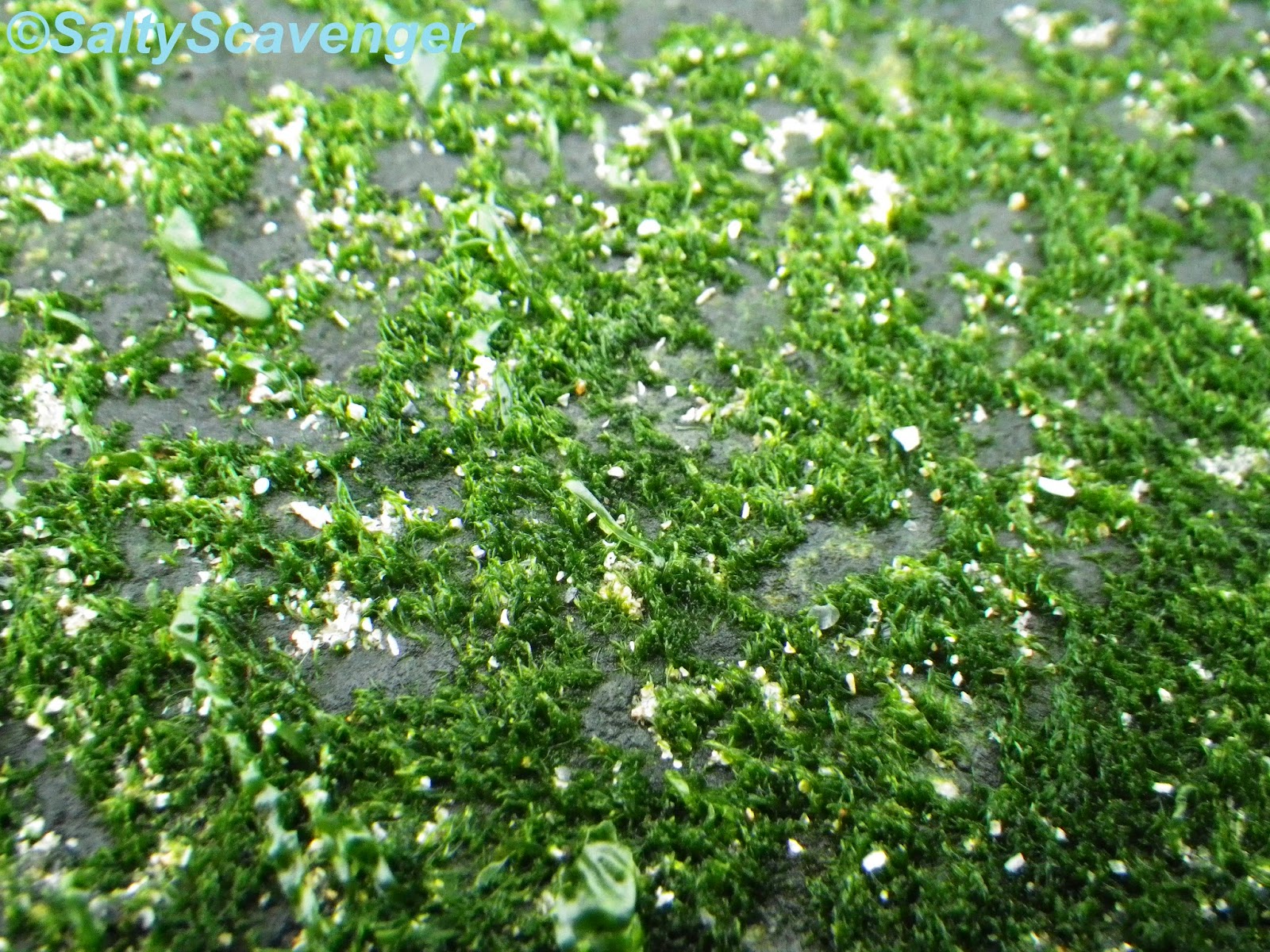
In summer month ephemeral green algae exhibit rapid growth within the coralline rockpools.

Claodophora spp

Claodophora spp

Claodophora spp


In the deeper rockpools of the shore brown seaweeds, such as sea oak (Halidrys siliquosa) and thong weed (Himanthalia elongata) occur. Habitat classification: LR.FLR.Rkp.Fk (Fucoids and kelp in deep eulittoral rockpools) EUNIS: A1.412.

Halidrys siliquosa , Himanthalia elongata and Coarllinaceae crusts. 


Wednesday, 8 July 2015

Rockpooling Destination: Revisit Lands' End Penisular, April 2015 - Ephemeral seaweeds to Fucoid and Barnacle habitats

Steep cliffs surround the bay, the lower craggy edges covered in lichens. The cliff bases and steeper bedrock transition between the lichen and barnacle communities with limpets, periwinkles and whelks. Boulders and bedrock of the mid and lower shore host a similar barnacle community plus a variety of seaweeds, including where sand scour is event, ephemeral seaweeds. Rockpools occur throughout the shore, and a river flows downs from the cliffs.

The bay experiences a dynamic regime, alternating between periods of erosion and deposition. The underlying substrate is boulders and bedrock, however, variable amounts of sand may be deposited on top, sourced from the sand bar situated offshore. The communities encountered reflect the alternation between these regimes.


The shore alternates between periods of deposition (sandy)  and erosion (stony).


April 2015


September 2013                    January 2014
The overlaying sand has been eroded to reveal the boulders beneath.
At the time of visitation the cove was comprised of boulders and bedrock with an occasional thin veneer of sand.


Habitat classification:


Substrate
LR (Littoral rock)
Habitat


LR.HLR (High energy littoral rock)
LR.MLR (Moderate energy littoral rock)
LR.FLR (Features of ilttoral rock)
Biotope complex
LR. 


HLR.MusB (Mussels and/or barnacles on high energy littoral rock)
LR.MLR.BF (Barnacles and fucoids on moderately exposed shores)
LR.FLR.Lic.(Lichens on supralittoral and littoral fringe rock).
LR.FLR.Rkp (Rockpools)
LR.FLR.Eph (Ephemeral green or red seaweed communities
LR.FLR.CvoV (Littoral caves and overhangs).
Biotope


LR.MLR.BF.Fser (Fucus serratus on   moderately exposed eulittoral rock)


LR.MLR.BF.Rho (Rhodothamniella floridula on sand scoured lower eulittoral rock)
LR.FLR.Lic.Ver (Verrucaria Maura on littoral fringe rock)
LR.FLR.Rkp.Cor (Coralline crust-dominated shallow eulittoral rockpools)
 LR.FLR.Rckp.SwSed (Seaweeds in sediment- floored eulittoral rockpools).
LR.FLR.Eph (Ephermeral green or red   seaweeds (Fresh water or sand influenced)
LR.FLR.Eph.EntPor (Porphyra purpurea and Entomorpha spp. on sand scoured mid to  lower eulittoral rock)

Sub Biotope


LR.MLR.BF.Fser.R (Fucus serratus and red seaweeds on moderately exposed lower eulittoral rock)


LR.FLR.Rkp.Cor.Cor (Corallina officinalis and coralline crusts in shallow eulittoral rockpools)


 Below are images of organisms you may encounter whilst rockpooling in the upper and mid shore habitats:


One year ago these boulders were covered by sand. Now uncovered they are slowly being colonized by organisms, either from neighbouring rock or from planktonic recruitment.
Boulders and rockpools of the upper to mid shore that are influenced by the fresh water run off and sand scour are characterised by ephemeral red and green seaweeds. Habitat classification: LR.FLR.Eph (Ephermeral green or red  seaweeds (Fresh water or sand influenced) EUNIS:A2.82

The ephermeral green and/or red  seaweed biotope extends over much of the upper and mid shore coinciding with the rivers flow.
Ephemeral green algae (Ulva spp - previously Entomorpha spp)
The distribution of fauna in the mid to lower shore is influenced by wave exposure, subtidal sand scour, fresh water run off and desiccation. The result is a patchwork of biotopes that are not distributed evenly down the shore. Here fucoids and barnacles cover the boulders, whilst ephemeral green algae lace the diluted pools where the river flows to the sea.  Habitat classification: LR.MLR. BF (Barnacles and fucoids on moderately exposed shores) and LR.FLR.Eph (Ephermeral green or red seaweeds (Fresh water or sand influenced). 


Unlike the upper shore the mid shore habitats appear unchanged from October, 2014 when this photograph was taken.

The fucoid and barnacle community of the  LR.MLR. BF (Barnacles and fucoids on moderately exposed shores) habitat comprises dog whelks, beadelt anemones, barnacles and red seaweeds, among other species....


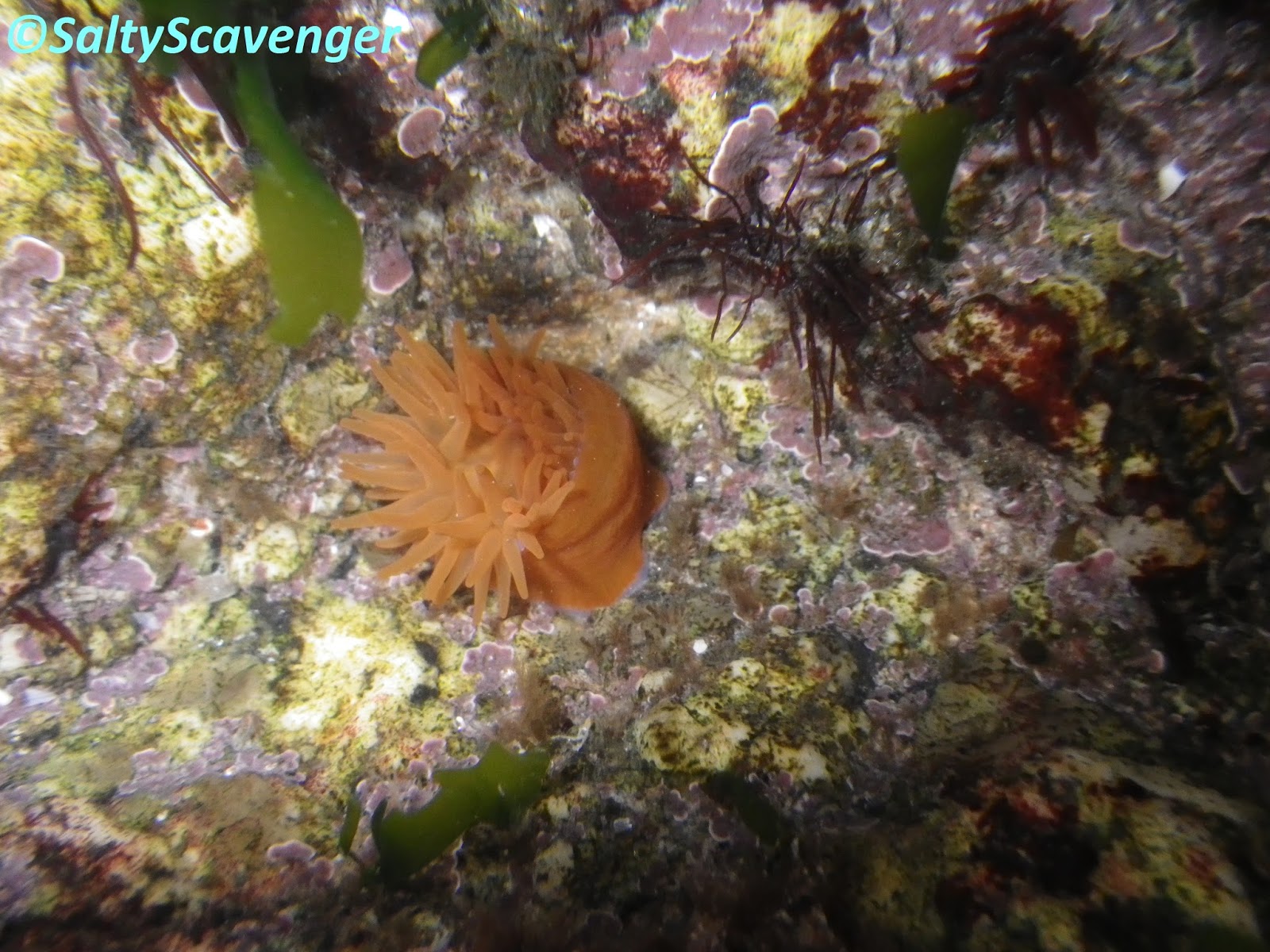
Beadlet anemone (Actinia equina)


A Chiton, so highly camouflaged it could be missed among the coralline edged rock.


Gibbula umbilicus can be found between and under the boulders, where conditions are damper.


Limpets are able to withstand greater desiccation than other shore gastropods and are found all over the boulders, usually aggregated on the lee ward side.  

New fucoid growth, on a particularly sandy boulder. As the lower shore is reached the influence of subtidal sand scour increases and this influences the organisms found.


Fucus sp and a red seaweed.


Tuesday, 19 May 2015

Rockpooling Destination: Lamorna, December 2014

The shore is positioned within in a small cove, with a crumbled down harbour wall. Boulders back the cove giving way to sand on the lower shore and a river runs over and under the boulders down to the sea. The harbour wall had relatively recently fallen into disrepair and where the wall has broken down, slabs of rock that were once positioned in the sublittoral have been washed up the shore, to occupy a position in the intertidal. The result is that 'at present' species usually found in the subtidal can be seen in the intertidal.


The shore is comprised of boulders that give way to sand on the lower shore.

A strandline has formed on the sandy shore. Habitat classification: LS.LSa (Littoral sand) and  LS.LSa.St (Strandline) EUNIS: A2.21.


Periwinkles and sparse barnacles aggregate within crevices and pits of the boulders of the upper shore, whilst below ephemeral algae cover boulders that experience sand scour from the adjacent sand below. 

Small periwinkles (Melarhaphe neritoides), rough periwinkles (Littorina sp) and sparse barnacles aggregate in a crevice of a boulder. 
Small periwinkles (Melarhaphe neritoides), rough periwinkles (Littorina sp) and sparse barnacles aggregate in a crevice of a boulder.
Small periwinkles (Melarhaphe neritoides) utilize the pits of the boulder.
Ephemeral green algae covers the boulders that are adjacent to the sand and experience sand scour. Habitat classification: Eph.FLR.Eph (Ephemeral green or red seaweed communities) EUNIS A1.45.

Ephemeral green algae


The red ephemeral algae, Porphyra sp also grows on the boulders affected by sand scour.

The harbour wall provides a hard substrate upon which organisms can grow and feed.

Damp conditions at the base of the harbour wall facilitate the growth of coralline crusts, red seaweeds, polychaete worm tubes and anemones, whilst above barnacles and mussels occur.
Small periwinkles (Melarhaphe neritoides), rough periwinkles (Littorina compressa) and sparse barnacles.

Limpets (Patella spp) and barnacles are the most prominant species of the harbour wall. Habitat classification: LR.HLR. MusB (Mussel and/or barnacle communities) EUNIS A1.11.


Other organisms are restricted to crevices and damp patches at the base of the harbour wall. Here a common blue mussel (Mytilus edulis)  exploits a crevice of the harbour wall.
         

Red seaweeds occur in patches on the lower extents of the harbour wall, Mastrocarpus stellatus


Mastrocarpus stellatus


A red seaweed


Barnacle and beadlet anemone  (Actina equina) abundance reaches its highest at a height on the wall where exposure and sand scour reach a trade off.

A damp area at the base of the wall facilitates the growth of Coralline crusts and limpets increase in abundance.

Spirobid polychaete worm tubes also occur within this damp patch.


Beadlet anemones (Actina equina) also occur on the cobbles beneath the harbour wall.
On parts of the harbour wall that have been washed up, sublittoral species are now found in the intertidal. Here you can see serpulid polychaete worm tubes.


 A chiton and serpulid polychaete  (Pomatoceros triqueter).


A chiton finds protection within a depression of the rock.


Limpets

A serpulid worm tube (Pomatoceros triqueter)


Serpulid worm tubes  (Pomatoceros triqueter).
Gastropods aggregate within the protection of the serpulid  worm tube  (Pomatoceros triqueter).


Gastropods within Ulva spp.


A blue rayed limpet (Patella pellucida)


A limpet (Patella depressa)


Bryozoan


Flat topshell (Gibbula umbilicus)

Barnacles

Barnacles (Balanus perforatus)
Limpets, rough periwinkles (Littorina compressa v nigrolineata), beadlet anemone (Actina equina), barnacles (Balanus perforatus) and Lomentaria articulata..