Showing posts with label littorina littoria. Show all posts

Wednesday, 12 August 2015

Rockpooling Destination: Ardnamurchan Light House, Scotland, May 2015

The shore comprises bedrock with crevices, gullies, rockpools and varying amounts of sand. Yellow and grey lichens characterise the supralittoral, with tar lichen and channel wrack in the littoral fringe. The littoral communities below comprise barnacles, periwinkles, anemones and sand scour tolerant seaweeds.

Below are images of organisms you may encounter whilst rockpooling in these habitats:


The shore comprises bedrock and sand. The supralittoral rock of the shore supports yellow and grey lichens and sea pinks (Armeria maritima). Below, the black tar lichen, Verrucaria maura covers the rock. Habitat classification: LS.Lsa (Littoral sand) EUNIS A.2, LR.FLR.Lic.YG (Yellow and grey lichens on supralittoral rock) EUNIS: B3.111 and LR.FLR.Lic.Ver (Verrucaria maura on littoral fringe rock)  EUNIS: B3.113.


Sea pinks and lichens have a patchy distribution among the pinnacles of rock.

Channel wrack (Pelvetia canaliculata) occurs as a band on the littoral fringe bedrock.
Rough periwinkles (Littorina spp) occur within the littoral fringe
 and upper shore.

A rough periwinkle (Littorina spp)


Ulva spp (formally entermorpha spp) occurs in many of the upper shore, sand filled rockpools.

Ulva spp 

Barnacles and limpets of the upper shore exhibit an aggregated distribution, positioning themselves in the leeward side of the bedrock.

This distribution is seen across the shore with barnacles and limpets aggregating in the leeward side of the bedrock.

Barnacles

Patches of  Lichina pygmaea can be found among the barnacle communities.
Lichina pygmaea and Edible periwinkle (Littorina littorea)

Littorina littorea

Littorina littorea

Littorina littorea

Snakelocks anemone (Anemonia viridis)

Mastrocarpus stellatus
Among the shells of the upper shore, terrestrial insects like wood lice can often be found.


Saturday, 8 August 2015

Rockpooling Destination: Nr Kilchoan, Scotland, May 2015

The rocky shore comprises cobbles and boulders on bedrock with multiple gullies, crevices and rockpools. This variable topography has resulted in a patchy distribution of habitats. Lichens characterise the elevated rock with barnacle communities below. Rockpools occur across the shore, supporting variable communities depending on their elevation. 

Habitat classification:

Substrate
LR (Littoral rock)
Habitat

LR.HLR (High energy littoral rock)
LR.MLR (Moderate energy littoral rock)
LR.FLR (Features if littoral rock)
Biotope Complex
LR.HLR.MusB (Mussel and/or barnacle communities)


LR.MLR.BF.PelB (Pelvetia canaliculata,and sparse barnacles on moderately exposed littoral fringe rock)
LR.FLR.Lic (Lichens on supralittoral   and littoral fringe rock)
LR.FLR.Rkp (Rockpools)
Biotope

LR.FLR.Lic.YG (Yellow and grey lichens on supralittoral rock)
LR.FLR.Lic.Ver (Verrucaria maura on littoral fringe rock) 
LR.FLR.Rkp.Cor (Coralline crust-dominated shallow eulittoral rockpools)
LR.FLR.Rkp.Fk (Fucoids and kelp in deep eulittoral rockpools)

Below are images of organisms and habitats you may encounter whilst rockpooling on the shore near Kilchoan:


The rocky shore comprises cobbles, boulders, bedrock and rockpools. Habitat classification: LR.FLR.Lic.YG (Yellow and grey lichens on supralittoral rock) EUNIS: B3.111, LR.FLR.Lic.Ver (Verrucaria maura on littoral firnge rock) EUNIS: B3.113,  LR.MLR.BF.PelB (Pelvetia canaliculata,and sparse barnacles on moderately exposed littoral fringe rock) EUNIS: A1.211 LR.HLR.MusB (Mussel and/or barnacle communities) EUNIS: A1.11 and LR.FLR.Rkp (Rockpools) EUNIS: A1.41.

This photograph taken at the exposed far end of the shore shows how the biotopes on the headlands exhibit distinct distributions. Yellow and grey lichens occur at the highest elevation of the rock in the supralittoral. Below, the rocks of the littoral fringe appear black, from the tar lichen (Verrucaria maura ) with a fringing of  the brown channel wrack (Pelvetia canaliculata); below this are the barnacle communities with patches of Lichina pygmaea. Habitat classification: LR.FLR.Lic.YG (Yellow and grey lichens on supralittoral rock) EUNIS: B3.111, LR.FLR.Lic.Ver (Verrucaria maura on littoral firnge rock) EUNIS: B3.113,  LR.MLR.BF.PelB (Pelvetia canaliculata,and sparse barnacles on moderately exposed littoral fringe rock) EUNIS: A1.211 and LR.HLR.MusB (Mussel and/or barnacle communities) EUNIS: A1.11.


Rough periwinkles (Littorina spp) and sparse barnacles occur among the less stable cobbles of the upper shore

Dense barnacle communities cover the stable bedrock of the upper and mid shore, inter-dispersed by shallow coralline rockpools. Habitat classification: LR.HLR.MusB (Mussel and/or barnacle communities) EUNIS: A1.11 and LR.FLR.Rkp.Cor (Coralline crust-dominated shallow eulittoral rockpools) EUNIS: A1.411.

An edible periwinkle (Littorina littoria) within a coralline rockpool.
Mussels grow within the crevices of the coralline rockpools, often becoming covered by Corallinaceae crusts.

Gibbula umbilicus within a coralline rockpool.


A china limpet (Patella ulyssiponensis) forages within a coralline rockpool.

A green sea urchin (Psammechinus miliaris) uses dead shells and debris from the coralline rockpool as camouflage.

Psammechinus miliaris uses dead shells and debris from the coralline rockpool as camouflage.

In summer month ephemeral green algae exhibit rapid growth within the coralline rockpools.

Claodophora spp

Claodophora spp

Claodophora spp


In the deeper rockpools of the shore brown seaweeds, such as sea oak (Halidrys siliquosa) and thong weed (Himanthalia elongata) occur. Habitat classification: LR.FLR.Rkp.Fk (Fucoids and kelp in deep eulittoral rockpools) EUNIS: A1.412.

Halidrys siliquosa , Himanthalia elongata and Coarllinaceae crusts. 


Saturday, 9 May 2015

Rockpooling Destination: Mousehole, December 2014


The shore comprises bedrock with gullies, crevices and rockpools. The variability in the bedrock topography results in a patchy distribution of habitats. Lichens occur in the splash zone and extend into the upper shore with periwinkles, channel wrack and sparse barnacles, the latter increasing in density toward the lower shore. Rockpools occur across the shore supporting variable communities depending on their position.


Below are images of organisms you may encounter whilst rockpooling in this habitat:

The rocky shore comprises bedrock with gullies, crevices and rockpools. Habitat classification:LR.HLR. MusB (Mussel and/or barnacle communities),  LR.FLR.Rkp (Rockpools), LR.LMR.BF.PelB (Pelvetia canaliculata and barnacles on moderately exposed shores), LR.FLR.Lic.YG (Yellow and grey lichens on supralittoral rock). 


Channel wrack (Pelvetia canaliculata) forms a distinct band on the upper shore where it overgrows the tar lichen (Verrucaris maura). Habitat classification: LR.LMR.BF.PelB (Pelvetia canaliculata and barnacles on moderately exposed shores) EUNIS A1.211. 

 Barnacles and Small periwinkles (Melarhaphe neritoides), the latter seek refuge within the dead barnacle tests of the upper shore.

Sparse barnacles and  M. neritoides on the upper shore.

A rough periwinkles (Littorina spp) seeks refuge within a depression of the upper shore rock.

A rough periwinkles (Littorina spp) seeks refuge within a depression of the upper shore rock.


A rockpool of the upper shore with ephemeral green seaweed (Ulva sp) and Edible periwinkles (Littorina littorea). Habitat classification: LR.FLR.Rkp (Rockpools) EUNIS:A1.41.


Barnacle and common limpets (Patella vulgata) characterise the exposed rock of the mid and lower shore  Habitat classification: LR.HLR. MusB (Mussel and/or barnacle communities).
P. vulgata and barnacles
M. neritoides can also be found among the barnacles of the mid and lower shore.


The lichen, Lichina pygmaea, amongst barnacles.


The shelving nature of the bedrock results in high topographic heterogeneity which, in turn provides greater shelter form the oncoming waves. Notice how barnacle abundance is higher on the leeward sides of the shelves.


Small pits in the rock also provide shelter from the waves and in the case of this particular shore, support small individuals of the common blue mussel (Mytilus edulis).
Large shallow coralline rockpools occur from the mid shore down. Habitat classification: LR.FLR.Rkp.Cor (Coralline crust dominated shallow eulittoral rockpools) EUNIS A1.411.

Further down on the lower shore the brown seaweed, Birurcaria bifurcata grows in the coralline rock pools . Habitat classification: LR.FLR.Rkp.Cor.Bif (Bifurcaria bifurcata in shallow eulittoral rockpool) EUNIS: A1.4113.


Bifurcaria bifurcata

Corallina officinalis

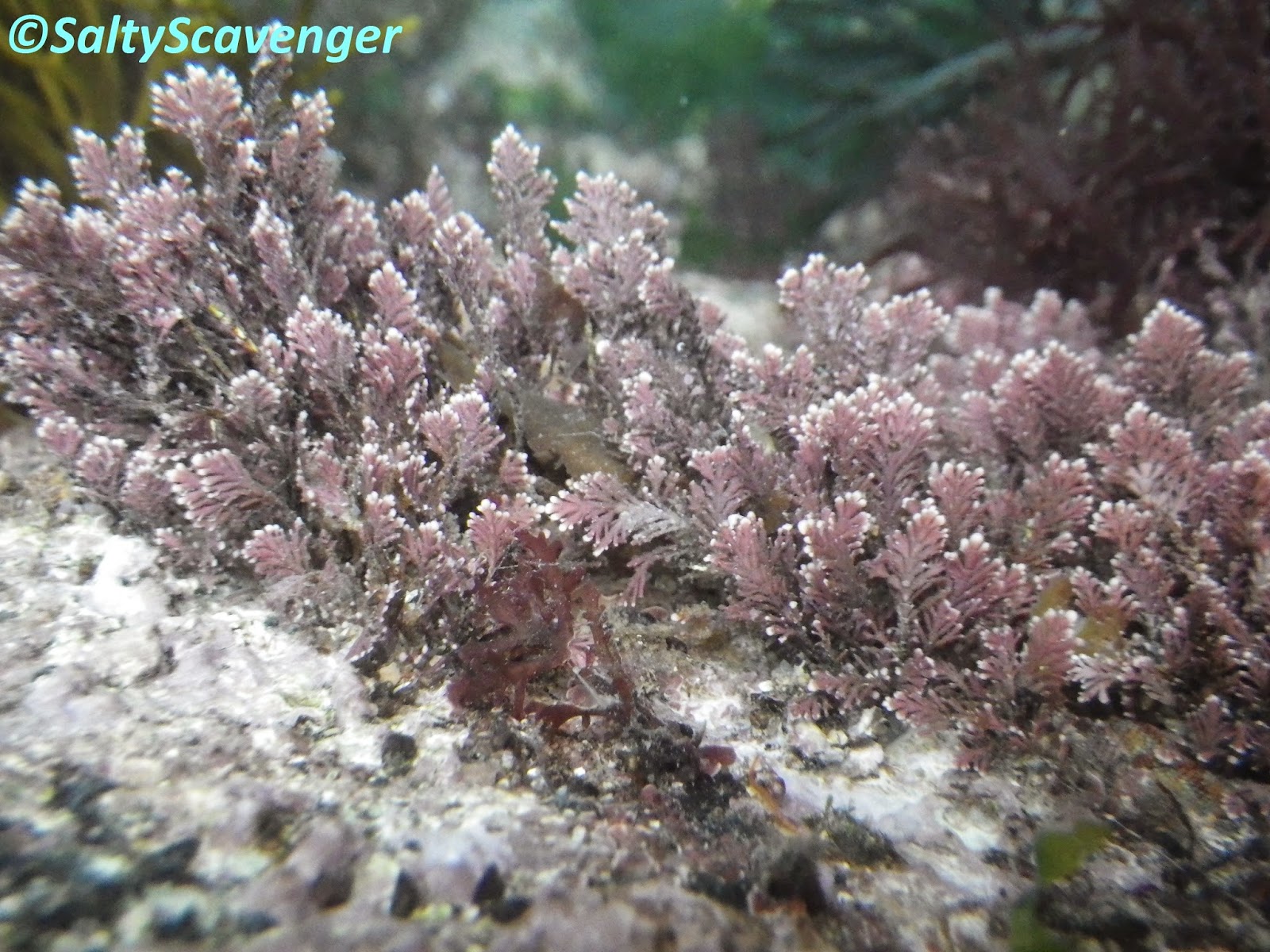
A variety of red seaweed species can be found amongst these rockpools.

Gastropod diversity also increases within the pools and includes, Edible periwinkles (Littorina littorea), Thick topshells (Osilinus lineatus) and flat topshells (Gibbula umilicus).

The invasive sargassum muticum can also be found. Submitting records of such sightings to organisations such as MarLIN or, your local recording centre can enable the spread of invasive species to be tracked.