Tuesday, 5 May 2015

Rockpooling Destination: Revisit South- West Penwith, October 2014 - Rockpools


The rocky shore is a high energy environment comprised of boulders and bedrock with rock pools, crevices and gullies.


The rocky shore is comprised of boulders and bedrock with rockpools, crevices and gullies. Habitat classification: LR.HLR (High energy littoral rock) EUNIS: A1.1 , LR.FLR.Rkp (Rockpools) EUNIS:A1.41 and LR.FLR.Lic.(Lichens on supralittoral and littoral fringe rock) EUNIS: B3.11.

The barnacle communities that dominate from the upper to lower shore are inter dispersed by shallow coralline rockpools in the mid shore, and deeper cobble filled rockpools on the lower shore. 

Habitat classification:


Substrate
LR (Littoral rock)
Habitat

LR.HLR (High energy littoral rock)
LR.FLR (Features of littoral rock)
Biotope complex


LR.HLR. MusB (Mussel and/or barnacle communities)
    LR.FLR.Lic.(Lichens on supralittoral and littoral fringe rock).

LR.FLR.Rkp (Rockpools)
Biotope

LR.FLR.Lic.Ver (Verrucaria Maura on  littoral fringe rock)

LR.FLR.Lic.YG (Yellow and grey lichens on supralittoral rock)
LR.FLR.Rkp.Cor (Coralline crust dominated shallow eulittoral rockpools)
SubBiotope

LR.FLR.Liv.VerB (Verrucaria maura and sparse barnacles on exposed littoral fringe rock)


LR.FLR.Rkp.Cor.Bif (Bifurcaria bifurcata in shallow eulittoral rockpools)


Below are images of the organisms you may encounter in the rockpools:


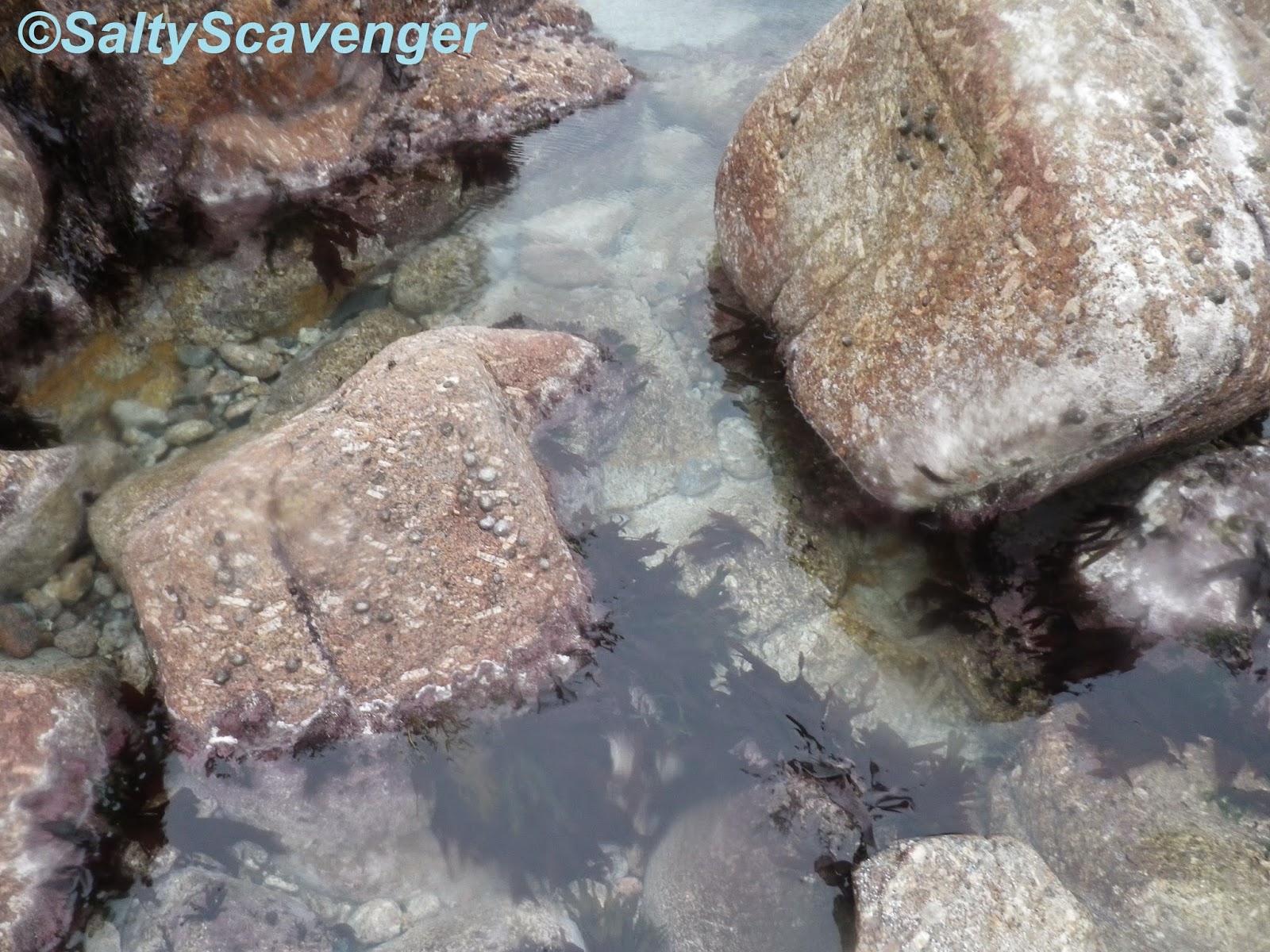
The rockpools on this high energy shore are characterized by the presence of coralline seaweeds that make the rockpools appear as if they have been covered in a layer of pink paint. Habitat classification: LR.FLR.Rkp.Cor (Coralline crust dominated shallow eulittoral rockpools) EUNIS: A1.411.


The coralline rockpools come in a variety of sizes.

Even crevices support small coralline rockpools as well as aggregations of common blue mussels (Mytilus edulis). Habitat classification: LR.FLR.Rkp.Cor (Coralline crust dominated shallow eulittoral rockpools) EUNIS: A1.411 and LR.HLR. MusB (Mussel and/or barnacle communities) EUNIS: A1.11.


The rockpools support a community that is distinct from the surrounding barnacle communities and includes a greater diversity of seaweed and mollusc species.


The rockpools support coralline species of red seaweed including, Corallinaceae crusts and Coral weed (Corallina officinalis), plus species found in the surrounding crevices of the barnacle habitat, such as  L. compressa nigrolineata and M. Edulis

China limpets (Patella ulyssiponsensis) are characteristic species of the coralline rockpools.


As the lower shore is reached large rockpools and gullies occur among the barnacle communities. Habitat classification: LR.FLR.Rkp (Rockpools) EUNIS: A1.4 and LR.HLR. MusB (Mussel and/or barnacle communities) EUNIS: A1.11..


The larger rockpools are filled with coarse sediments, ranging from gravel to boulders. 

The sheltered deep gravel and cobble filled rockpools support more life. Their edges are encrusted by corallinaceae crusts,  which are overgrown by other red seaweeds and the brown forking weed ( Bifurcaria bifurcata). Habitat classification: LR.FLR.Rkp.Cor.Bif (Bifurcaria bifurcata in shallow eulittoral rockpools) EUNIS: A1.4113

B. bifurcata edges the upper sides of the rockpool, while corallinaceae crusts and red seaweeds occur beneath.

The corallinaceae crusts cover the more stable boulders of the rockpool.

In less sheltered conditions the corallinaceae crusts are limited to the large boulders and Dulse (P. palmata)  grows in place of B. bifurcata.


Elsewhere turfts of fucoids and Coral weed (Corallina offiecinalis) edge rockpools.


C. officinalis is one of the most distinctive and characteristic seaweeds of the coralline rockpools.


Snakelocks anemone (Anemonia viridis) and  C. officinalis.


C. officinalis.
A variety of seaweeds and mobile fauna occur within the deeper rockpools of the lower shore, including grey topshell ( Gibbula cineraria), Ulva sp and corallinaceae crusts.
Red seaweeds predominately comprise the understory species.

Chondrus crispus


Dulse (Palmaria palmata) 
P. palmata

P. palmata, Corallinaceae crusts and young fucoids
A variety of anemones occur within the coralline rockpools.
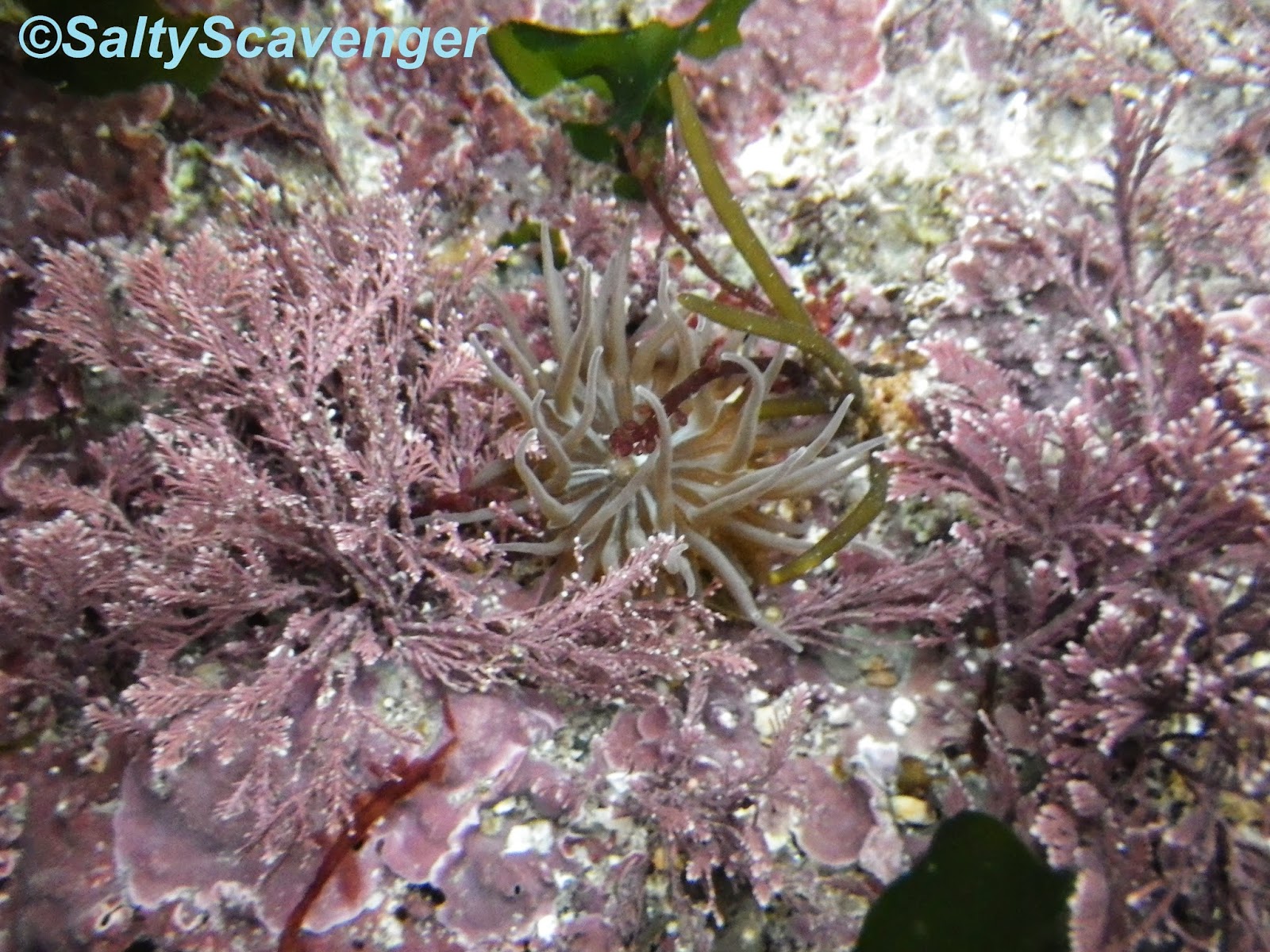

Snakelocks anemones (Anemonia viridis) occur in many of the coralline rockpools.
A. viridis

A. viridis can come in varying colours and often reach high densities in rockpools.
Gem anemones (Aulactinia verrucosa) can be found in rockpool crevices.


A beadlet anemone (Actina equina) and brittlestar (Ophiuroidea)


A cushionstar (Asterina gibbosa)

Seven armed starfish (Luidia ciliaris)


L. ciliaris

Three spot cowrie (Trivia monacha)

T. monacha


Wednesday, 15 April 2015

Rockpooling Destination Revisit: South-West Penwith, October 2014 -Barnacle and robust seaweed communities


The rocky shore is a high energy environment comprised of boulders and bedrock with rock pools, crevices and gullies.


The rocky shore is comprised of boulders and bedrock with rockpools, crevices and gullies. Habitat classification: LR.HLR (High energy littoral rock) EUNIS: A1.1 , LR.FLR.Rkp (Rockpools) EUNIS:A1.41 and LR.FLR.Lic.(Lichens on supralittoral and littoral fringe rock) EUNIS: B3.11.

The high energy environment of the shore leads to an extended lichen zone, that descends over much of the boulder field, which apart from Littorinids is relatively barren. Patches of lichens extend further down into the barnacle communities, which dominate from the upper to lower shore, inter dispersed by shallow coralline rockpools in the mid shore, and deeper cobble filled rockpools on the lower shore. As the low tide mark is reached wave tolerant seaweeds lace the gullies.

Habitat classification:


Substrate
LR (Littoral rock)
Habitat
LR.HLR (High energy littoral rock)
LR.FLR (Features of littoral rock)
Biotope complex
LR.HLR. MusB (Mussel and/or barnacle communities)
LR.HLR.FR (Robust fucoid and/or red seaweed communities)
    LR.FLR.Lic.(Lichens on    supralittoral and littoral fringe rock).
LR.FLR.Rkp (Rockpools)
Biotope


LR.FLR.Lic.Ver (Verrucaria Maura on  littoral fringe rock)
LR.FLR.Lic.YG (Yellow and grey lichens on supralittoral rock)
LR.FLR.Rkp.Cor (Coralline crust dominated shallow eulittoral rockpools)
SubBiotope


LR.FLR.Liv.VerB (Verrucaria maura and sparse barnacles on exposed littoral fringe rock)

LR.FLR.Rkp.Cor.Bif (Bifurcaria bifurcata in shallow eulittoral rockpools)

Habitat classification of the shore anticlockwise from the top of the shore down:
 
LR.FLR.Lic.YG (Yellow and grey lichens on supralittoral rock)LR.FLR.Lic.Ver (Verrucaria Maura on  littoral fringe rock)
 LR.FLR.Liv.VerB (Verrucaria maura and sparse barnacles on exposed littoral fringe rock)
 LR.HLR. MusB (Mussel and/or barnacle communities)
 LR.FLR.Rkp.Cor (Coralline crust dominated shallow eulittoral rockpools)
A crevice within the habitat LR.HLR. MusB (Mussel and/or barnacle communities)
 LR.FLR.Rkp.Cor.Bif (Bifurcaria bifurcata in shallow eulittoral rockpools)
and LR.HLR.FR (Robust fucoid and/or red seaweed communities).

Below are images of the organisms you may encounter within the barnacle and robust seaweed communities:
Barnacles dominate the shore, covering much of the available bedrock. Habitat classification: LR.HLR. MusB (Mussel and/or barnacle communities) EUNIS: A1.11
Barnacles and limpets (Patella sp)
Barnacles and small periwinkles (Melarhaphe neritoides) take advantage of the uneven texture of the bedrock by aggregating in the leeward sides of  depressions.


Barnacles and small periwinkles (Melarhaphe neritoides)

Barnacles and small periwinkles (Melarhaphe neritoides)

Barnacles and small periwinkles (Melarhaphe neritoides)

 The lichen , Lichina pygmaea  forms small bushy growths on the boulders, often supporting increased numbers of small periwinkles (Melarhaphe neritoides).


 The lichen , Lichina pygmaea  and  small periwinkles (Melarhaphe neritoides).


 The lichen, Lichina pygmaea ,  small periwinkles (Melarhaphe neritoides),  limpets (Patella vulgata) and barnacles.

Catenella caespitosa grows on the shaded sides of  the upper shore boulders.

Else where fauna aggregate in crevices that support humid microclimates, and in so doing reduce desiccation. Here we can see Beadlet anemones (Actina equina), barnacles, dog whelks (Nucella lapillus) and limpets (Patella sp).

Deeper crevices support small coralline rockpools and aggregations of common blue mussels (Mytilus edulis). Habitat classification: LR.FLR.Rkp.Cor (Coralline crust dominated shallow eulittoral rockpools) EUNIS: A1.411 and LR.HLR. MusB (Mussel and/or barnacle communities) EUNIS: A1.11.

N. lapillus aggregate on the leeward side of the bedrock, to reduce the chances of dislodgement by the waves.


Gibbula umbilicus

Grey topshell (Gibbula cineraria)


Gibbula cineraria and beadlet anemone (Actina equina)


Barnacle communities dominate the mid and lower shore, inter dispersed by large rockpools and gullies. 

Due to the high wave exposure seaweed abundance on the mid  shore is low, restricted mainly to the more sheltered crevices and rockpools. 


Foam from the waves fills the gullies of the lower shore, here only robust wave tolerant species occur, including, turfs of red seaweeds and stunted fucoids, limpets and barnacles. Habitat classification: LR.HLR.FR (Robust fucoid and/or red seaweed communities) EUNIS: A1.12.

Fucus cover is low, individuals are strong and tough. In late autumn these seaweeds show signs of seasonal dieback, so that only whip like midribs of the frond remain.


Dulse (Palmaria palmata) grows on the bottoms of the lower shore boulders.


P. palmata
Osmundea sp 
A flat periwinkle (Littorina sp) 

Gibbula umbilicus


A crevice beneath an overhang on the lower shore is covered in filter feeders and coralline seaweeds. Barnacles, Beadlet anemones (Actina equina), Breadcrumb sponge (Halichondria panicea), Topshells, Limpets (Patella sp) and coralline seaweeds.


Red seaweeds cover the shaded boulder overhangs.
A red seaweed forms a turf on the bedrock.