The rocky shore is a high energy environment comprised of boulders and bedrock with rock pools, crevices and gullies.
The high energy environment of the shore leads to an extended lichen zone, that descends over much of the boulder field, which apart from Littorinids is relatively barren. Patches of lichens extend further down into the barnacle communities, which dominate from the upper to lower shore, inter dispersed by shallow coralline rockpools in the mid shore, and deeper cobble filled rockpools on the lower shore. As the low tide mark is reached wave tolerant seaweeds lace the gullies.
 |
| The rocky shore is comprised of boulders and bedrock with rockpools, crevices and gullies. Habitat classification: LR.HLR (High energy littoral rock) EUNIS: A1.1 , LR.FLR.Rkp (Rockpools) EUNIS:A1.41 and LR.FLR.Lic.(Lichens on supralittoral and littoral fringe rock) EUNIS: B3.11. |
Habitat classification:
Substrate
|
LR (Littoral rock)
|
|||||
Habitat
|
LR.HLR (High energy littoral rock)
|
LR.FLR (Features of littoral rock)
|
||||
Biotope complex
|
LR.HLR. MusB (Mussel and/or barnacle
communities)
|
LR.HLR.FR (Robust fucoid and/or red
seaweed communities)
|
LR.FLR.Lic.(Lichens on
supralittoral and littoral fringe rock).
|
LR.FLR.Rkp (Rockpools)
|
||
Biotope
|
LR.FLR.Lic.Ver (Verrucaria Maura
on littoral fringe rock)
|
LR.FLR.Lic.YG (Yellow and grey
lichens on supralittoral rock)
|
LR.FLR.Rkp.Cor (Coralline crust
dominated shallow eulittoral rockpools)
|
|||
SubBiotope
|
LR.FLR.Liv.VerB (Verrucaria maura and
sparse barnacles on exposed littoral fringe rock)
|
LR.FLR.Rkp.Cor.Bif (Bifurcaria
bifurcata in shallow eulittoral rockpools)
|
||||
 |
| Habitat classification of the shore anticlockwise from the top of the shore down: LR.FLR.Lic.YG (Yellow and grey lichens on supralittoral rock)LR.FLR.Lic.Ver (Verrucaria Maura on littoral fringe rock) LR.FLR.Liv.VerB (Verrucaria maura and sparse barnacles on exposed littoral fringe rock) LR.HLR. MusB (Mussel and/or barnacle communities) LR.FLR.Rkp.Cor (Coralline crust dominated shallow eulittoral rockpools) A crevice within the habitat LR.HLR. MusB (Mussel and/or barnacle communities) LR.FLR.Rkp.Cor.Bif (Bifurcaria bifurcata in shallow eulittoral rockpools) and LR.HLR.FR (Robust fucoid and/or red seaweed communities). |
Below are images of the organisms you may encounter within the barnacle and robust seaweed communities:
 |
| Barnacles dominate the shore, covering much of the available bedrock. Habitat classification: LR.HLR. MusB (Mussel and/or barnacle communities) EUNIS: A1.11 |
 |
| Barnacles and limpets (Patella sp) |
 |
| Barnacles and small periwinkles (Melarhaphe neritoides) take advantage of the uneven texture of the bedrock by aggregating in the leeward sides of depressions. |

Barnacles and small periwinkles (Melarhaphe neritoides)

Barnacles and small periwinkles (Melarhaphe neritoides)

Barnacles and small periwinkles (Melarhaphe neritoides)

The lichen , Lichina pygmaea forms small bushy growths on the boulders, often supporting increased numbers of small periwinkles (Melarhaphe neritoides).


Catenella caespitosa grows on the shaded sides of the upper shore boulders.

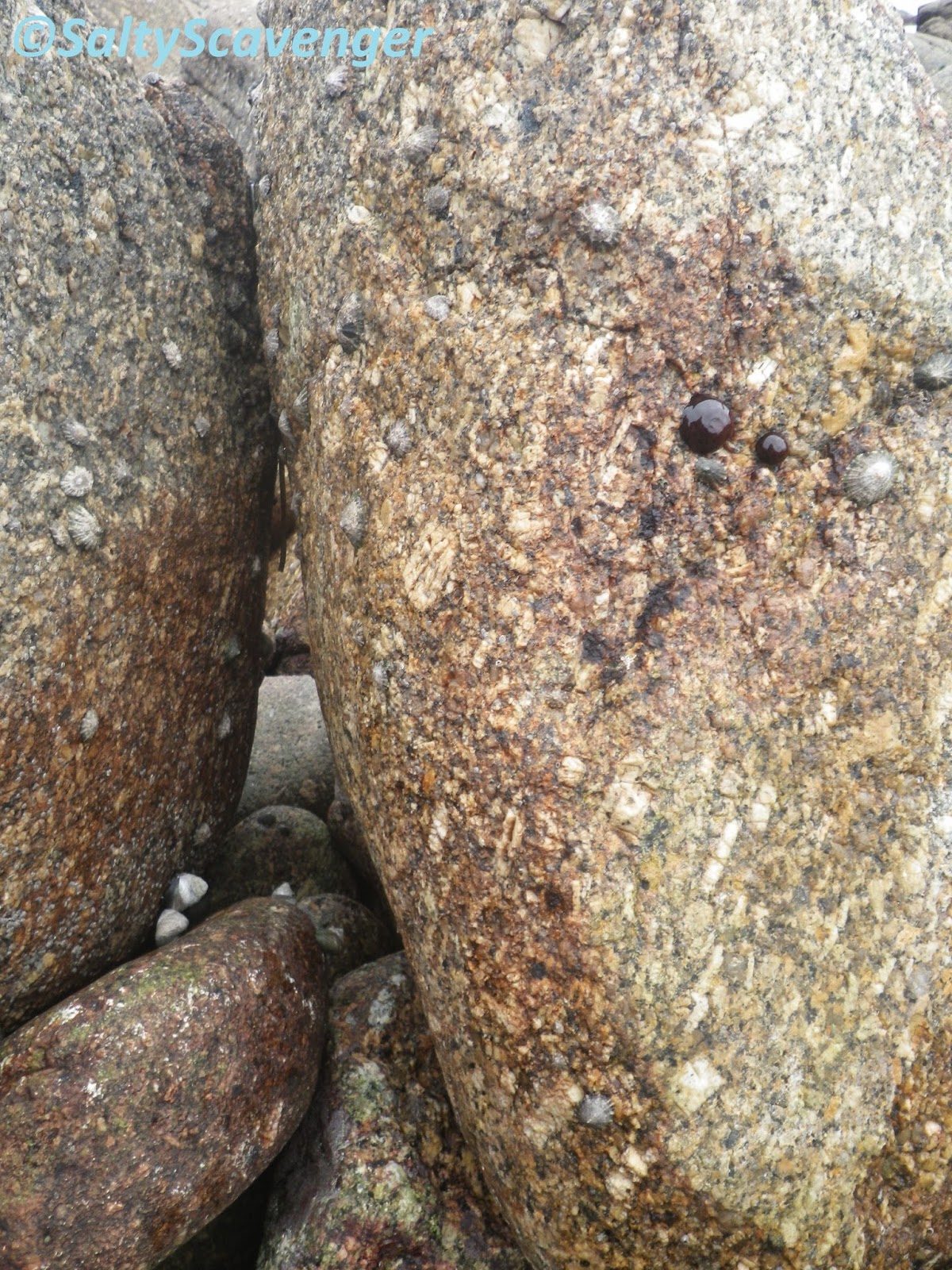
Else where fauna aggregate in crevices that support humid microclimates, and in so doing reduce desiccation. Here we can see Beadlet anemones (Actina equina), barnacles, dog whelks (Nucella lapillus) and limpets (Patella sp).

Deeper crevices support small coralline rockpools and aggregations of common blue mussels (Mytilus edulis). Habitat classification: LR.FLR.Rkp.Cor (Coralline crust dominated shallow eulittoral rockpools) EUNIS: A1.411 and LR.HLR. MusB (Mussel and/or barnacle communities) EUNIS: A1.11.

N. lapillus aggregate on the leeward side of the bedrock, to reduce the chances of dislodgement by the waves.

Gibbula umbilicus

Grey topshell (Gibbula cineraria)

Gibbula cineraria and beadlet anemone (Actina equina)
|


Barnacle communities dominate the mid and lower shore, inter dispersed by large rockpools and gullies.
 |
| Due to the high wave exposure seaweed abundance on the mid shore is low, restricted mainly to the more sheltered crevices and rockpools. |
 |
| Foam from the waves fills the gullies of the lower shore, here only robust wave tolerant species occur, including, turfs of red seaweeds and stunted fucoids, limpets and barnacles. Habitat classification: LR.HLR.FR (Robust fucoid and/or red seaweed communities) EUNIS: A1.12. |

Fucus cover is low, individuals are strong and tough. In late autumn these seaweeds show signs of seasonal dieback, so that only whip like midribs of the frond remain.
 |
| Dulse (Palmaria palmata) grows on the bottoms of the lower shore boulders. |
 |
| P. palmata |
 |
| Osmundea sp |
 |
| A flat periwinkle (Littorina sp) |
 |
| Gibbula umbilicus |

A crevice beneath an overhang on the lower shore is covered in filter feeders and coralline seaweeds. Barnacles, Beadlet anemones (Actina equina), Breadcrumb sponge (Halichondria panicea), Topshells, Limpets (Patella sp) and coralline seaweeds.
 |
| Red seaweeds cover the shaded boulder overhangs. |
 |
| A red seaweed forms a turf on the bedrock. |