Showing posts with label eunis habitats. Show all posts

Sunday, 15 March 2015

Rockpooling destination: St. Loy, Cornwall, October 2014 - Lower shore

The shore is a high energy environment comprised of boulders and bedrock with crevices, rock pools and gullies.

 
Fauna are relatively sparse among the boulder field of the spralittoral to upper shore, increasing within the rockpools, crevices and gullies of the mid and lower shore bedrock.


As the lower shore is reached robust wracks and red seaweeds increases in abundance.


Habitat classification (Lower shore):

Substrate
LR (Littoral rock)
Habitat
LR.HLR (High energy littoral rock)
Biotope complex
LR.HLR. MusB (Mussel and/or barnacle communities)
LR.HLR.FR (Robust fucoid and/or red seaweed communities)

Below are images of some of organisms you may encounter whilst rock pooling in these habitats:


On the lower shore wave tolerant red seaweeds form turfs with the wrack, Himanthalia elongata on the boulder below the barnacle communities . Habitat classification: LR.HLR.FR (Robust fucoid and/or red seaweed communities) EUNIS A1.12 and LR.HLR. MusB (Mussel and/or barnacle communities) EUNIS A1.11.


 On the exposed shore, Coral weed (Corallina officinalis) forms a turf  with the red seaweeds Osmundea sp, Lomentaria articulata and Mastrocarpus stellatus and occasional  bootlace weed (Himanthalia elongata).

Snakelocks anemone (Anemonia viridis) and Lomentaria articulata among coralline crusts.


Snakelocks anemones (Anemonia viridis) and the red seaweeds Osmundea sp, Corallina officinalis and coralline crusts. 

Mastrocarpus stellatusOsmundea Sp, Corallina officinalis,  Lomentaria articulata, young 'buttons' of  Himanthalia elongata and Coralline crusts.


Codium Sp.,  Corallina officinalis,  young 'buttons' of  Himanthalia elongata and Coralline crusts.


Some boulders as well as bedrock are covered in turfs of seaweed.


A variety of red and green seaweeeds cover the boulder.

A mix of reds including, Lomentaria articulata and Ceranium sp.

Blue raid limpets (Patella pellucida) on the lower shore.

Corallina officinalis

Many of the red seaweeds including, Gelidiales, grow as dense clusters and turfs.


A Gelidiale and Osmundea sp


A red seaweed


A plumose red and Mastrocarpus stellatus

Creep horn (Chondracanthus acicularis)

Osmundea sp forms a turf


A limpet (Patella sp) tackles a turf of Osmudea sp.


Seaweeds cover larger limpets of the lower shore.

 Gelidiale covers a limpet of the lower shore.


Flat top shell (Gibbula umbilicalis)


An encrusting soft red algae occurs as occasional patches covering rock and barnacles of the lower shore.

A plumose red seaweed and breadcrumb sponge (Halichondria panicea ).
Coralline crust and  a band of dulse (Palmaria palmata) on the lower shore.


Palmaria palmata


Palmaria palmata

An overhang provides shade, enabling subtidal species such as,  Fried egg anemones (Actinothoe sphyrodeta) to occur within the rockpool and enables Coralline crusts, Serpulid polychaetes  and breadcrumb sponge (Halichondria panicea)to extend up the shaded boulder sides; Grey topshells (Gibbula cineraria) also occur.


Sunday, 8 March 2015

Rockpooling destination: St. Loy, Cornwall October 2014 - Mid shore and rockpools


The shore is a high energy environment, comprised of boulders and bedrock, with crevices, rock pools and gullies.

 
Fauna are relatively sparse among the spralittoral and upper shore boulders (see previous post), increasing within the rockpools, crevices and gullies of the mid and lower shore bedrock.

Barnacle communities characterise much of the upper and mid shore, inter-dispersed by coralline rockpools.


Habitat classification (Mid shore and rockpools):


Substrate
LR (Littoral rock)

Habitat
LR.HLR (High energy littoral rock)
FLR (Features of littoral rock)
Biotope complex
LR.HLR. MusB (Mussel and/or barnacle communities)
LR.FLR.Rkp (Rockpools)
Biotope

LR.FLR.Rkp.Cor (Coralline crust dominated shallow eulittoral rockpools)
Sub Biotope
LR.FLR.Rkp.Cor.Bif (Bifurcaria bifurcata in shallow eulittoral rockpools)
LR.FLR.Rkp.Cor.Cor (Coralline crust and Corallina officialis in shallow eulittoral rockpools)


Below are images of some of organisms you may encounter whilst rock pooling in these habitats:


Once the exposed bedrock is reached there is a stark increase in barnacle abundance, with much of the remaining fauna restricted to the crevices and coralline rockpools. Habitat classification: LR.HLR. MusB (Mussel and/or barnacle communities) EUNIS: A1.11

The lichen, Lichina pygmaea occurs as patches among the barnacles.

Lichina pygmaea


Common mussels (Mytilus edulis) occur within the crevices of the bedrock.

Individual robust fucoids occur among the barnacles. Now in October, these fucoids are showing signs of seasonal die back.


Dog whelks (Nucella lapillus) feed upon the barnacles and mussels.

The deep groove at the bottom of the shells' opening is where the siphon comes out of.  It is   this siphon that the dog whelk uses to 'sniff out' food.


Barnacles and small periwinkles (Melarhaphe neritoides).

A coralline rockpool within the barnacle community. Habitat classification: LR.FLR.Rkp.Cor (Coralline crust dominated shallow eulittoral rockpools) EUNIS:A1.411 and  LR.HLR. MusB (Mussel and/or barnacle communities) EUNIS: A1.11

A shallow coralline rock pool dominated by pink corallinaceae crust on the upper mid shore.

A coralline rockpool on the mid shore.


A coralline rock pools with corallinaceae crusts, coral weed (Corallina officinalis) and a variety of red seaweeds on the lower shore. Habitat classification:  Coralline crusts and Corallina officinalis in shallow eulittoral rockpools(LR.FLR.Rkp.Cor.Cor) EUNIS: A1.4111


Corallinaceae crusts have formed where there is continual runoff from a rockpool above.


A coralline rockpool of the lower shore dominated by Corallina officinalis. The brown forkingweed (Bifurcaria bifurcata) also occurs and is charecteristic of the sub biotope LR.FLR.Rkp.Cor.Bif (Bifurcaria bifurcata in shallow eulittoral rockpools) EUNIS: A1.4113


A coralline rockpool of the lower shore dominated by Corallina officinalis with brown forkingweed (Bifurcaria bifurcata).


A coralline rockpool of the lower shore dominated by Corallina officinalis with brown forkingweed (Bifurcaria bifurcata).


A coralline rockpool of the lower shore with brown forkingweed (Bifurcaria bifurcata).


Corallina officinalis within a coralline rockpool.


Snakelocks anemone (Anemonia viridis) within a coralline rockpool.


Coral weed within a coralline rockpool.


A coralline rockpool. The sides of the rockpool are covered by corallinaceae crusts, clumps of coral weed (Corallina officinalis) sprout up like pink trees, Ulva sp often occur within these pools as does the brown forking weed (Bifurcaria bifurcata). On some coasts you may also encounter Codium fragile. Limpets (Patella sp) are also common within these rockpools. Habitat classification:LR.FLR.Rkp.Cor.Cor (Coralline crust and Corallina officinalis in shallow eulittoral rockpools) EUNIS: A1.4111.


A coralline rockpool. The sides of the rockpool are covered by corallinaceae crusts, clumps of coral weed (Corallina officinalis) sprout up like pink trees, Ulva sp often occur within these pools as does the brown forking weed (Bifurcaria bifurcata). On some coasts you may also encounter Japweed (Sargassum muticum) Limpets (Patella sp) and blenny are also common within the larger rockpools. Habitat classification: LR.FLR.Rkp.Cor (Coralline crust dominated shallow eulittoral rockpools).


Friday, 6 March 2015

Rockpooling destination: St. Loy, Cornwall October 2014 - Supralittoral - Upper shore


The shore is a high energy environment, comprised of boulders and bedrock, with crevices, rock pools and gullies.

 
Fauna are relatively sparse among the spralittoral and upper shore boulders, increasing within the rockpools, crevices and gullies of the mid and lower shore bedrock.

The upper most shore is charecterised by lichen communities, whilst barnacle communities occur across the rest of the shore, inter-dispersed by coralline rockpools and as the lower shore is reached, robust fucoids and red seaweeds come to dominate.


A river flows onto the shore and beneath the boulders, until it emerges again on the shore, this time marked by an increase in ephemeral green algae.

Where conditions are sheltered enough, a strandline of kelp occurs.


Habitat classification: (Supralittoral - Upper shore)


Habitat
LR.HLR (High energy littoral rock)
FLR (Features of littoral rock)
LS.LSa (Littoral sand)
Biotope complex
LR.HLR. MusB (Mussel and/or barnacle communities)
LR.FLR.Lic.(Lichens on supralittoral and littoral fringe rock).
LR.FLR.Eph (Ephemeral green or red seaweed communities
LS.LSa.St (Strandline)
Biotope

LR.FLR.Lic.YG (Yellow and grey lichens on supralittoral rock)
LR.FLR.Lic.Ver (Verrucaria Maura on littoral fringe rock)
LR.FLR.Eph (Ephermeral green or red seaweeds (Fresh water or sand influenced)

Sub Biotope


LR.FLR.Liv.VerB (Verrucaria maura and sparse barnacles on exposed littoral fringe rock)
LR.FLR.Lic.Ver.Ver (Verrucaria maura on very exposed to very sheltered
upper littoral fringe rock)


Below are images of some of organisms you may encounter whilst rock pooling in these habitats:


The exposed nature of the shore leads to an extended lichen zone. Habitat classification: LR.FLR.Lic.(Lichens on supralittoral and littoral fringe rock) ENUI.11S: B3 and LR.HLR. MusB (Mussel and/or barnacle communities) EUNIS: A1.11.

A variety of grey and yellow lichens occur on the boulders within the supra littoral. Habitat classification: LR.FLR.Lic.YG (Yellow and grey lichens on supralittoral rock) EUNIS: B3.111.

Below the grey and yellow lichens the black, Tar lichen (Verrucaria maura) covers the rock . Habitat classification: LR.FLR.Lic.Ver (Verrucaria maura on litto.ral fringe rock) EUNIS: B3.113
Faunal diversity is low among the boulders  and principally constitute Verrucaria maura and periwinkles. Here a rough periwinkle (Littorina sp) seeks refuge on the underside of a boulder. Habitat classification: A variant of LR.FLR.Lic.Ver.Ver (Verrucaria maura on very exposed to sheltered upper littoral fringe rock).


A limpet, Periwinkle (Littorina sp) and sparse barnacles occur below the more barren LR.LIC.Ver.Ver. Habitat classification:A variant of  LR.FLR.Liv.VerB (Verrucaria maura and sparse barnacles on exposed littoral fringe rock) EUNIS: B3.1131
A rough periwinkle (Littorina compressa), small periwnkles (Melarhaphe neritoides) and barnacles seek refuge from wave exposure by pushing them selves up into each knock and cranny that the uneven texture of the boulder face provides.

Rough periwinkles (Littorina sp) aggregate between boulders.

A rough periwinkle (Littorina saxatilis agg.) and small periwinkles (Melarhaphe neritoides).

A rough periwinkle (Littorina compressa)
Further down the shore the Verrucaria spp occurs as patches, and barnacle and limpet abundance increase. Other species, such as dog whelk (Nucella lapillus) also occur. Habitat classification: LR.HLR. MusB (Mussel and/or barnacle communities) EUNIS: A1.11.
Limpets
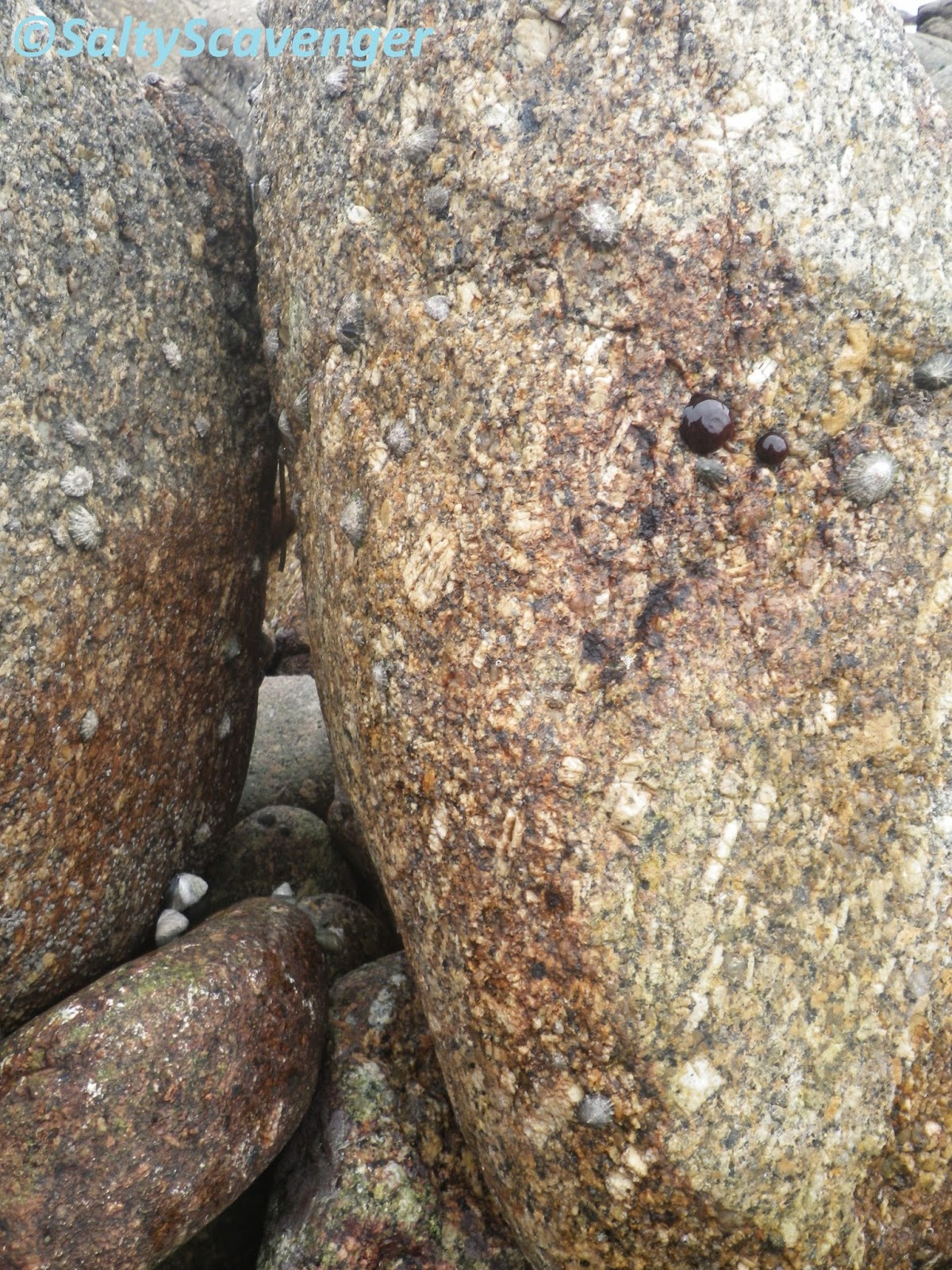
On exposed shores species aggregate on the leeward side of boulders to avoid  being dislodged by wave action.
Thick topshells (Osilinus lineatus) aggregate among more sheltered boulders that are in the lee of bedrock formations.
Thick topshells (Osilinus lineatus), beadlet anemones (Actinia equina), barnacles and limpets charecterise the upper shore barnacle communities.
An encrusting red grows on a boulder.
Catenella caespitosa forms a turf  in the damp between two boulders.