Friday, 19 June 2015

Rockpooling Destination: Treen Cornwall April 2015

The shore comprises shelving bedrock with gullies and rockpools. Lichens communities dominate large areas of the shore, eventually giving way to barnacle and mussel/fucoid communities. Rockpools occur throughout the shore, varying in species composition depending on their level of exposure to air and wave.

Below are images of the habitats and organisms you  may encounter whilst rockpooling on this shore:


The shore comprises shelving bedrock with gullies and rockpools. Lichens communities dominate large areas of the shore before they give way to barnacle and mussel/fucoid communities. Rockpools occur throughout the shore, varying in species composition depending on their level of exposure to air and wave. Habitat classification: LR.FLR.Lic.YG (Yellow and grey lichens on supralittoral rock) EUNIS B3.111, LR.FLR.Lic.Ver (Verrucaria Maura on littoral fringe rock) EUNIS: B3.113, LR.FLR.Rkp.Cor (Coralline crust dominated shallow eulittoral rockpools)  EUNIS: A1.4111, LR.HLR. MusB (Mussel and/or barnacle communities) EUNIS: A1.11.

Coralline rockpools and lower barnacle/fucoid shore communities:


On the mid to lower shore the coralline rockpools increase in species diversity, including increased numbers of red seaweeds and gastropods. Habitat classification: LR.FLR.Rkp.Cor.Cor (Coralline crusts and Corallina officinalis in shallow eulittoral rockpools) EUNIS: A1.4111.

The coralline rockpools come in a variety of shapes, sizes and depths which in turn influences the species found within.

A large coralline rockpool.
Corallina officinalis forms a turf on the edge of this deeper coralline rockpool.


The coralline rockpools support a variety of species, including Corallinaceae crusts, Mytilus edulis,  Corallina officinalis, Ulva spp and China limpets (Patella ulyssiponensis). The grazing gastropods can reduce the abundance of seaweeds within the rockpool, sometimes to such an extent that only a few non encrusting individuals remain!


Periwinkles (Littorina spp)
A blenny and beadlet anemones (Actina equina)

Corallinaceae crusts and Corallina officinalis.

 Corallina officinalis.
Corallina spp. turf
Barnacles 'peak' out from the surrounding Corallinaceae crusts that envelope them.

A china limpet (Patella ulyssiponensis)

Corallinaceae crusts and sponge.


Snakelocks anemones (Anemonia viridis)

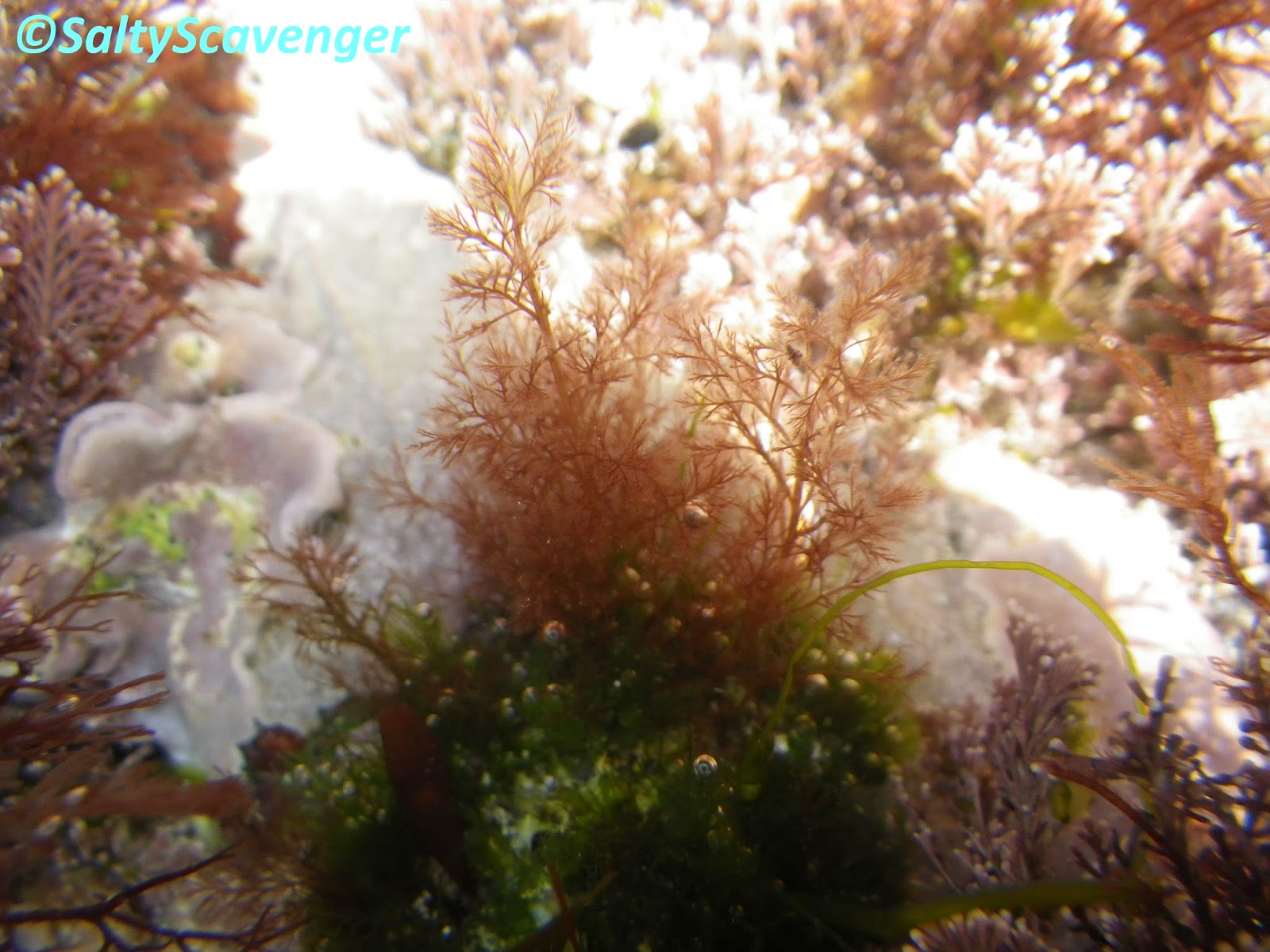
Where seaweeds can avoid grazing pressure a range of filamentous reds occur.
Ceranium spp


Many seaweeds avoid grazing by living on the grazers' shell!
A limpet encrusted by Corallinaceae crust.
Coralline rockpools of the lower shore support a greater number of brown seaweeds, and on this shore are typically characterised by the presence of the brown forking weed (Bifurcaria bifurcata).  Habitat classification: LR.FLR.Rkp.Cor.Bif  (Bifurcaria bifurcata in shallow eulittoral rockpools) EUNIS: A1.41113

Bifurcaria bifurcata  and Corallina officinalis

Young Himanthalia elongata overgrows Bifurcaria bifurcata and could, at this stage of growth, be confused with it.

Kelps may also be present within the deeper lower shore rockpools.

Red seaweed diversity and abundance increase within these deeper lower shore rockpools.

Chondrus crispus


Robust fucoids occur within a discrete band across the bedrock, marking the boundary between the barnacle dominated communities to the barnacle and fucoid communities.
Robust Fucus spp. showing signs of winter die back.

New growth of Fucus spp.

Deep crevices run through the bedrock, these shady areas retain water and contain coralline rockpools.
As the lower shore is reached there is an increase in those species that are more vulnerable to dessication. Beadlet anemones occur at a high abundance and Coralline algae is also able to grow where water seeps down the rock from the rockpools above. Habitat classification: LR.HLR.MusB (Mussel and/or barnacle communities) EUNIS A1.11.

Dog whelk (Nucella lapilus) abundance increase.


Dog whelks (Nucella lapilus), Limpets and barnacles.

Red seaweeds are no longer confined to rockpools and occur within the damp crevices and pits of the bedrock.
Dog whelks (Nucella lapillus)

Small periwinkles (Melarhaphe neritoides) seek refuge among the barnacles
Barnacles

Eventually the low water mark is characterised by Corallinaceae crusts and red seaweeds that cover the lower shore bedrock


Tuesday, 16 June 2015

Rockpooling Destination: Treen, Cornwall April 2015

The shore comprises shelving bedrock with gullies and rockpools. Lichens communities dominate large areas of the shore, eventually giving way to barnacle and mussel/fucoid communities. Rockpools occur throughout the shore, varying in species composition depending on their level of exposure to air and wave.

Below are images of the habitats and organisms you  may encounter whilst rockpooling on this shore:


The shore comprises shelving bedrock with gullies and rockpools. Lichens communities dominate large areas of the shore before they give way to barnacle and mussel/fucoid communities. Rockpools occur throughout the shore, varying in species composition depending on their level of exposure to air and wave. Habitat classification: LR.FLR.Lic.YG (Yellow and grey lichens on supralittoral rock) EUNIS B3.111, LR.FLR.Lic.Ver (Verrucaria Maura on littoral fringe rock) EUNIS: B3.113, LR.FLR.Rkp.Cor (Coralline crust dominated shallow eulittoral rockpools)  EUNIS: A1.4111, LR.HLR. MusB (Mussel and/or barnacle communities) EUNIS: A1.11.

 Yellow and grey lichens cover the spuralittoral bedrock, whilst Tar lichen (Verrucaria Maura) domaintes littoral fringe bedrock.  Habitat classification: LR.FLR.Lic.YG (Yellow and grey lichens on supralittoral rock) EUNIS B3.111.


Below the yellow and grey lichens, Tar lichen (Verrucaria Maura) covers littoral fringe bedrock. Rough periwinkles (Littorina spp) and small periwinkles (Melarhaphe neritoides) occur and in damp crevices patches of the ephemeral green algae, Ulva spp (Formally Entomoropha spp.) Habitat classification:LR.FLR.Lic.Ver (Verrucaria Maura on littoral fringe rock) EUNIS: B3.113.


Small periwinkles (Melarhaphe neritoides) and the lichens  Verrucaria maura and Caloplaca marina.


M. neritoides and   V.maura 

  V.maura , M. neritoides and  sparse barnacles. Habitat classification: LR.FLR.Lic.Ver.B (Verrucaria Maura and sparse barnacles on exposed littoral fringe rock) EUNIS: B3.1131.

Sparse barnacles and V. maura.

The rockpools within the Verrucaria maura biotope support relatively few species, in part due to the grazing of the periwinkles and the environmental fluctuations experienced within rockpools at this height on the shore. Habitat classification: LR.FLR.Rkp (Rockpools) EUNIS: A1.41.
Below the Verrucaria maura biotope rockpools of the upper shore are dominated by Corallinaceae crusts. Habitat classification: LR.FLR.Rkp.Cor (Coralline crust dominated shallow eulittoral rockpools) EUNIS: A1.411.
Barnacle density begins to increase as you descend down the shore. Barnacles and Melarhaphe neritoides. Habitat classification: LR.HLR. MusB (Mussel and/or barnacle communities), EUNIS: A1.11.

The lichen, Lichina pygmaea occurs as a band among the barnacles communities of the upper shore. Habitat classification: LR.HLR.MusB.Cht.Lpyg (Chthamalus spp. and Lichina pygmaea on steep exposed upper eulittoral rock) EUNIS: A1.1122

Lichina pygmaea  and Melarhaphe neritoides.

Lichina pygmaea

Common blue mussels (Mytilus edulis) occur within the crevices, covered by a red seaweed (Porphyra spp).


On the mid shore the mussel abundance increases, although their distribution continues to be confined to crevices among the barnacles. Habitat classification: LR.HLR.MusB.MytB (Mytilus edulis and barnacles on very exposed eulittoral rock) EUNIS: A1.111.

Barnacles, M. edulis and Porphyra spp.

M. edulis aggregate within crevices surrounded by barnacles and common limpets (Patella vulgata).

M. edulis and Porphyra spp.

M. edulis and Porphyra spp.
On sheltered aspects on the shore fucoids are interspersed among the barnacle and mussel community.  

Barnacles, Melarhaphe neritoides and Patella vulgata.