Showing posts with label Limpet. Show all posts

Sunday, 23 November 2014

Rockpooling destination: Unst, Shetland September 2014


The rocky shore comprises steeply shelving bedrock with crevices and small rock pools.
Tar lichen occurs in the littoral fringe and extends as patches into the upper shore (supralittoral). The upper and mid shore are charecterised by barnacles, periwinkles and limpets with the addition of mussels and dog whelks in the mid shore; ephemeral red and green seaweeds occur across the mid and lower shore. The abundance of barnacles and clumps of large mussels in the mid shore and presence of rock pools is characteristic of the habitats LR.MLR.BF (barnacles and fucoids on moderately exposed shores) and LR.FLR.Rkp (rock pools).

Habitat classification:


Biotope complex LR.MLR.BF (Barnacles and fucoids on moderately exposed shores) LR.FLR.Rkp (Rockpools)
Biotope   LR.FLR.Rkp.Cor (Corallina officinalis, coralline crusts and brown seaweeds in shallow eulittoral rockpools)

Below are images of the organisms you may encounter within this habitat:


The rocky shore comprises steeply sloping bed rock with crevices and small coralline rock pools.  The upper shore is charecterised by barnacles and periwinkles, the mid shore by barnacles, periwinkles, limpets, mussels, dog whelks and red seaweeds, whilst the lower shore is charecterised by ephemeral green and red seaweeds.

Barnacles and small periwinkles ( Melarhaphe neritoides) of the upper shore.

Barnacles density increases as you go down the shore.
Barnacles, mussels (Mytilus edulis) and small periwinkles ( Melarhaphe neritoides) of the mid shore. 
Dog whelks (Nucella lapillus), barnacles and M. edulis on the mid shore.


Old N. lapillus egg capsules.

M. edulis overgrown by red seaweeds.

M. edulis covered by Porphyra sp

Ephemeral greens (Ulva sp) and red (Porphyra sp) seaweeds on the lower shore.

Ephemeral greens (Ulva sp) and red (Porphyra sp) seaweeds on the lower shore.


Ephemeral greens (Ulva sp) and red (Porphyra sp) seaweeds on the lower shore.


Mastocarpus stellatus on lower shore.


Sunday, 2 November 2014

Rockpooling destination: North Shetland, September 2014

The shore comprised of pebbles, cobbles and boulders slopes gently to the low water mark and is positioned within a sheltered inlet on the Northern extend of Shetland main land.
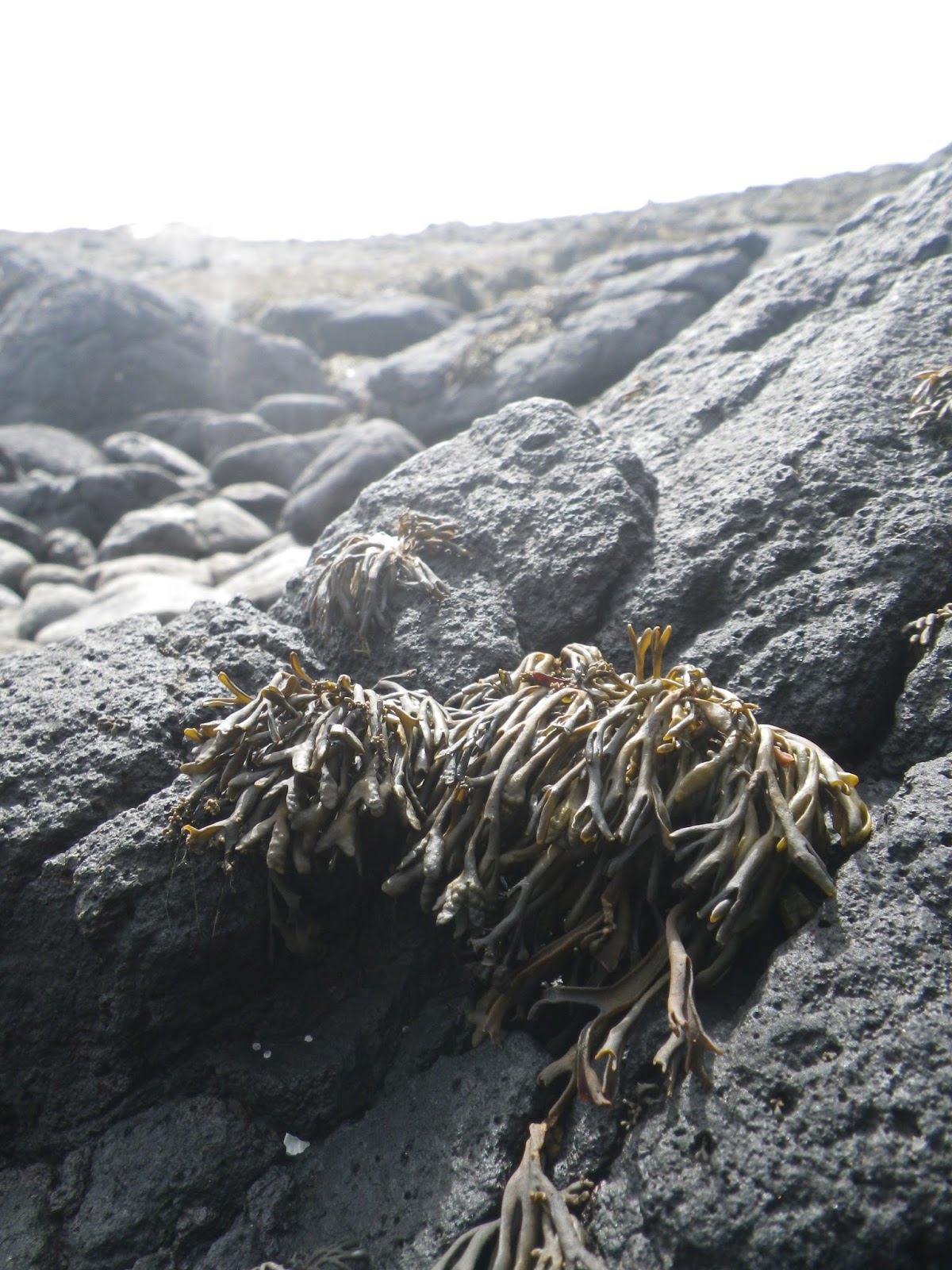
The upper most shore shore is characterised by lichens and succulent plants with a strandline of washed up seaweed and debris. Channel wrack forms a band in the upper shore before a blanket of fucoids come to cover the mid and lower shore.

Habitat classification:

Substrate
LR (Littoral rock)
Habitat
LLR (Low energy littoral rock)
FLR (Features of littoral rock)
Biotope complex
LR.LLR.F (Fucoids on sheltered marine shores)
LR.FLR.Lic (Lichens on supralittoral rock)
Biotope
LR.LLR.F.Asc (Ascophyllum nodosum on sheltered mid eulittoral rock).
LR.LLR.F.Pel (Pelvetia canaliculata on sheletered littoral fringe rock)
 (Fucus spiralis on moderately exposed to very sheltered upper eulittoral rock)
LR.FLR.Lic.YG (Yellow and grey lichens on supralittoral rock)
LR.FLR.Lic.Ver (Verrucaria maura on littoral fringe rock)


Below are images of organisms you may encounter whilst rock pooling in these habitats:

    The shore comprises relatively stable pebbles, cobbles and boulders within a sheltered inlet .Habitat classification: LR.LLR (Low energy littoral rock).

  In the splash zone ‘supralittoral’ yellow and grey lichens occur amongst the black lichen, Verrucaria maura. A red succulent plant also occurs amongst the crevices. Habitat classification: LR.FLR.Lic.YG (Yellow and grey lichens on supralittoral rock).

    Channel wrack (Pelvetia canaliculata) occurs as a band amongst Verrucaria maura in the upper shore. Habitat classification: LR.LLR.F.Pel (Pelvetia canaliculata on sheltered littoral fringe rock)

 New growth of P. canaliculata.

Spiral wrack (Fucus spiralis) with the occasional P. canaliculata occur below the main band of P. canaliculata of the upper shore. Habitat classification: LR.LLR.F.Fspi (Fucus spiralis on moderately exposed to very sheltered upper eulittoral rock) 

A barnacle

    New growth of F. spiralis

F. spiralis, Bladder wrack (Fucus vesiculosus) and Egg wrack (Ascophyllum nodosum).

  Egg wrack (A. nodosum) dominates the mid shore. Habitat classification: LR.LLR.F.Asc (Ascophyllum nodosum on sheltered mid eulittoral rock).

    Beneath the A. nodosum are limpets (Patella vulgata) and barnacles.

   Limpets, dog whelks (Nucella lapillus), edible periwinkles (Littorina littorea) and spirorbid polychaetes occur on boulders beneath the fucoid under storey.

   A limpet covered in spirorbid polychaetes.

  Edible periwinkles (Littorina littorea)

A flat periwinkle (Littorina sp.)

Ulva sp grows on the less stable mixed substrata.

  The surrounding edges of the inlet are comprised of a higher component of cobbles and boulders. Habitat classification: LR.LLR (Low energy littoral rock).

Thursday, 10 October 2013

Rock pooling destination: Behind the harbour Cafe on Eigg, May 2013

The shore comprises a bedrock platform that drops off towards the low tide mark and contains a number of rock pools.

Lichens occur in the splash zone and extend into the upper shore with channel wrack and periwinkles. The mid to lower shore is covered by a patch work of fucoids and barnacles. Rock pools occur across the shore, with species diversity increasing as you near the low tide mark.


Habitat classifications: 

Substrate
LR (Littoral rock)
Habitat
MLR (Moderate energy littoral rock)
FLR (Features of ilttoral rock)
Biotope complex
BF (Barnacles and fucoids on moderately exposed shores)
Rkp (Rockpools)
LR.FLR.Lic (Lichens or small green algae on supralittoral rock)
Biotope
LR.LMR.BF       (Pelvetia canaliculata and barnacles on moderately exposed shores)
LR.MLR.BF.FspiB (Fucus spiralis on full salinity exposed to moderately exposed upper eulittoral rock)
LR.FLR.Rkp.G        (Green seaweeds (Entomorpha spp. and Cladophora spp.) in shallow upper shore rock pools)
LR.FLR.Rkp.Cor (Coralline crust dominated shallow eulittoral rockpools)
LR.FLR.Lic.Ver (Verrucaria Maura on littoral fringe rock)

Below are images of some of the organisms you may encounter whilst rock pooling in these habitats:
The rocky shore at Eigg. Habitat classifications: LR.FLR.Lic (Lichens or small green algae on supralittoral rock), LR.MLR.BF (Barnacles and fucoids on moderately exposed shores) and LR.FLR.Rkp (Rock pools).


A rock pool in the upper shore is dominated by Entomorpha spp. Entomorpha spp. characterises the biotope LR.FLR.Rkp.G (Green seaweeds (Entomorpha spp. and cladophora spp. in shallow upper shore rock pools.) that occurs within the broader biotope complex LR.FLR.Rkp (Rockpools). The black lichen Verrucaria maura covers the surrounding rocks and characterises the biotope  LR.FLR.Lic.Ver (Verrucaria Maura on littoral fringe rock) that occurs within the broader biotope complex of LR.FLR.Lic (Lichens or small green algae on supralittoral rock).

Small periwinkles (Melarhaphe neritoides) seek shelter from desiccation within a crevice on the upper shore. Habitat classification: LR.FLR.Lic.Ver (Verrucaria Maura on littoral fringe rock).

The periwinkles, Littorina saxatilis and Melarhaphe neritoides) with Channel wrack (Pelvetia canaliculata)on the upper shore. Pelvetia canaliculata characterises the biotope LR.LMR.BF (Pelvetia canaliculata and barnacles on moderately exposed shores) that occurs within the broader biotope complex of LR.MLR.BF (Barnacles and fucoids on moderately exposed shores). The band of channel wrack delimits the upper extent of the biotope complex.

Channel wrack (Pelvetia canaliculata) and spiral wrack (Fucus spiralis) on the upper shore. Habitat classification: LR.LMR.BF (Pelvetia canaliculata and barnacles on moderately exposed shores).

The periwinkles, Littorina saxatilis and Melarhaphe neritoides) seek refuge in a rock pool of the upper shore. Habitat classification: LR.FLR.Rkp (Rockpools).

Rough periwinkles (Littorina saxatilis) and Entomorpha spp. in a pool. Habitat classification: LR.FLR.Rkp (Rockpools).

A shallow rock pool edges by clumps of spiral wrack (Fucus spiralis). Fucus spiralis characterises the biotope LR.MLR.BF.FspiB (Fucus spiralis on full salinity exposed to moderately exposed upper eulittoral rock) that occurs within the broader biotope complex of LR.MLR.BF (Barnacles and fucoids on moderately exposed shores). The rock pool itself holds a few patches of coralline crust and green algae. Habitat classification: LR.FLR.Rkp (Rockpools).

Seaweed deposited by wave action fills a rockpool; as the seaweed decomposes and using the available oxygen within the pool it can, over time, become stagnant. Habitat classification: LR.FLR.Rkp (Rockpools)

Spiral wrack (Fucus spiralis) has a patchy distribution interspersed with barnacles and rock pools. Habitat classification: LR.MLR.BF.FspiB (Fucus spiralis on full salinity exposed to moderately exposed upper eulittoral rock) and LR.FLR.Rkp (Rockpools).

Coralline crust extends over the bottom of the rock pool together with clumps of green algae, while spiral wrack (Fucus spiralis) edges the rock pool. Coralline crusts characterises the biotope LR.FLR.Rkp.Cor (Coralline crust dominated shallow eulittoral rockpools) that occurs within the broader biotope complex LR.FLR.Rkp (Rock pools).

A coralline crust dominated pool, with coral weed (Corallina officinalis), beadlet anemones (Actinia equina),  limpets (Patella sp), Topshells (Gibbula spp.), barnacles, the red seaweeds Osmundea spp and green seaweeds. Habitat classification: LR.FLR.Rkp.Cor (Coralline crust dominated shallow eulittoral rockpools). Surrounding the pool is a mosaic of barnacles and spiral wrack (Fucus spiralis). Habitat classification: LR.MLR.BF.FspiB (Fucus spiralis on full salinity exposed to moderately exposed upper eulittoral rock).


Friday, 30 August 2013

Rock pooling destination: Eilean Feoir, Eigg May 2013

The shore near Eilean Feoir comprises bedrock and boulders with rock pools of varying sizes. Lichens occur in the splash zone and extend into the upper shore with channel wrack and periwinkles. The mid to lower shore is covered by fucoids beneath which an understory community of gastropods, anemones, barnacles, crustaceans and saeweeds exists. Many of these species also occur within the large rockpools with the addition of a wider variety of red seaweeds, anemones and  encrusting fauna.


Habitats classification: 
Substrate
LR (Littoral rock)
Habitat
LLR (Low energy littoral rock)
FLR (Features of littoral rock)
Biotope complex
LR.LLR.F (Fucoids on sheltered marine shores)
Rkp (Rockpools)
LR.FLR.Lic (Lichens on supralittoral rock)
Biotope
LR.LLR.F.Pel (Pelvetia canaliculata on sheltered littoral fringe rock)
LR.LLR.F.Fspi (Fucus spiralis on sheltered upper eulittoral rock)
LR.LLR.F.Asc (Ascophyllum nodosum on very sheltered mid eulittoral rock)

LR.FLR.Lic.Ver (Verrucaria Maura on littoral fringe rock)
Below are images of some of the organisms you may encounter whilst rock pooling in these habitats:


 The rocky shore contains the biotope complexes LR.FLR.Lic (Lichens on supralittoral rock), LR.LLR.F (Fucoids on sheltered marine shores) and LR.FLR.Rkp (Rockpools).


 Lichens occur on supralittoral rock. Habitat classification: LR.FLR.Lic (Lichens on supralittoral rock).


Tar lichen (Verrucaria maura) covers the upper shore and characterises the biotope LR.FLR.Lic.Ver (Verrucaria maura on littoral fringe rock) that occurs within the broader biotope complex LR.FLR.Lic (Lichens on supralittoral rock).


 Channel wrack (Pelvetia canaliculata) on the upper shore. Pelvetia canaliculata characterises the biotope LR.LLR.F.Pel (Pelvetia canaliculata on sheltered littoral fringe rock) that occurs within the broader biotope complex of LR.LLR.F (Fucoids on sheltered marine shores).


  The rough periwinkle (Littorina saxatilis) seeks refuge from the sun in the shade between boulders of the upper shore. Habitat classification: LR.LLR.F.Pel (Pelvetia canaliculata on sheltered littoral fringe rock).


Channel wrack (Pelvetia canaliculata) and Spiral wrack (Fucus spiralis) on the upper-mid shore. Fucus spiralis characterises the biotope LR.LLR.F.Fspi (Fucus spiralis on sheltered upper eulittoral rock) that occurs within the broader biotope complex of LR.LLR.F (Fucoids on sheltered marine shores).


  Channel wrack (Pelvetia canaliculata) and Spiral wrack (Fucus spiralis) surround a rock pool of the upper-mid shore. Fucus spiralis in its reproductive phase with swollen ends to the frond known as receptacles that contain the conceptacles from which gametes are released. Habitat classification: LR.LLR.F.Fspi (Fucus spiralis) on sheltered upper eulittoral rock.


  Regrowth of Spiral wrack (Fucus spiralis). Habitat classification: LR.LLR.F.Fspi (Fucus spiralis) on sheltered upper eulittoral rock.


  Dog whelks (Nucella lapillus) amongst Spiral wrack (Fucus spiralis). Habitat classification: LR.LLR.F.Fspi (Fucus spiralis) on sheltered upper eulittoral rock.


   Beneath the fronds of Fucus spiralis are common limpets (Patella vulgata) and barnacles. Habitat classification: LR.LLR.F.Fspi (Fucus spiralis) on sheltered upper eulittoral rock.


   Beneath the fronds of Fucus spiralis are beadlet anemones (Actinia equina) and sparse barnacles. Habitat classification: LR.LLR.F.Fspi (Fucus spiralis) on sheltered upper eulittoral rock.


   Egg wrack (Ascophyllum nodosum) and the epiphyte Polysiphonia lanosa occur on the mid shore below the band of Fucus spiralis. Ascophyllum nodosum charecterises the biotope LR.LLR.F.Asc (Ascophyllum nodosum on very sheltered mid eulittoral rock) that occurs within the biotope complex of LR.LLR.F (Fucoids on sheltered marine shores).


The transition from the biotope : LR.LLR.F.Fspi (Fucus spiralis on sheltered upper eulittoral rock) to LR.LLR.F.Asc (Ascophyllum nodosum on very sheltered mid eulittoral rock) can clearly be seen. Such a distribution is driven by competition between species and their physiological tolerance to the environmental gradients experienced across the shore.


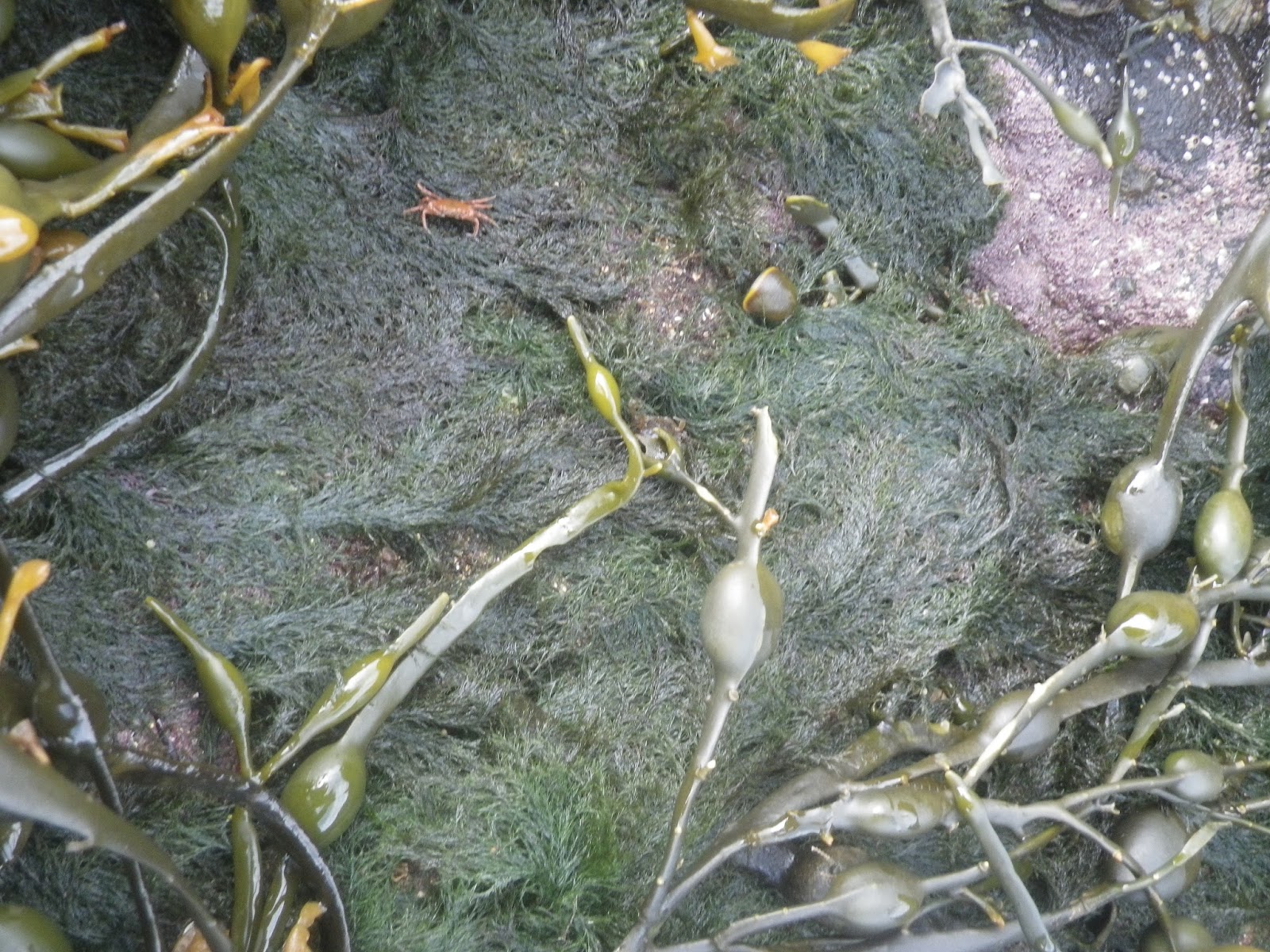
A juvenile crab, flat periwinkle (Littorina obtusata) and green seaweed, Cladophora rupestris occur beneath the Egg wrack (Ascophyllum nodosum). Habitat classification: LR.LLR.F.Asc (Ascophyllum nodosum on very sheltered mid eulittoral rock).


   Seaweed diversity increases within the refuge of the larger rock pools. Habitat classification: LR.FLR.Rkp (Rockpools).


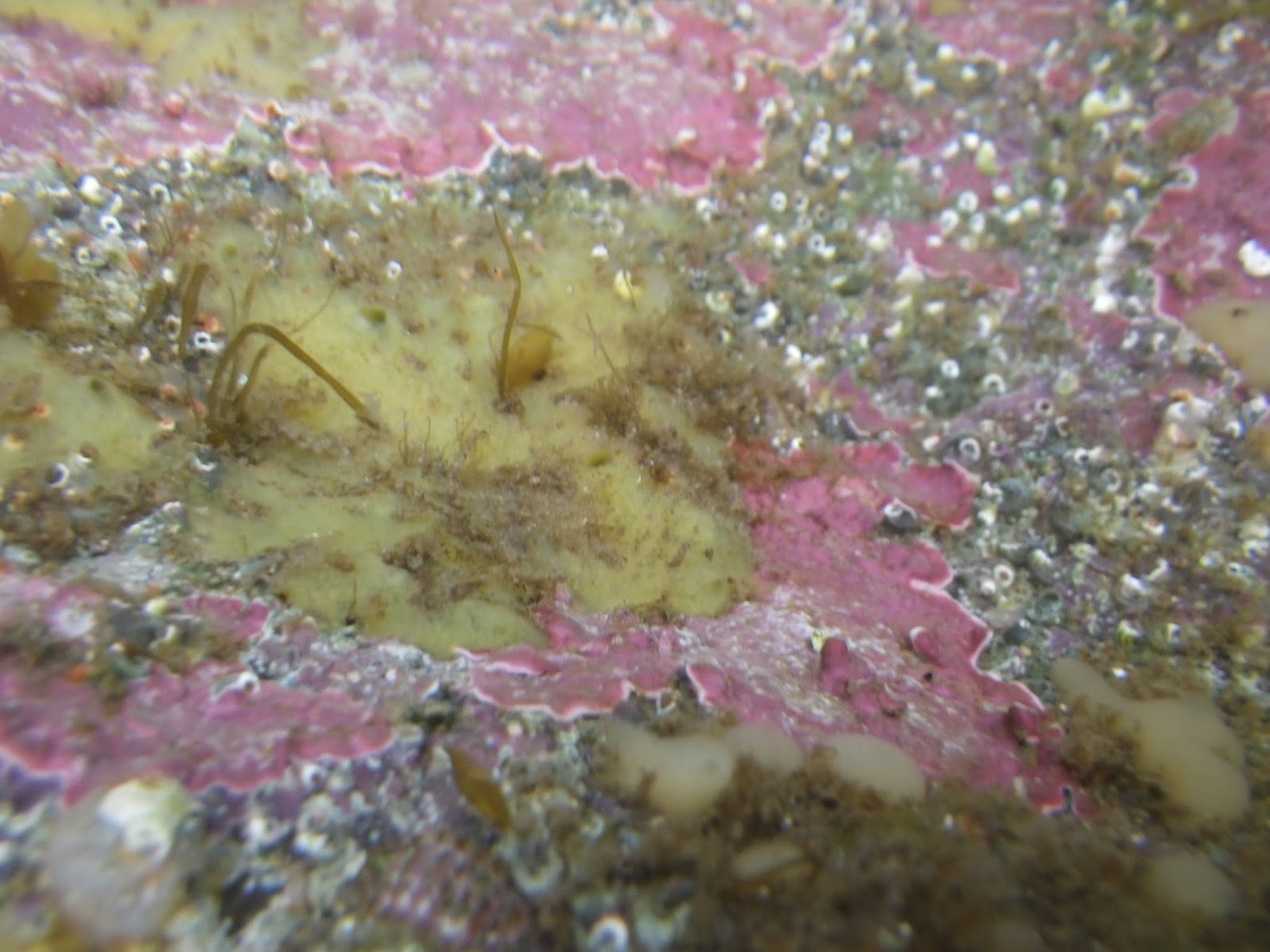
  Pebbles, Cobbles and boulders form the principle substrate within the rock pools and are colonised by bread crumb sponge (Halichondria (Halichondria) panicea), seaweeds and a variety of faunal turfs. Habitat classification: LR.FLR.Rkp (Rockpools).
 Juvenile barnacles cover the boulder and extend into the rock pool. The submerged section of the boulder is encrusted by coralline crusts; their upper limit on the boulder marking the lowest water levels experienced by the rock pool. Further down in the pool green algae occur and a beadlet anemone (Actinia equina). Above the water line a common limpet (Patella vulgata) wait motionless for the tide to return. Habitat classification: LR.FLR.Rkp (Rockpools).
Coralline crusts cover the submerged boulders of a rock pool. Habitat classification: LR.FLR.Rkp (Rockpools).


An under-boulder community within a rock pool. Habitat classification: LR.FLR.Rkp (Rockpools).


An under-boulder community within a rock pool. Habitat classification: LR.FLR.Rkp (Rockpools).
Juvenile anomiidae and spirorbidae on the under- side of a boulder within a rock pool. Habitat classification: LR.FLR.Rkp (Rockpools).


Snakelocks anemone (Anemonia viridis) within a rock pool. Habitat classification: LR.FLR.Rkp (Rockpools).


Snakelocks anemone (Anemonia viridis) attached to seaweed within a rock pool. Habitat classification: LR.FLR.Rkp (Rockpools).