Showing posts with label snakelocks anemone. Show all posts

Tuesday, 5 May 2015

Rockpooling Destination: Revisit South- West Penwith, October 2014 - Rockpools


The rocky shore is a high energy environment comprised of boulders and bedrock with rock pools, crevices and gullies.


The rocky shore is comprised of boulders and bedrock with rockpools, crevices and gullies. Habitat classification: LR.HLR (High energy littoral rock) EUNIS: A1.1 , LR.FLR.Rkp (Rockpools) EUNIS:A1.41 and LR.FLR.Lic.(Lichens on supralittoral and littoral fringe rock) EUNIS: B3.11.

The barnacle communities that dominate from the upper to lower shore are inter dispersed by shallow coralline rockpools in the mid shore, and deeper cobble filled rockpools on the lower shore. 

Habitat classification:


Substrate
LR (Littoral rock)
Habitat

LR.HLR (High energy littoral rock)
LR.FLR (Features of littoral rock)
Biotope complex


LR.HLR. MusB (Mussel and/or barnacle communities)
    LR.FLR.Lic.(Lichens on supralittoral and littoral fringe rock).

LR.FLR.Rkp (Rockpools)
Biotope

LR.FLR.Lic.Ver (Verrucaria Maura on  littoral fringe rock)

LR.FLR.Lic.YG (Yellow and grey lichens on supralittoral rock)
LR.FLR.Rkp.Cor (Coralline crust dominated shallow eulittoral rockpools)
SubBiotope

LR.FLR.Liv.VerB (Verrucaria maura and sparse barnacles on exposed littoral fringe rock)


LR.FLR.Rkp.Cor.Bif (Bifurcaria bifurcata in shallow eulittoral rockpools)


Below are images of the organisms you may encounter in the rockpools:


The rockpools on this high energy shore are characterized by the presence of coralline seaweeds that make the rockpools appear as if they have been covered in a layer of pink paint. Habitat classification: LR.FLR.Rkp.Cor (Coralline crust dominated shallow eulittoral rockpools) EUNIS: A1.411.


The coralline rockpools come in a variety of sizes.

Even crevices support small coralline rockpools as well as aggregations of common blue mussels (Mytilus edulis). Habitat classification: LR.FLR.Rkp.Cor (Coralline crust dominated shallow eulittoral rockpools) EUNIS: A1.411 and LR.HLR. MusB (Mussel and/or barnacle communities) EUNIS: A1.11.


The rockpools support a community that is distinct from the surrounding barnacle communities and includes a greater diversity of seaweed and mollusc species.


The rockpools support coralline species of red seaweed including, Corallinaceae crusts and Coral weed (Corallina officinalis), plus species found in the surrounding crevices of the barnacle habitat, such as  L. compressa nigrolineata and M. Edulis

China limpets (Patella ulyssiponsensis) are characteristic species of the coralline rockpools.


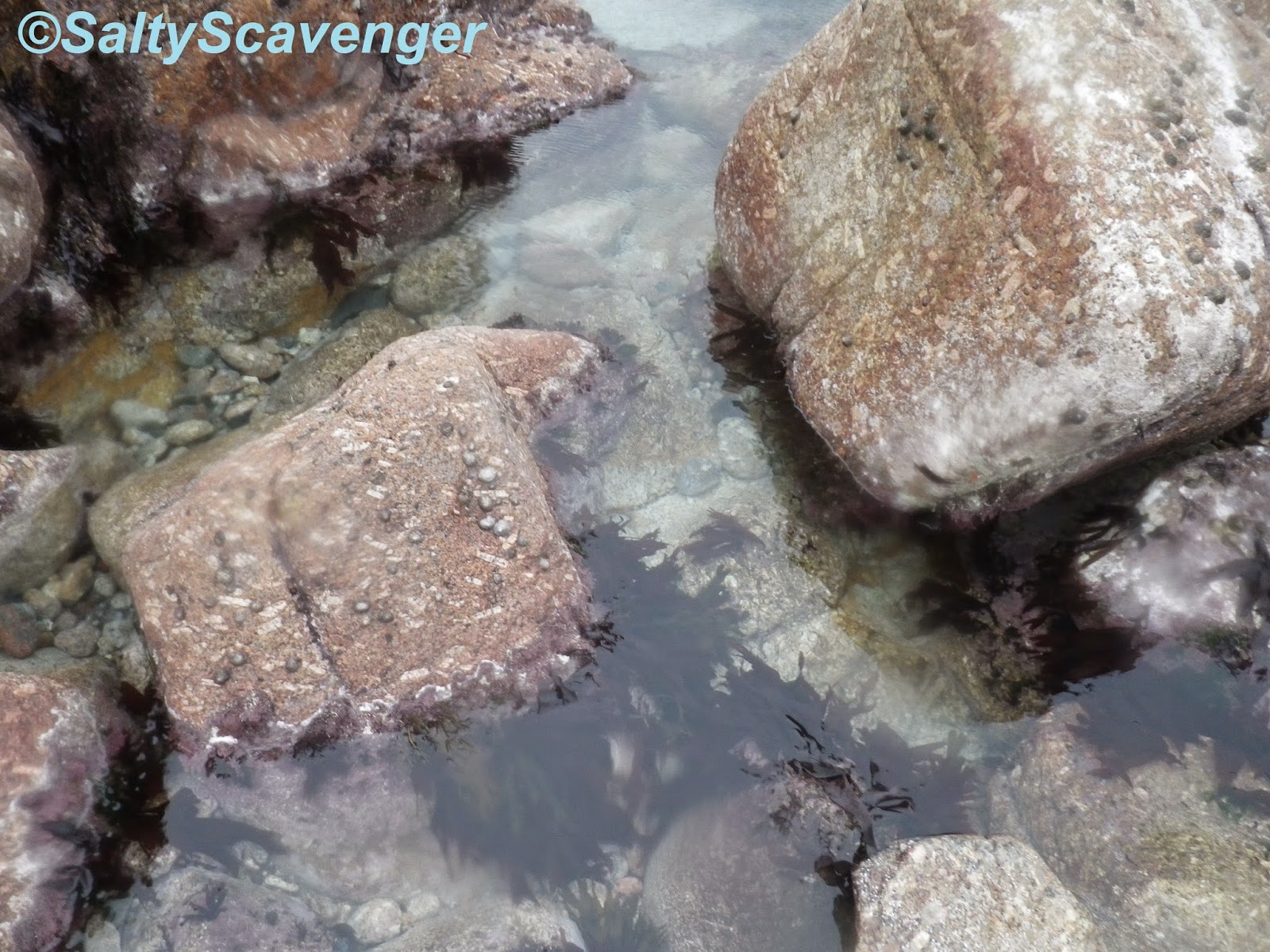
As the lower shore is reached large rockpools and gullies occur among the barnacle communities. Habitat classification: LR.FLR.Rkp (Rockpools) EUNIS: A1.4 and LR.HLR. MusB (Mussel and/or barnacle communities) EUNIS: A1.11..


The larger rockpools are filled with coarse sediments, ranging from gravel to boulders. 

The sheltered deep gravel and cobble filled rockpools support more life. Their edges are encrusted by corallinaceae crusts,  which are overgrown by other red seaweeds and the brown forking weed ( Bifurcaria bifurcata). Habitat classification: LR.FLR.Rkp.Cor.Bif (Bifurcaria bifurcata in shallow eulittoral rockpools) EUNIS: A1.4113

B. bifurcata edges the upper sides of the rockpool, while corallinaceae crusts and red seaweeds occur beneath.

The corallinaceae crusts cover the more stable boulders of the rockpool.

In less sheltered conditions the corallinaceae crusts are limited to the large boulders and Dulse (P. palmata)  grows in place of B. bifurcata.


Elsewhere turfts of fucoids and Coral weed (Corallina offiecinalis) edge rockpools.


C. officinalis is one of the most distinctive and characteristic seaweeds of the coralline rockpools.


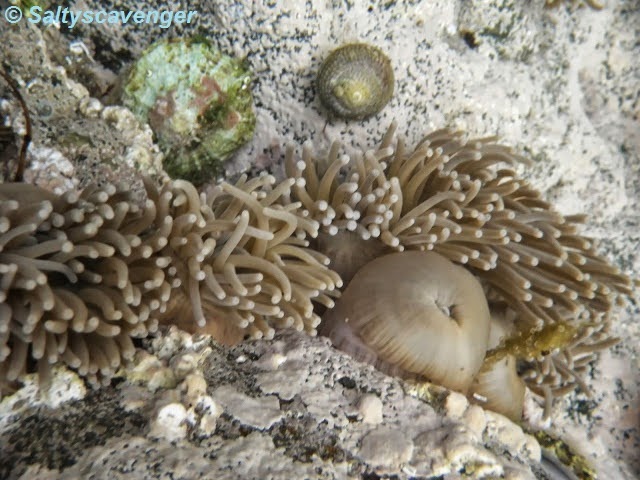
Snakelocks anemone (Anemonia viridis) and  C. officinalis.


C. officinalis.
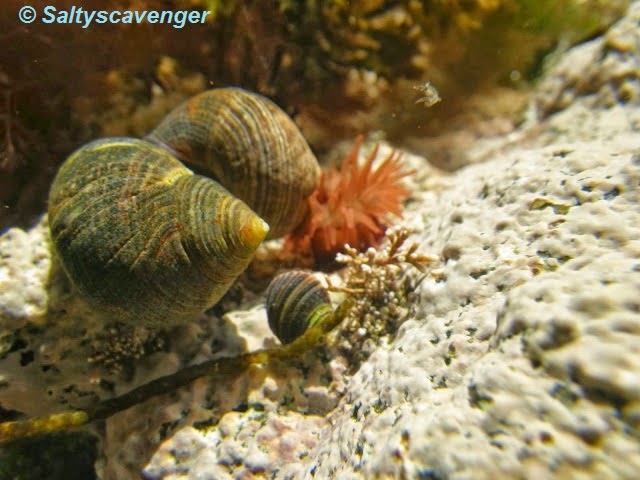
A variety of seaweeds and mobile fauna occur within the deeper rockpools of the lower shore, including grey topshell ( Gibbula cineraria), Ulva sp and corallinaceae crusts.
Red seaweeds predominately comprise the understory species.

Chondrus crispus


Dulse (Palmaria palmata) 
P. palmata

P. palmata, Corallinaceae crusts and young fucoids
A variety of anemones occur within the coralline rockpools.
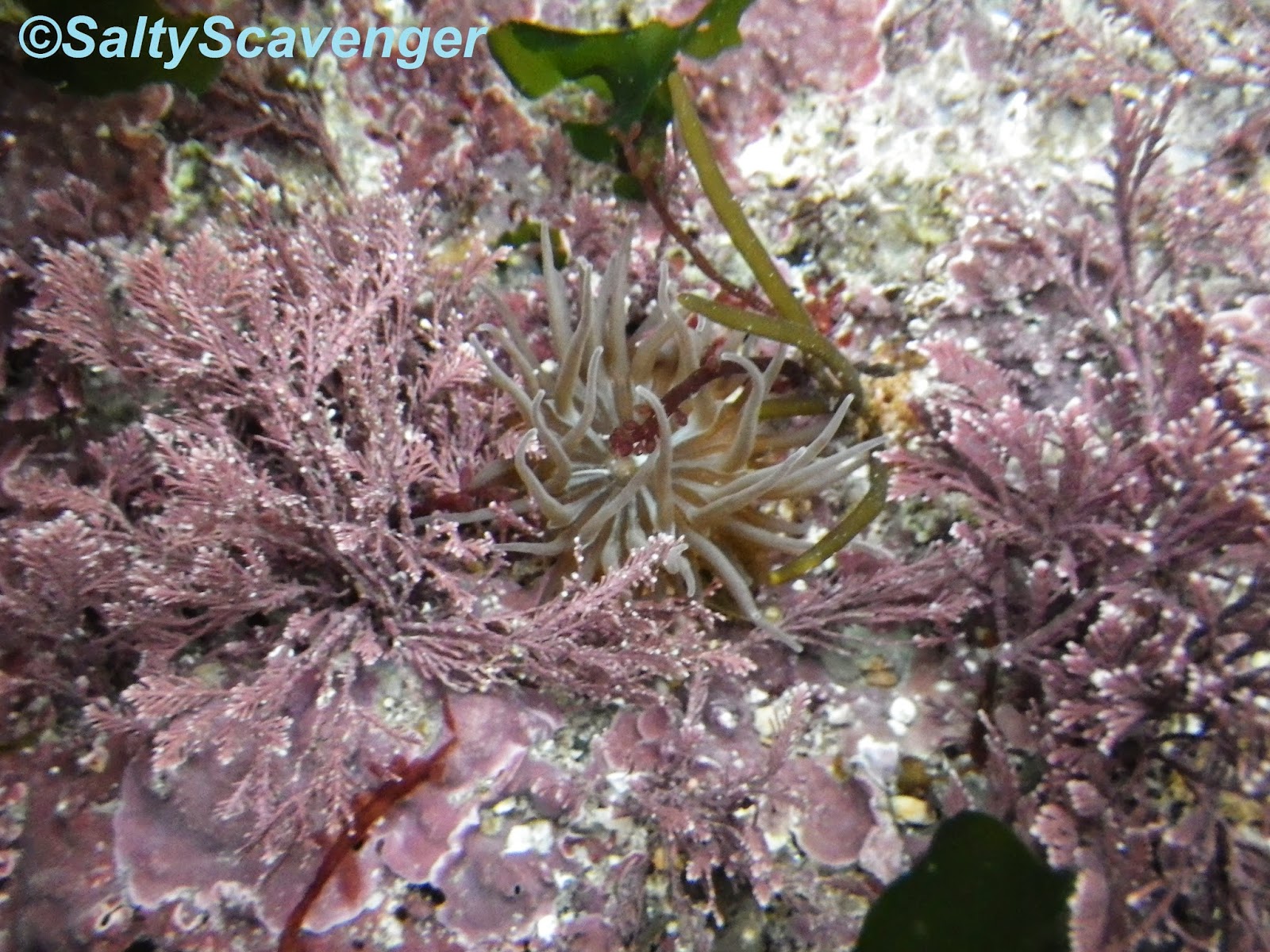

Snakelocks anemones (Anemonia viridis) occur in many of the coralline rockpools.
A. viridis

A. viridis can come in varying colours and often reach high densities in rockpools.
Gem anemones (Aulactinia verrucosa) can be found in rockpool crevices.


A beadlet anemone (Actina equina) and brittlestar (Ophiuroidea)


A cushionstar (Asterina gibbosa)

Seven armed starfish (Luidia ciliaris)


L. ciliaris

Three spot cowrie (Trivia monacha)

T. monacha


Sunday, 13 October 2013

Rockpooling destination:Near Mallaig, Scotland, May 2013


The shore comprises a small sandy bay with a cobble upper shore flanked by steep outcrops of bedrock and boulders, amongst which rockpools occur.

Habitat classifications: 

Substrate
LR (Littoral rock)
LS (Littoral substrate)
Habitat
HLR (High energy littoral rock)
FLR (Features of littoral rock)
LS.LSa (Littoral sand)
Biotope complex
LR.HLR. MusB (Mussel and/or barnacle communities)
Rkp (Rockpools)
LS.LSa.sh (Shingle and gravel shores)
LS.LSa.St (Strandline)
Biotope

LR.FLR.Rkp.Cor (Coralline crust dominated shallow eulittoral rockpools)


The shore. Habitat classification: LS.LSa (Littoral sand), LS.LSa.sh (Shingle and gravel shores) and LR.HLR. MusB (Mussel and/or barnacle communities).

Cobbles and pebbles comprise the substrate of the upper shore. Due to their mobile and porous  nature this is a species poor area of the shore. Habitat classification: LS.LSa.sh (Shingle and gravel shores).

Where a strand line forms fauna may be found as it provides a source of food and shelter from desiccation. Habitat classification: LS.LSa.St (Strandline) surrounded by LS.LSa.sh (Shingle and gravel shores).

Turning over the crisp seaweed within the strand line reveals a damp and moist environment where amphipods and terrestrial insects occur. Habitat classification: LS.LSa.St (Strandline).

The occasional wrack (Fucus spp) grows on the larger more stable boulders. Habitat classification: LS.LSa.sh (Shingle and gravel shores).

The ephemeral green algae Entomorpha spp. occurs where fresh water influx influences the shore during the spring/summer when the substrate becomes more stable. Habitat classification:  LS.LSa.sh (Shingle and gravel shores).
Entomorpha spp. Habitat classification:  LS.LSa.sh (Shingle and gravel shores).

The bedrock and boulders that flank the bay and extend around the coast are covered in barnacles and hold a number of varying sized rockpools. Habitat classifications: LR.HLR. MusB (Mussel and/or barnacle communities).

A coralline crust covered pool with limpets (Patella spp) and snakelocks anemones (Anemonia viridis). Habitat classification: LR.FLR.Rkp.Cor (Coralline crust dominated shallow eulittoral rockpools).

Coralline pool with limpets (Patella spp), Uvla spp. and snakelocks anemones (Anemonia viridis). Habitat classification: LR.FLR.Rkp.Cor (Coralline crust dominated shallow eulittoral rockpools).


Coralline pool with limpets (Patella spp), grey topshell (Gibbula cineraria), and open and closed snakelocks anemones (Anemonia viridis). Habitat classification: LR.FLR.Rkp.Cor (Coralline crust dominated shallow eulittoral rockpools).

Coralline pool with daisy anemones (Cereus pedunculatus). Habitat classification: LR.FLR.Rkp.Cor (Coralline crust dominated shallow eulittoral rockpools).

A serpulid worm in a coralline rockpool. Habitat classification: LR.FLR.Rkp.Cor (Coralline crust dominated shallow eulittoral rockpools).

Coral weed (Corallina officinalis) in a coralline rock pool. Habitat classification: LR.FLR.Rkp.Cor (Coralline crust dominated shallow eulittoral rockpools).

Coral weed (Corallina officinalis). A close up of the frond shows the white tips of new growth. Habitat classification: LR.FLR.Rkp.Cor (Coralline crust dominated shallow eulittoral rockpools

A china limpet (Patella ulyssiponensis). The tide had recently receded so that many limpets were still returning to their ‘scars’. Habitat classification: LR.FLR.Rkp.Cor (Coralline crust dominated shallow eulittoral rockpools).

Two china limpet (Patella ulyssiponensis). Habitat classification: LR.FLR.Rkp.Cor (Coralline crust dominated shallow eulittoral rockpools).

Two limpets interacting; often limpets will slam the edges of their shells down on one another in such interactions. Habitat classification: LR.FLR.Rkp.Cor (Coralline crust dominated shallow eulittoral rockpools).

china limpet (Patella ulyssiponensis) on its way and covered in epifauna including coralline crust, brown algae and spirorbid worms.  Habitat classification: LR.FLR.Rkp.Cor (Coralline crust dominated shallow eulittoral rockpools).

A small community algae, escape limpet predation by growing on its shell! Habitat classification: LR.FLR.Rkp.Cor (Coralline crust dominated shallow eulittoral rockpools).

Coralline crust has completely engulfed this limpet. Habitat classification: LR.FLR.Rkp.Cor (Coralline crust dominated shallow eulittoral rockpools).

Coralline pool with beadlet anemone (Actinia equina), daisy anemones (Cereus pedunculatus), edible periwinkles (Littorina littorea), flat topshell (Gibbula umbilicus), limpet (Patella spp) and a blenny. The blenny lies perfectly still relying upon its camouflage to stay undetected.  Habitat classification: LR.FLR.Rkp.Cor (Coralline crust dominated shallow eulittoral rockpools).

Edible periwinkles (Littorina littorea), beadlet anemone (Actinia equina) and Coral weed (Corallina officinalis) in a coralline pool. Habitat classification: LR.FLR.Rkp.Cor (Coralline crust dominated shallow eulittoral rockpools).