Sunday, 13 October 2013

Rockpooling destination:Near Mallaig, Scotland, May 2013


The shore comprises a small sandy bay with a cobble upper shore flanked by steep outcrops of bedrock and boulders, amongst which rockpools occur.

Habitat classifications: 

Substrate
LR (Littoral rock)
LS (Littoral substrate)
Habitat
HLR (High energy littoral rock)
FLR (Features of littoral rock)
LS.LSa (Littoral sand)
Biotope complex
LR.HLR. MusB (Mussel and/or barnacle communities)
Rkp (Rockpools)
LS.LSa.sh (Shingle and gravel shores)
LS.LSa.St (Strandline)
Biotope

LR.FLR.Rkp.Cor (Coralline crust dominated shallow eulittoral rockpools)


The shore. Habitat classification: LS.LSa (Littoral sand), LS.LSa.sh (Shingle and gravel shores) and LR.HLR. MusB (Mussel and/or barnacle communities).

Cobbles and pebbles comprise the substrate of the upper shore. Due to their mobile and porous  nature this is a species poor area of the shore. Habitat classification: LS.LSa.sh (Shingle and gravel shores).

Where a strand line forms fauna may be found as it provides a source of food and shelter from desiccation. Habitat classification: LS.LSa.St (Strandline) surrounded by LS.LSa.sh (Shingle and gravel shores).

Turning over the crisp seaweed within the strand line reveals a damp and moist environment where amphipods and terrestrial insects occur. Habitat classification: LS.LSa.St (Strandline).

The occasional wrack (Fucus spp) grows on the larger more stable boulders. Habitat classification: LS.LSa.sh (Shingle and gravel shores).

The ephemeral green algae Entomorpha spp. occurs where fresh water influx influences the shore during the spring/summer when the substrate becomes more stable. Habitat classification:  LS.LSa.sh (Shingle and gravel shores).
Entomorpha spp. Habitat classification:  LS.LSa.sh (Shingle and gravel shores).

The bedrock and boulders that flank the bay and extend around the coast are covered in barnacles and hold a number of varying sized rockpools. Habitat classifications: LR.HLR. MusB (Mussel and/or barnacle communities).

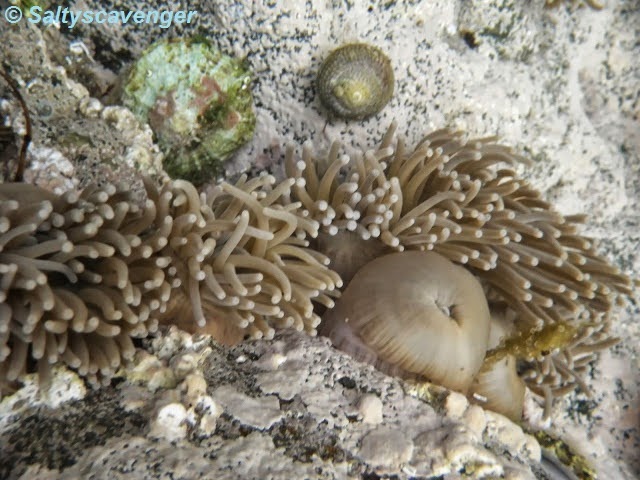
A coralline crust covered pool with limpets (Patella spp) and snakelocks anemones (Anemonia viridis). Habitat classification: LR.FLR.Rkp.Cor (Coralline crust dominated shallow eulittoral rockpools).

Coralline pool with limpets (Patella spp), Uvla spp. and snakelocks anemones (Anemonia viridis). Habitat classification: LR.FLR.Rkp.Cor (Coralline crust dominated shallow eulittoral rockpools).


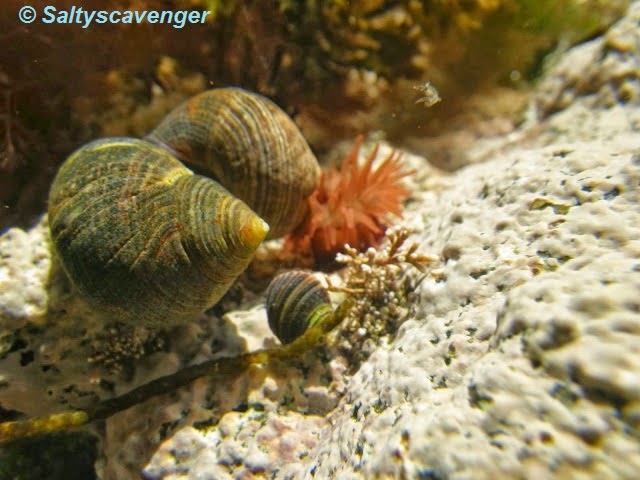
Coralline pool with limpets (Patella spp), grey topshell (Gibbula cineraria), and open and closed snakelocks anemones (Anemonia viridis). Habitat classification: LR.FLR.Rkp.Cor (Coralline crust dominated shallow eulittoral rockpools).

Coralline pool with daisy anemones (Cereus pedunculatus). Habitat classification: LR.FLR.Rkp.Cor (Coralline crust dominated shallow eulittoral rockpools).

A serpulid worm in a coralline rockpool. Habitat classification: LR.FLR.Rkp.Cor (Coralline crust dominated shallow eulittoral rockpools).

Coral weed (Corallina officinalis) in a coralline rock pool. Habitat classification: LR.FLR.Rkp.Cor (Coralline crust dominated shallow eulittoral rockpools).

Coral weed (Corallina officinalis). A close up of the frond shows the white tips of new growth. Habitat classification: LR.FLR.Rkp.Cor (Coralline crust dominated shallow eulittoral rockpools

A china limpet (Patella ulyssiponensis). The tide had recently receded so that many limpets were still returning to their ‘scars’. Habitat classification: LR.FLR.Rkp.Cor (Coralline crust dominated shallow eulittoral rockpools).

Two china limpet (Patella ulyssiponensis). Habitat classification: LR.FLR.Rkp.Cor (Coralline crust dominated shallow eulittoral rockpools).

Two limpets interacting; often limpets will slam the edges of their shells down on one another in such interactions. Habitat classification: LR.FLR.Rkp.Cor (Coralline crust dominated shallow eulittoral rockpools).

china limpet (Patella ulyssiponensis) on its way and covered in epifauna including coralline crust, brown algae and spirorbid worms.  Habitat classification: LR.FLR.Rkp.Cor (Coralline crust dominated shallow eulittoral rockpools).

A small community algae, escape limpet predation by growing on its shell! Habitat classification: LR.FLR.Rkp.Cor (Coralline crust dominated shallow eulittoral rockpools).

Coralline crust has completely engulfed this limpet. Habitat classification: LR.FLR.Rkp.Cor (Coralline crust dominated shallow eulittoral rockpools).

Coralline pool with beadlet anemone (Actinia equina), daisy anemones (Cereus pedunculatus), edible periwinkles (Littorina littorea), flat topshell (Gibbula umbilicus), limpet (Patella spp) and a blenny. The blenny lies perfectly still relying upon its camouflage to stay undetected.  Habitat classification: LR.FLR.Rkp.Cor (Coralline crust dominated shallow eulittoral rockpools).

Edible periwinkles (Littorina littorea), beadlet anemone (Actinia equina) and Coral weed (Corallina officinalis) in a coralline pool. Habitat classification: LR.FLR.Rkp.Cor (Coralline crust dominated shallow eulittoral rockpools).


Thursday, 10 October 2013

Rock pooling destination: Behind the harbour Cafe on Eigg, May 2013

The shore comprises a bedrock platform that drops off towards the low tide mark and contains a number of rock pools.

Lichens occur in the splash zone and extend into the upper shore with channel wrack and periwinkles. The mid to lower shore is covered by a patch work of fucoids and barnacles. Rock pools occur across the shore, with species diversity increasing as you near the low tide mark.


Habitat classifications: 

Substrate
LR (Littoral rock)
Habitat
MLR (Moderate energy littoral rock)
FLR (Features of ilttoral rock)
Biotope complex
BF (Barnacles and fucoids on moderately exposed shores)
Rkp (Rockpools)
LR.FLR.Lic (Lichens or small green algae on supralittoral rock)
Biotope
LR.LMR.BF       (Pelvetia canaliculata and barnacles on moderately exposed shores)
LR.MLR.BF.FspiB (Fucus spiralis on full salinity exposed to moderately exposed upper eulittoral rock)
LR.FLR.Rkp.G        (Green seaweeds (Entomorpha spp. and Cladophora spp.) in shallow upper shore rock pools)
LR.FLR.Rkp.Cor (Coralline crust dominated shallow eulittoral rockpools)
LR.FLR.Lic.Ver (Verrucaria Maura on littoral fringe rock)

Below are images of some of the organisms you may encounter whilst rock pooling in these habitats:
The rocky shore at Eigg. Habitat classifications: LR.FLR.Lic (Lichens or small green algae on supralittoral rock), LR.MLR.BF (Barnacles and fucoids on moderately exposed shores) and LR.FLR.Rkp (Rock pools).


A rock pool in the upper shore is dominated by Entomorpha spp. Entomorpha spp. characterises the biotope LR.FLR.Rkp.G (Green seaweeds (Entomorpha spp. and cladophora spp. in shallow upper shore rock pools.) that occurs within the broader biotope complex LR.FLR.Rkp (Rockpools). The black lichen Verrucaria maura covers the surrounding rocks and characterises the biotope  LR.FLR.Lic.Ver (Verrucaria Maura on littoral fringe rock) that occurs within the broader biotope complex of LR.FLR.Lic (Lichens or small green algae on supralittoral rock).

Small periwinkles (Melarhaphe neritoides) seek shelter from desiccation within a crevice on the upper shore. Habitat classification: LR.FLR.Lic.Ver (Verrucaria Maura on littoral fringe rock).

The periwinkles, Littorina saxatilis and Melarhaphe neritoides) with Channel wrack (Pelvetia canaliculata)on the upper shore. Pelvetia canaliculata characterises the biotope LR.LMR.BF (Pelvetia canaliculata and barnacles on moderately exposed shores) that occurs within the broader biotope complex of LR.MLR.BF (Barnacles and fucoids on moderately exposed shores). The band of channel wrack delimits the upper extent of the biotope complex.

Channel wrack (Pelvetia canaliculata) and spiral wrack (Fucus spiralis) on the upper shore. Habitat classification: LR.LMR.BF (Pelvetia canaliculata and barnacles on moderately exposed shores).

The periwinkles, Littorina saxatilis and Melarhaphe neritoides) seek refuge in a rock pool of the upper shore. Habitat classification: LR.FLR.Rkp (Rockpools).

Rough periwinkles (Littorina saxatilis) and Entomorpha spp. in a pool. Habitat classification: LR.FLR.Rkp (Rockpools).

A shallow rock pool edges by clumps of spiral wrack (Fucus spiralis). Fucus spiralis characterises the biotope LR.MLR.BF.FspiB (Fucus spiralis on full salinity exposed to moderately exposed upper eulittoral rock) that occurs within the broader biotope complex of LR.MLR.BF (Barnacles and fucoids on moderately exposed shores). The rock pool itself holds a few patches of coralline crust and green algae. Habitat classification: LR.FLR.Rkp (Rockpools).

Seaweed deposited by wave action fills a rockpool; as the seaweed decomposes and using the available oxygen within the pool it can, over time, become stagnant. Habitat classification: LR.FLR.Rkp (Rockpools)

Spiral wrack (Fucus spiralis) has a patchy distribution interspersed with barnacles and rock pools. Habitat classification: LR.MLR.BF.FspiB (Fucus spiralis on full salinity exposed to moderately exposed upper eulittoral rock) and LR.FLR.Rkp (Rockpools).

Coralline crust extends over the bottom of the rock pool together with clumps of green algae, while spiral wrack (Fucus spiralis) edges the rock pool. Coralline crusts characterises the biotope LR.FLR.Rkp.Cor (Coralline crust dominated shallow eulittoral rockpools) that occurs within the broader biotope complex LR.FLR.Rkp (Rock pools).

A coralline crust dominated pool, with coral weed (Corallina officinalis), beadlet anemones (Actinia equina),  limpets (Patella sp), Topshells (Gibbula spp.), barnacles, the red seaweeds Osmundea spp and green seaweeds. Habitat classification: LR.FLR.Rkp.Cor (Coralline crust dominated shallow eulittoral rockpools). Surrounding the pool is a mosaic of barnacles and spiral wrack (Fucus spiralis). Habitat classification: LR.MLR.BF.FspiB (Fucus spiralis on full salinity exposed to moderately exposed upper eulittoral rock).


Thursday, 5 September 2013

Rock pooling destination: Bay of Laig, Eigg May 2013

The rocky shore at the Bay of Laig: Shelving bed rock juts out into the sand. Habitat classification: LR.FLR.Eph Ephermeral green or red seaweeds (Fresh water or sand influenced), LR.MLR.BF (Barnacles and fucoids on moderately exposed shores) and LR.FLR.Rkp (Rock pools).


The shore comprises shelving bedrock and boulders with shallow rock pools and narrow gullies  below which sand extends to the low water mark.

The top of the rocky shore is influenced by fresh water runoff, whilst the lower extremity is influenced by sand scour. Both these factors interact to determine the communities present.


Ephermeral green seaweed characterises areas of the upper shore where there is fresh water influx, elsewhere on the upper shore channel wrack, barnacles and periwinkles occur. As you extend further down the shore fucoids increasingly dominate the available hard substrate, until the lower rocky shore is reached and sand resistant species form bands with Fucus serratus perpendicular to the shore in relation to the shelving bedrock.


Habitat classifications:


Substrate
LR (Littoral rock)
Habitat
MLR (Moderate energy littoral rock)
FLR (Features of ilttoral rock)
Biotope complex
BF (Barnacles and fucoids on moderately exposed shores)
Eph (Ephemeral green or red seaweed communities
Rkp (Rockpools)
Biotope
LR.LMR.BF.Pel (Pelvetia canaliculata and barnacles on moderately exposed shores)
LR.MLR.BF.FspiB (Fucus spiralis on full salinity exposed to moderately exposed upper eulittoral rock)
LR.MLR.BF.Fser (Fucus serratus on moderately exposed mid eulittoral rock)
LR.MLR.BF.Rho (Rhodothamniella floridula on sand scoured lower eulittoral rock)
LR.FLR.Eph (Ephermeral green or red seaweeds (Fresh water or sand influenced)
LR.FLR.Eph.EntPor (Porphyra purpurea and Entomorpha spp. on sand scoured lower eulittoral rock)


Below are images of these habitats and the organisms you may encounter whilst rock pooling within it:


Ephermeral green seaweed characterises areas of the upper shore where there is fresh water influx. Habitat classification: LR.FLR.Eph Ephermeral green or red seaweeds (Fresh water or sand influenced).


Channel wrack (Pelvetia canaliculata), Spiral wrack (Fucus spiralis), Common blue mussel (Mytilus edulis) and barnacles on the upper shore.  Pelvetia canaliculata characterises the biotope LR.LMR.BF.Pel (Pelvetia canaliculata and barnacles on moderately exposed shores) that occurs within the broader biotope complex of LR.MLR.BF (Barnacles and fucoids on moderately exposed shores). The band of channel wrack delimits the upper extent of the biotope complex.

Channel wrack (Pelvetia canaliculata) in its reproductive phase with swollen ends to the frond known as receptacles that contain the conceptacles from which gametes are released.
Habitat classification: LR.LMR.BF.Pel (Pelvetia canaliculata and barnacles on moderately exposed shores).

 The rough and small periwinkles (Littorina spp and Melarhaphe neritoides) seek refuge within a depression of a boulder that has also been colonised by a group of barnacles. Habitat classification: LR.LMR.BF.Pel (Pelvetia canaliculata and barnacles on moderately exposed shores).

Spiral wrack (Fucus spiralis), barnacles and Limpets (Patella vulgata).  Fucus spiralis characterises the biotope LR.MLR.BF.FspiB (Fucus spiralis on full salinity exposed to moderately exposed upper eulittoral rock) that occurs within the broader biotope complex of LR.MLR.BF (Barnacles and fucoids on moderately exposed shores).


Within the crevices of the bed rock, barnacles, common blue mussels (Mytilus edulis) and rough periwinkles (Littorina saxatilis and L. Compressa) occur. Habitat classification LR.MLR.BF.FspiB (Fucus spiralis on full salinity exposed to moderately exposed upper eulittoral rock).
Fucoids exhibit a patchy distribution across the shore. Habitat classification: LR.MLR.BF (Barnacles and fucoids on moderately exposed shores).


A gully of the lower shore edged by serrated wrack (Fucus serratus). Fucus serratus characterises the biotope LR.MLR.BF.Fser (Fucus serratus on moderately exposed mid eulittoral rock) that occurs within the broader biotope complex of LR.MLR.BF (Barnacles and fucoids on moderately exposed shores).
Serrated wrack (Fucus serratus) in its reproductive phase with swollen and mottled areas on the frond known as conceptacles from which gametes are released. Habitat classification: LR.MLR.BF.Fser (Fucus serratus on moderately exposed mid eulittoral rock).
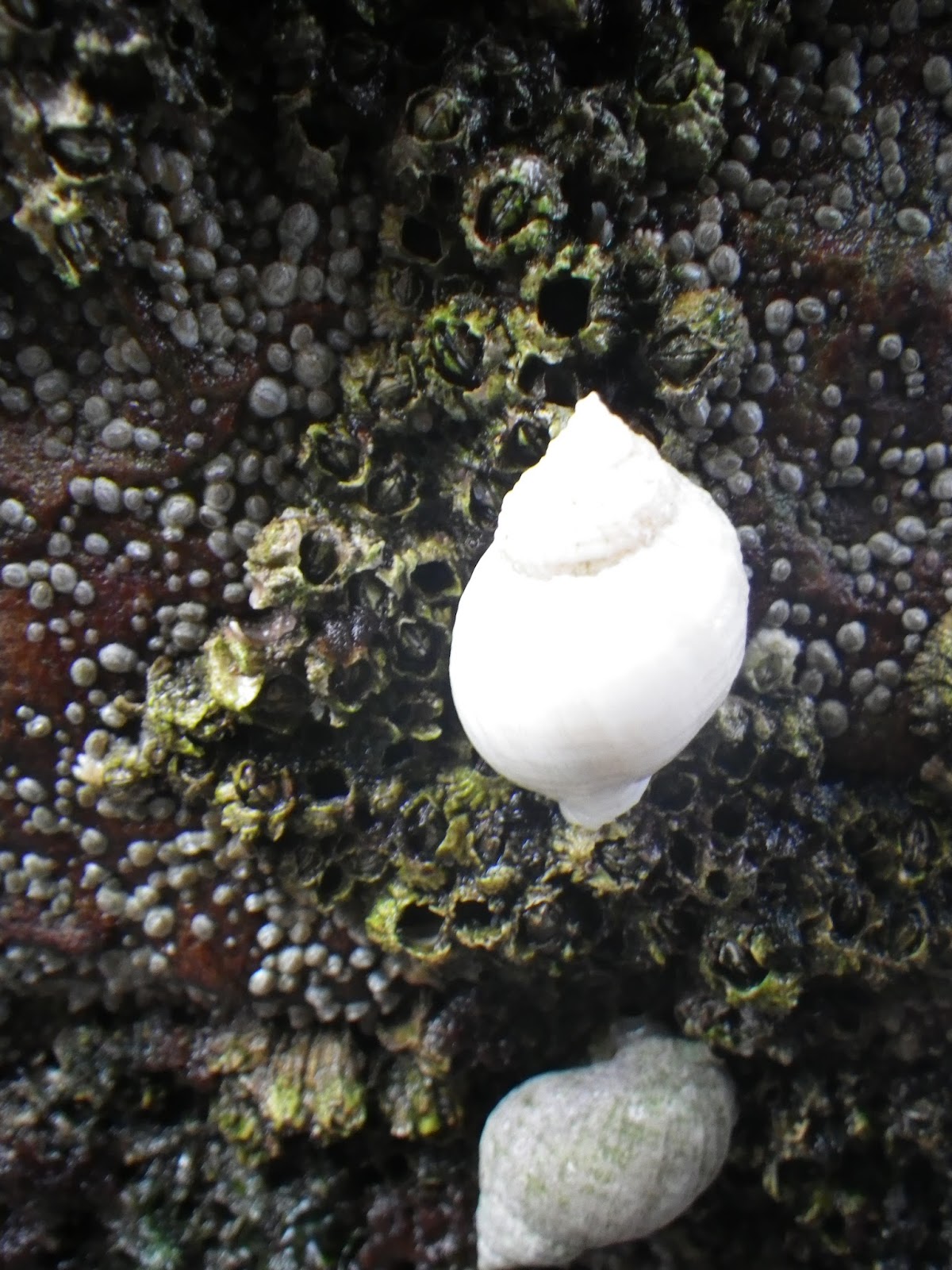
Dog whelks (Nucella lapillus) are predatory among the barnacles that comprise a mixed aged population. Habitat classification: LR.MLR.BF.Fser (Fucus serratus on moderately exposed mid eulittoral rock).

Barnacles and the common blue mussel (Mytilus edulis) occur on the ridge of a gully on the lower rocky shore. Habitat classification: LR.MLR.BF.Fser (Fucus serratus on moderately exposed mid eulittoral rock).


Barnacles on the lower shore. Habitat classification: LR.MLR.BF.Fser (Fucus serratus on moderately exposed mid eulittoral rock).


Lower down the shore the influence of the surrounding sand increases, with deposits on top of the bed rock that cause a patchy distribution of Fucus serratus and sand tolerant ephemeral green and red seaweeds. Habitat classification: LR.MLR.BF (Barnacles and fucoids on moderately exposed shores) and LR.MLR.BF.Rho (Rhodothamniella floridula on sand scoured lower eulittoral rock).
Sand binder (Rhodothamniella floridula) and Porphyra spp. are sand tolerant species associated with the biotope LR.MLR.BF.Rho (Rhodothamniella floridula on sand scoured lower eulittoral rock) that occurs within the biotope complex LR.MLR.BF (Barnacles and fucoids on moderately exposed shores).
The edges of the rocky shelves are colonized by seaweeds, each distributed within distinct bands.
Serrated wrack (Fucus serratus) occurs at the top, beneath which are the sand tolerant Mastocarpus stellatus,  porphyra and then cladophora sp. Habitat classification: LR.MLR.BF.Rho (Rhodothamniella floridula on sand scoured lower eulittoral rock).

 Sand resistant species form alternating bands with fucus serratus perpendicular to the shore in relation to the shelving bedrock and driven by exposure to sand scour. Habitat classification: LR.MLR.BF.Rho (Rhodothamniella floridula on sand scoured lower eulittoral rock) and LR.MLR.BF.Fser (Fucus serratus on moderately exposed mid eulittoral rock).


The sand tolerant Porphyra occurs on the lowest extreme of the rocky shore where sand scour is greatest and represents its own biotope LR.FLR.Eph.EntPor (Porphyra purpurea and Entomorpha spp. on sand scoured lower eulittoral rock).