The shore at Seapalling is influenced by a series
of artificial sea defences that have changed the dynamics of the
shore to produce multiple bays comprised of mobile sands with shingle
berms in between.
The hard substrate is characterised by a barnacle community
with periwinkles, limpets, dog whelks and beadlet anemones. The lower edges of
the breakwater harbour occasional seaweeds, whilst beneath the sea defences are
a network of tidal pools.
Since previous visits, in March and April, certain features
of the shore have changed, including changed in sand deposition, decreased
ephemeral algae and increased barnacle biomass. Many of the species ‘washed in’
by the storm in March still persist within the tidal pools beneath the sea
defences.
Habitat classifications:
Substrate
|
LR (Littoral rock)
|
LS (Littoral substrate)
|
Habitat
|
HLR (High energy littoral rock)
|
FLR (Features of littoral rock)
|
LS.LSa (Littoral sand)
|
Biotope complex
|
LR.HLR. MusB (Mussel and/or barnacle
communities)
|
Rkp (Rockpools)
|
Eph.FLR.Eph (Ephemeral green or
red seaweed communities
|
LS.LSa.sh (Shingle and gravel shores)
|
LS.LSa.MoSa.BarSa (Barren littoral
coarse sand)
|
Biotope
|
|
|
LR.FLR.Eph.EntPor (Porphyra
purpurea and Entomorpha spp. on sand scoured lower eulittoral rock)
|
|
|
Below are images of some of the organisms you may encounter
whilst rock pooling in these habitats:
 |
| The sea defences provide an artificial hard substrate amongst the littoral sediments of the shore. Habitat classification: LR.HLR (High energy littoral rock) and LS.LSa (Littoral sand). |
 |
| Sand masons (Lanice conchilega) occur on the lower shore of one of the multiple bays. Habitat description: LS.LSa (Littoral sand). |
 |
| Two spherical eyes protruding from the sand give away the position of a shrimp (Crangonidae) buried in a tidal pool of the sheltered bay. |
 |
| A goby is equally camouflaged in a tidal pool of the sheltered bay |
 |
| The sea defences comprise large rectangular boulders that have relatively shear faces. Habitat classification: LR.HLR (High energy littoral rock). |
 |
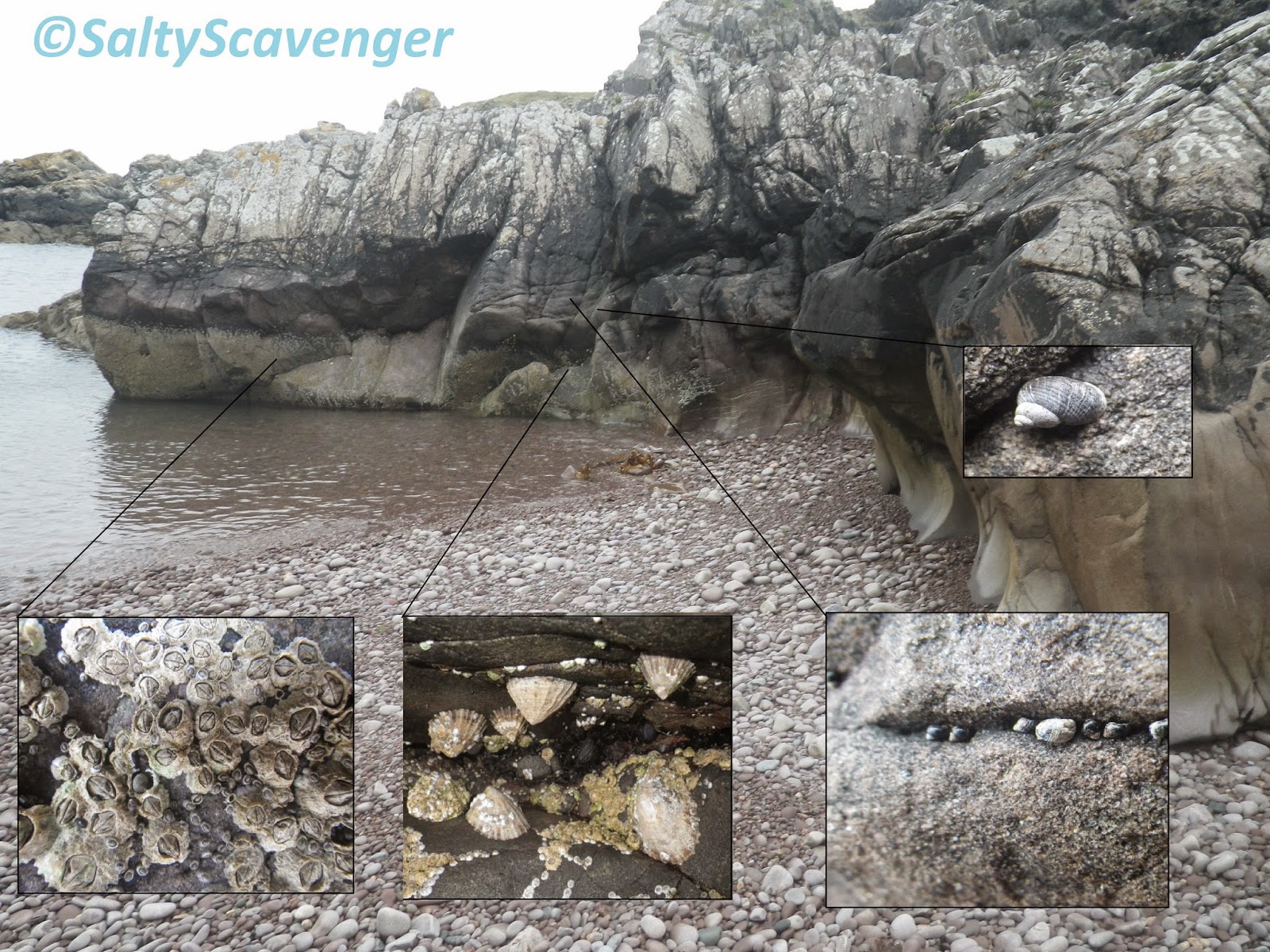
| Rocky shore communities have formed on the artificial sea defences; barnacles, limpets and periwinkles occur throughout and characterise the biotope complex LR.HLR.MusB (Mussels and/or barnacles in high energy littoral rock). |
 |
| The barnacles show a patchy distribution across the rock, often only covering certain faces of the rock; possibly as a result of variation in settlement success. |
 |
| The barnacles covering the rock are of variable sizes indicating a mixed aged community. The dead barnacles provide shelter for a variety of including rough periwinkles (Littorina sp) |
 |
| Rough periwinkles (Littorina sp) and a small common mussel (Mytilus edulis) seek shelter within the ‘hollowed’ remains of barnacles. |
 |
| Small and Rough periwinkles (Melarhaphe neritoides and Littorina sp) seek shelter within the ‘hollowed’ remains of barnacles. |
 |
| Limpets (Patella vulgata) within the barnacle community. |
 |
| Mastocarpus stellatus and ephemeral green seaweeds on barnacles |
 |
| Seaweeds have colonised a small rockpool. Habitat classification: LR.FLR.Rkp (Rockpools). |
 |
| Beneath the boulder overhangs it is cooler, damp and shaded with interconnecting tidal pools. Barnacles, beadlet anemones (Actinia equina) and dog whelks (Nucella lapillus) occur across these shaded rock faces. |
 |
| Beadlet anemone (Actinia equina). |
 |
| A dog whelk (Nucella lapillus). |
 |
| A limpet |
The tidal pools beneath the sea defences host a number of
species that were possibly washed in by the winter storms. Many of the subtidal
species observed washed up on the beach during March are now found within these pools.
 |
| Since the storm in March Common starfish (Asterias rubens) are frequently encountered beneath the break water |
 |
| Common whelks (Buccinum undatum), usually a subtidal species occur beneath the breakwater. It is possible that these individuals have come up from the mussel community observed at extreme low tide at this site. |
 |
| Common whelk (Buccinum undatum) |
 |
| Common whelk (Buccinum undatum) smells food out with its siphon. |
 |
| An anemone (Urticina spp). |
 |
| Many Urticina were washed up during the winter storms (Photo from winter 2013). |
Seasonal Comparisons: since April the deposition of sand
behind the sea defence has changed with sand eroded from the base of the sea
defences at some locations to reveal more boulders and elsewhere deposited. Ephemeral algae has decreased in abundance and
barnacle biomass has increased on many boulders.
Since
April the spiral wrack (Fucus spiralis)
has come out of its reproductive phase with receptacles absent or burst and the
ephemeral green algae has died back. Habitat classification: LR.HLR.MusB
(Mussels and/or barnacles in high energy littoral rock).
 |
| April |
 |
| July- the spiral wrack is in its reproductive phase and ephemeral green algae is present. |
 |
| October - the spiral wrack is not in its reproductive phase and ephemeral green algae has died back. |
In this example below, barnacle biomass has increased and all but two limpets maintain the same
position on the boulder face, except for two who are absent in the photo from
the October survey.
 |
| April |
 |
| October |
Two photographs, the first in April and the second October, reveal changes in sediment deposition at one location on the shore.
 |
| April |
 |
| October, sediment has been removed from this location, revealing the rocks beneath. |