Showing posts with label actina equina. Show all posts

Monday, 26 September 2016

Common anemones of the shore


Anemones are some of the most colourful organism of the shore. Usually found within rockpools or crevices, anemones belong to the Anthozoa and posses stinging tentacles with which they trap and catch their prey. Out of water anemones look like bobs of jelly but when immersed their tentacles come out and they look quite different! Below is a guide to some of the common intertidal anemones of UK shores.

Beadlet anemone (Actina equina)
This is the most commonly encountered anemone on the shore and can be found on open rock, in crevices, beneath overhangs or in rockpools. It comes in a variety of colours and sizes.

Beadlet anemones on a harbour wall

Beadlet anemones look like blobs of jelly when out of water

They come in a variety of colours, including red, orange and green be carfeul as in some areas of the country green ones can represent a similar species!


When they are immersed in water, blue 'beads' can be seen encircling the column.


Strawberry anemone (Actinia fragacea)
The body of a strawberry anemone is spotty and looks a bit like a strawberry!

Snakelocks anemone (Anemonia viridis)
These anemones are usually encountered within rockpools and sometimes attached to seaweed. It can appear green or pinkish

.


Gem anemone (Aulactinia verrucosa)
This anemones is usually found in rockpools with sand and pebbles, which is occur amongst making it sometimes hard to spot!


The column has rows of white dots.


Dahlia Anemone (Urticina felina
The Dahlia anemone is the largest anemone encountered on the shore and often found in rockpools beneath boulder over hangs.


When the Dahlia anemones withdraws its tentacles its column that is covered in sand and shell can be seen. 


Anthopleura sp


Cereus pedunculatus


Anemones


Tuesday, 9 December 2014

Rockpooling destination: NW Shetland, September 2014

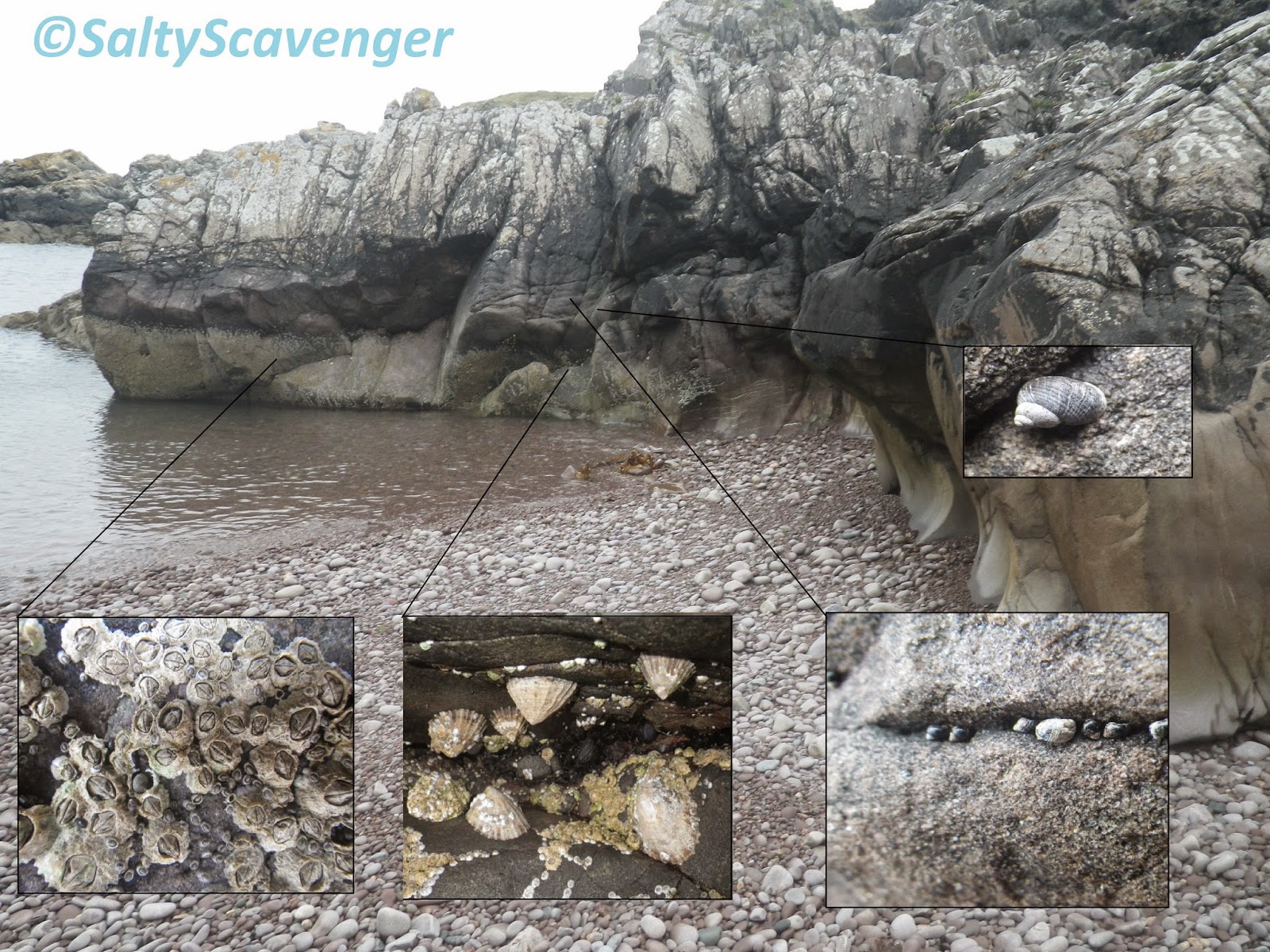
The exposed rocky shore consists of a steeply sloping cobble cove surrounded by cliffs and caves.
The cobbles support little wildlife, that which does occur is concentrated within the strand line.
The stable cliffs support a community typical of high energy environments with barnacles, limpets, periwinkles, dog whelks and anemones.

Habitat classification:


Biotope complex
LR.HLR. MusB (Mussel and/or barnacle communities)
LR.FLR.Lic.(Lichens on supralittoral and littoral fringe rock).
LS.LSa (Littoral sand)
Biotope

LR.FLR.Lic.Ver (Verrucaria Maura on littoral fringe rock)
LR.FLR.Lic.YG (Yellow and grey lichens on supralittoral rock)
LS.LSa.St (Strandline)


The rocky shore is made up of  an exposed cobble beach and surrounding cliffs. Habitat classification: LR.HR (High energy littoral rock)


Waves on this exposed shore have created the steep inclination of the cobbles and created a succession of strandlines that mark a succession of high tide marks. Habitat classification: LR.HL (High energy littoral rock) and LS. St (Strandline).


The power of the waves can also be seen on the cliff bases which have become smooth and 'cut into'  by the waves throwing cobbles and boulders at their base. Due to this continual process many organisms live within the refuge of crevices. 
Several communities occur on the cliffs. At the top of the cliff  is a community of yellow and grey lichens, below which is the black tar lichen (Verrucaria mauraand then a community dominated by barnacles. Habitat classification: LR.FLR.Lic.YG (Yellow and grey lichens on supralittoral rock), LR.FLR.Lic.Ver (Verrucaria Maura on littoral fringe rock) and  LR.HLR. MusB (Mussel and/or barnacle communities).


Yellow and grey lichens cover the splash zone of the cliff, below the black rock marks the community charecterised by V. maura and is where the rough periwinkle (Littorina saxatilis agg) and small periwinkles (Melarhaphe neritoidesbegin to occur, further down where the black gives way to brown marks the transition to the barnacles dominated community which supports the periwinkles and limpets.

Small periwinkles (M. neritoides)
within the V. maura community.
Rough periwinkle (L. saxatilis agg) and small periwinkle (M. neritoides)


Rough periwinkles (L. saxatilis agg.) seek refuge within a crevice.
Barnacles and rough periwinkles (L. saxatilis agg.) with in the barnacle community.


Barnacles


Common limpets (Patella vulgata) and barnacles


Dog whelks (Nucella lapillusand barnacles with patches of V maura

Dog whelks (N. lapillusand barnacles


Beadlet anemones (Actina equina) and barnacles.


The strandline is made up of old seaweed, drift wood, plastic bouys and birch bark from the North.


Saturday, 17 May 2014

Rockpooling destination: Revisit Seapalling, April 2014


The shore at Seapalling is influenced by a series of artificial sea defences that have changed the dynamics of the shore to produce multiple bays comprised of mobile sands with shingle berms in between.

The hard substrate is characterised by a barnacle community with periwinkles, limpets, dog whelks and beadlet anemones. The lower edges of the breakwater harbour occasional seaweeds, whilst beneath the sea defences are a network of tidal pools.

Since February certain features of the shore have changed, namely reduced strandline, decreased sand height and increased ephemeral algae.

Habitat classifications:


Substrate
LR (Littoral rock)
LS (Littoral substrate)
Habitat
HLR (High energy littoral rock)
FLR (Features of littoral rock)
LS.LSa (Littoral sand)
Biotope complex
LR.HLR. MusB (Mussel and/or barnacle communities)
Rkp (Rockpools)
Eph.FLR.Eph (Ephemeral green or red seaweed communities
LS.LSa.sh (Shingle and gravel shores)
LS.LSa.MoSa.BarSa (Barren littoral coarse sand)
Biotope


LR.FLR.Eph.EntPor (Porphyra purpurea and Entomorpha spp. on sand scoured lower eulittoral rock)


Below are images of organisms you may see whilst rock pooling in this location:


The sea defences provide an artificial hard substrate amongst the littoral sediments of the shore. The defences take the brunt of the waves.   Habitat classification: LR.HLR (High energy littoral rock) and LS.LSa (Littoral sand).

The sea defences comprise large rectangular boulders that have relatively shear faces which support rocky shore communities comprised of barnacles, limpets and periwinkles. Habitat classification:  LR.HLR.MusB (Mussels and/or barnacles in high energy littoral rock).
The littoral sediments surrounding the sea defences continually experience the dynamic forces of erosion and deposition.  Since February there has been deposition of finer sediment at the base of the sea defences at this location.


The same location as above but a few months previous shows how the sediment distributions have changed since February.


Other locations have experienced increased erosion reflected in the distribution of the barnacles. Erosion of sediment has provided new areas for settlement, resulting in a distinct barnacle size distribution. With a band of more recently settled and smaller barnacles on the recently available substrate below the more established barnacle community above. 

Variability in barnacle size gives an indication of the changing availability of substrate on the shore. Smaller, younger barnacles mark out those areas previously under sand.

The white tests of dead barnacles mark a previous height of the sand. 


Rocks covered in the dead tests of barnacles indicate that the sand was previously at a higher level, and their distribution suggest that the sand is lower than it had been when they originally colonised the rock.

Spiral wrack (Fucus spiralis) has experienced regrowth since February (see image below).
Spiral wrack (Fucus spiralis) in February.

Ephemeral seaweeds have increased in abundance and cover many of the lower shore rocks. Habitat classification: LR.FLR.Eph.EntPor (Porphyra spp.and Entomorpha spp. on sand scoured lower eulittoral rock)

Porphyra spp. occur on the sand scoured lower shore rocks.

A small coralline rockpool within the sea defences supports a number of seaweeds, limpets, and a serpulid polychaete all of which are subject to the dynamic nature of the shore at Seapalling. Habitat classification:  LR.FLR.Rkp (Rockpools).

This photo from February shows the same rock pool full of sand

A beadlet anemone (Actina equina) within its tentacles out within a rock pool.
A beadlet anemone (Actina equina) within its tentacles withdrawn to conserve water whilst exposed to the drying air.


A common star fish (Asterias rubens)