Showing posts with label channel wrack. Show all posts

Tuesday, 18 November 2014

Unst, Shetland September 2014


The rocky shore comprises steep shelving bedrock with crevices, some of which support small rock pools.  

Tar lichen occurs throughout the littoral fringe and down into the upper shore where channel wrack and barnacles grow on top. Below the tar lichen, spiral wrack, limpets, barnacles  and winkles occur.

Habitat table:

Substrate
LR (Littoral rock)
Habitat
LR.MLR (Moderate energy littoral rock)
LR.FLR (Features of ilttoral rock)
Biotope complex
LR.MLR.BF (Barnacles and fucoids on moderately exposed shores)
LR.FLR.Lic.(Lichens on supralittoral and littoral fringe rock).
Biotope
LR.LMR.BF  (Pelvetia canaliculata and barnacles on moderately exposed shores)
LR.MLR.BF.FspiB (Fucus spiralis on full salinity exposed to moderately exposed upper eulittoral rock)
LR.FLR.Lic.Ver (Verrucaria Maura on littoral fringe rock)


Below are images of organisms you may encounter whilst rock pooling in these habitats:

The rocky shore is comprised of steeply shelving bed rock with crevices. Black Tar lichen occurs in the littoral fringe and upper shore, with channel wrack and then spiral wrack below . Barnacles, limpets and winkles  occur from the upper to lower shore at varying densities. Habitat classification: LR.FLR.Lic.Ver (Verrucaria maura on littoral fringe rock), LR.LMR.BF  (Pelvetia canaliculata and barnacles on moderately exposed shores)  and LR.MLR.BF.FspiB (Fucus spiralis on full salinity exposed to moderately exposed upper eulittoral rock).

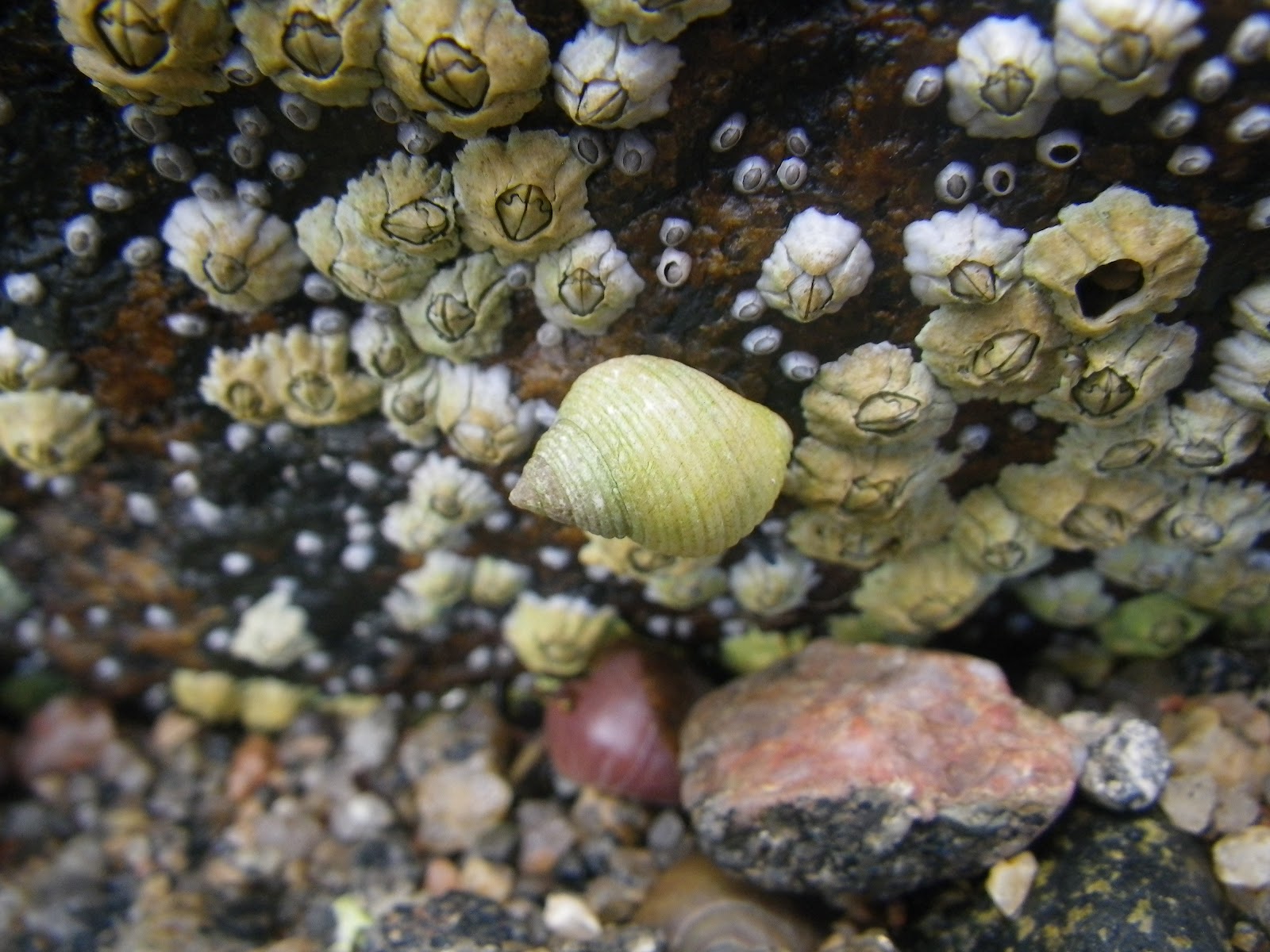
Below the  band of channel wrack, barnacles, small periwinkles (Melarhaphe neritoides) and edible periwinkle (Littorina littorea) among patches of tar lichen (Verrucaria maura).  Habitat classification LR.LMR.BF  (Pelvetia canaliculata and barnacles on moderately exposed shores).


Barnacles among tar V. maura 


Friday, 4 January 2013

Common Seaweeds of the shore - Wracks (Part 1)


Seaweeds are often the most conspicuous organisms of the rocky shore and are vital to the intertidal ecosystem, providing food, shelter and a substrate upon which to grow.

There are hundreds of species of seaweed in the UK and these are broadly divided into groups depending on their colour: reds (Rhodophyta), greens (Chloropyhta) and browns (phaeophyta).

The most familiar of the brown seaweeds are the wracks. Wracks can dominate the shore and are often used as the characterising species of a habitat.  For example LR.LLR.F Fucoids on sheltered marine shores.  Wracks can exhibit zonation where horizontal bands of the shore are characterized by a particular species of wrack, these patterns can be useful in inferring the hydrodynamic regimes of a shore and extent of exposure during low tide.

Below are images of wracks you may encounter whilst rock pooling in the UK.


Channel wrack (Pelvetia canaliculata), named after the furrow or, channel that forms as a result of the rolled fronds. Channel wrack is found in the upper shore of sheltered to exposed rocky shores.
Channel wrack (Pelvetia canaliculata)


Channel wrack (Pelvetia canaliculata)

Spiraled wrack (Fucus spiralis), is twisted as it hangs and has a midrib running down each frond. Spiraled wrack occurs in the upper shore below the band of channel wrack

Spiraled wrack (Fucus spiralis)

Bladder wrack (Fucus vesiculosus) has lots of swollen sacks formong pairs either side of its frond. Bladder wrack is found on exposed and sheltered coasts on the mid to lower shore.


Egg wrack (Ascophyllum nodosum) is long with a more rubbery texture than bladder wrack with oval to egg shapped bladders within its fronds. Egg wrack occurs on the mid shore and in sheltered locations can form huge expances.


Egg wrack (Ascophyllum nodosum)

Serrated wrack (Fucus serratus) has a toothed edge to its frond which is also hairy, it has no bladders and is found in the mid to lower shore where it can dominate.
Serrated wrack (Fucus serratus) dominates the lower shore

Serrated wrack (Fucus serratus), close up showing the hairy frond 


Friday, 27 July 2012

Rocky Shore - Western Isles, The Hebrides


Rock pooling destination: Western Isles, Elean Siaris, The Hebrides, June 2012

Rocky Shore - Lichens dominate the uppermost shore, whilst fucoids
occur throughout the mid to lower shore. Habitat classification: LR.FLR.Lic (Lichens on supralittoral and littoral fringe rock) and LR.LLR.F (Fucoids on sheltered marine shores).
The rocky shore is comprised of cobbles and boulders that are colonised by lichens in the uppermost shore and fucoid seaweeds from the mid to lower shore. Most marine organisms are aggregated beneath the fucoid understory and boulders.
Lichens grow on the rocks of the uppermost shore, interspersed with occasional clumps of sea thrift, in what is known as the ‘splash zone’.
Fucoid seaweeds dominate the mid to lower shore, exhibiting zonation, with specific species dominating bands of the shore.
Channelled wrack (Pelvitia canaliculata) is found first, where it co-occurs with the lichen Verrucaria Maura and occasional bladder wrack (Fucus vesiculosus), rough periwinkles (Littorina saxatilis) and barnacles.
Channel wrack (Pelvetia canaliculata) and the tar lichen (Verrucaria maura).
Habitat classification: LR.LLR.F.Pel (Pelvetia canaliculata on sheltered littoral fringe rock)
Egg wrack (Ascophyllum nodosum) forms blankets across the mid to lower shore. Underneath which other seaweeds including bladder wrack (Fucus vesiculosus) and smaller red, brown and green seaweeds grow. Limpets, winkles and whelks occur among the fronds and under the boulders are tunicates, sponges, polychaetes, byrozoans, hydrozoans, echinoderms, crustaceans and anemones.


Egg wrack (Ascophyllum nodosum).
Habitat classification: LR.LLR.F.Asc (Ascophyllum nodosum on very sheltered mid eulittoral rock)

As the low tide mark is reached the boulders give way to sediment. Serrated wrack (Fucus serratus), Ulva Spp and other membranous red and brown seaweeds come to dominate and amongst these a seasonal aggregation of sea hares had occured.
LR.LLR.F (Fucus serratus on sheltered eulittoral rock)
 Below are images of some of the marine organims encountered in the different habitats of this rocky shore:
Sea thirft amongst Lichen in the 'splash zone'
Lichens covering a boulder in the 'splash zone'
A white lichen, possibly Ochrolechia parella
The lichen, Black shields (Tephromela atra )
A black lichen, Lichina pygmaea
Channel wrack (Pelvetia canaliculata) and the tar lichen (Verrucaria maura).
Bladder wrack (Fucus vesiculosus), Channel wrack (Pelvetia canaliculata)
and tar lichen (Verrucaria maura)
Barnacles occur in lower abundance within the sheltered channel wrack habitat in
 contrast to where it occurs in more exposed channel wrack habitats.
Rough periwinkle (Littorina saxatilis) with barnacles on the side of a boulder.

Flat periwinkle (Littorina obtusata) beneath fucoid understory.

The seaweed Ralfsia verrucosa forms a crust on  a limpet (Patella vulgata).
Under boulder community of sponges (Porifera) and spirobid worms.
Underboulder community of bryozoans, spirobid worms and a
 terebelomorpha polychaete worm.
Under boulder community of spirobid worms and a sea squirt.
A variety of smaller seaweeds can be found underneath the Fucoid understory.
Chlorophyta and Rhodophyta seaweeds beneath fucoid understory.
Rhodophyta beneath fucoid understory.

Rhodophyta beneath Fucoid understory.
Edible periwinkle (Littorina littorea) amongst Egg wrack (Ascophyllum nodosum).
Dog whelk (Nucella lapillus) beneath Fucoid understory.
Purse sponge (Grantia compressa) and Breadcrumb sponge (Halichondria panicea)
Under boulder community of spirobid worms, bryozoa and sponge (Porifera).
Juvenile common starfish (Asterias rubens) on boulder underside.
Anemone
Purse sponge (Grantia compressa)
Serrated wrack (Fucus serratus)
Sipunculan and Common starfish (Asterias rubens) under a boulder.

Strawberry anemone (Actinia fragacea).
An isopod under the Fucoid understory.
Sea squirts on the under side of a boulder.
Flat topshell (Gibbula umbilicus)

Lower shore with Serrated wrack (Fucus serratus),
Osmundea Spp. and chlorphyta alga.
Keel worm (Serpulidae)
Serrated wrack (Fucus serratus) and encrusting fauna -
Keel worms (Serpulidae), encrusting coralline algae and spirobid worms.
Sea Hare (Aplysia punctata) out of water.
Sea Hare (Aplysia punctata)