The rock pools at Porth Seal vary with those in the upper shore characterized by the green seaweeds Cladophora and Ulva spp; whilst mid shore pools are dominated by encrusting coralline algae and a variety of red and brown seaweeds; further down the shore brown seaweeds, such as Bifurcaria bifurcata and Himanthalia elongata, become more prolific within the coralline pools with red seaweeds occupying the understory. Above the pools is a mosaic of fucoids, osmundea, grazing molluscs and barnacles.
Spring storms had washed large quantities of seaweed up onto the shore where it formed mounds marking the successive strand lines and filled many of the higher to mid shore pools. The presence of the decomposing seaweed in the pools caused the water to become de-oxygenation and stagnant. The spring storms also deposited sand into many of the higher and mid shore pools that formed a thick layer over the pre-existing coralline algae and facilitated the growth of ephemeral green seaweeds such as Cladophora spp. In comparison to April 2012 these pools appeared to contain less mobile fauna (fewer gastropods and no sea hares were observed).
Below are photographs of some of the organisms in these pools:
 |
| Spring storms had washed large quantities of seaweed on the shore. |
 |
| The washed up seaweed filled many of the higher to mid shore pools. |
 |
| The presence of the decomposing seaweed in the pools caused the water to become de-oxygenation and stagnant. |
 |
| The rocky shore is comprised of bed rock and boulders interspersed with rockpools and gullies. Biotope classification: LR.MLR (Moderate energy littoral rock). |
 |
 |
| Barnacles |
 |
| The shallow rock pools of the upper and mid shore that have not been smothered by sand or seaweed are charecterised by corallinacea crusts. Biotope classification:
LR.FLR.Rkp.Cor
(Coralline crust-dominated shallow eulittoral rockpools).
|
 |
| A corallinacea crust dominated rock pool with Coral weed (Corallina officinalis), Beadlet anemone (Actinia equina), Topshell (Gibbula umbilicus) and a blenny. |
 |
| A beadlet anemone (Actinia equina) |
 |
| A mussel (Mytilus edulis) |
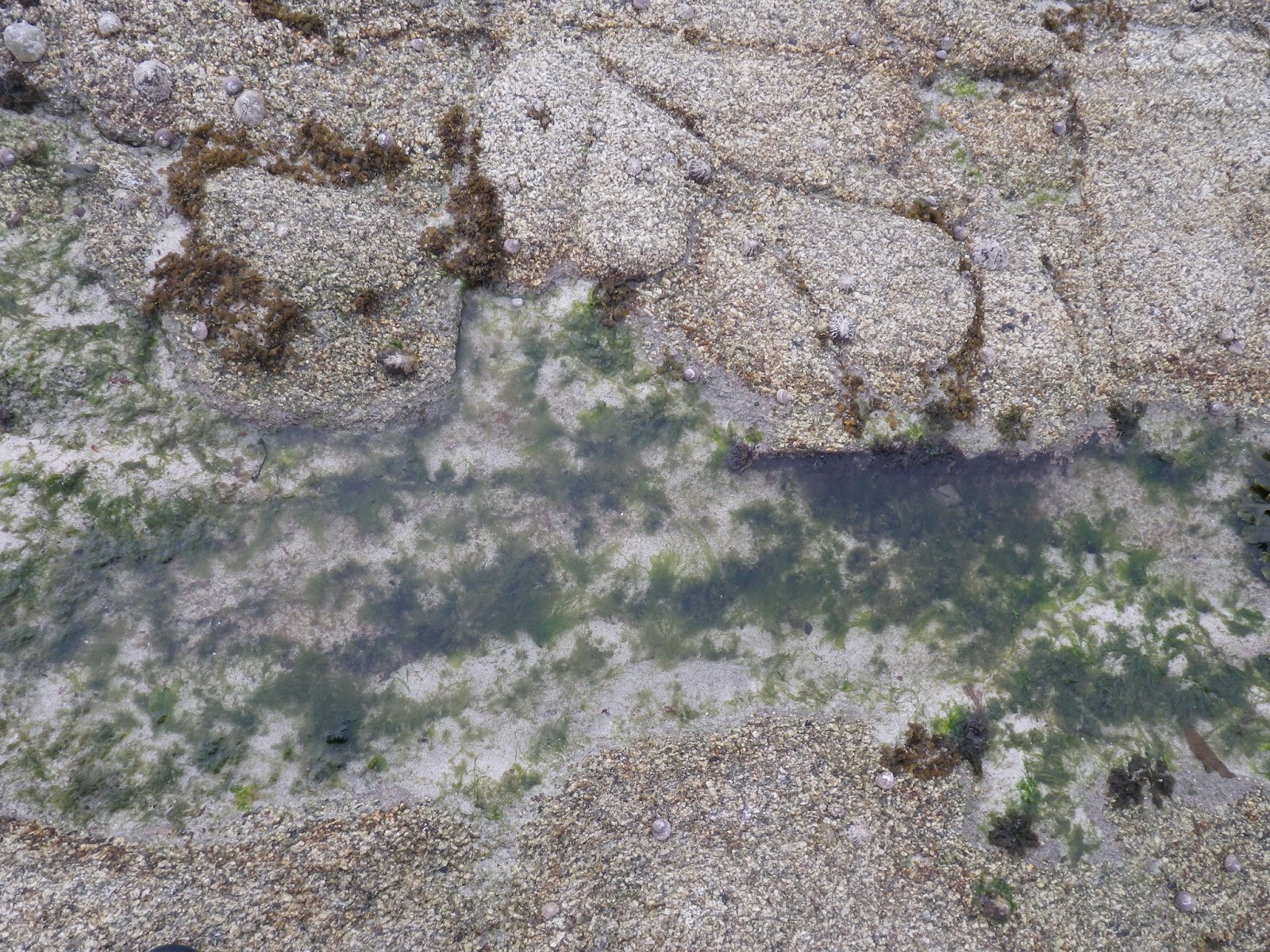 |
| A coralline pool dominated by ephemeral green seaweeds; coralline crusts can still be seen beneath the sand. |
 |
| Sand covers the Corallinacea crust and the pool is dominated by ephemeral green seaweeds. |
 |
| Mid shore pools are less effected by the deposition of seaweed and contain more seaweed species. |
 |
| Coral weed (Corallina officinalis) |
 |
| Ceramium Spp |
 |
| Codium fragile |
 |
| Codium fragile on the mid shore. |


 |
| Serrated wrack (Fucus serratus) dominates the lower shore with red seaweeds beneath its understory. Biotope claasification: LR.MLR.BF.Fser.R
(Fucus serratus and red
seaweeds on moderately exposed lower eulittoral rock). |
 |
| Red seaweeds form mosaics amongst the serrated wrack (Fucus serratus). Sand binder (Rhodothamniella floridula) forms a truf whilst Osmundea spp occurs within crevices and cracks of the boulders. |
 |
| Osmundea spp |
 |
| A limpet (Patella vulgata) and barnacles |
 |
| Grape pip weed (Mastocarpus stellatus) |
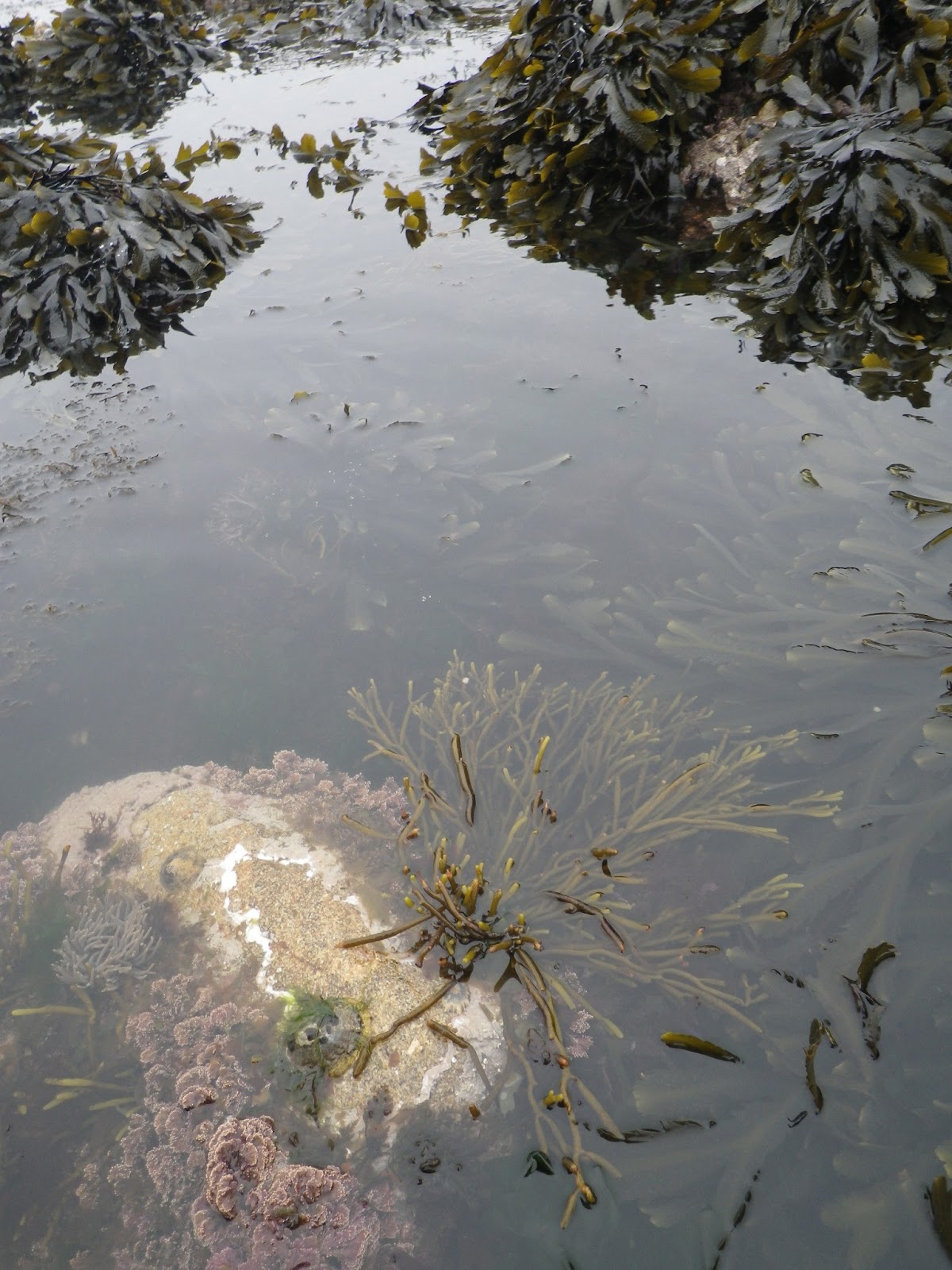 |
| Corallinacea crust, Corallina officinalis , Bifurcaria bifurcata, The limpet Patella vulgata and snakelocks anemone (Anemonia viridis) occur on a boulder amongst Serrated wrack (Fucus serratus). |
 |
| Corallinacea crust occurring on the lower shore. |
 |
| Coral weeds (Corallina spp ) form dense turfs on the lower shore. |
 |
| Dahlia anemone (Urticina felina) |
 | ||
Purse sponge (Grantia compressa)
|


